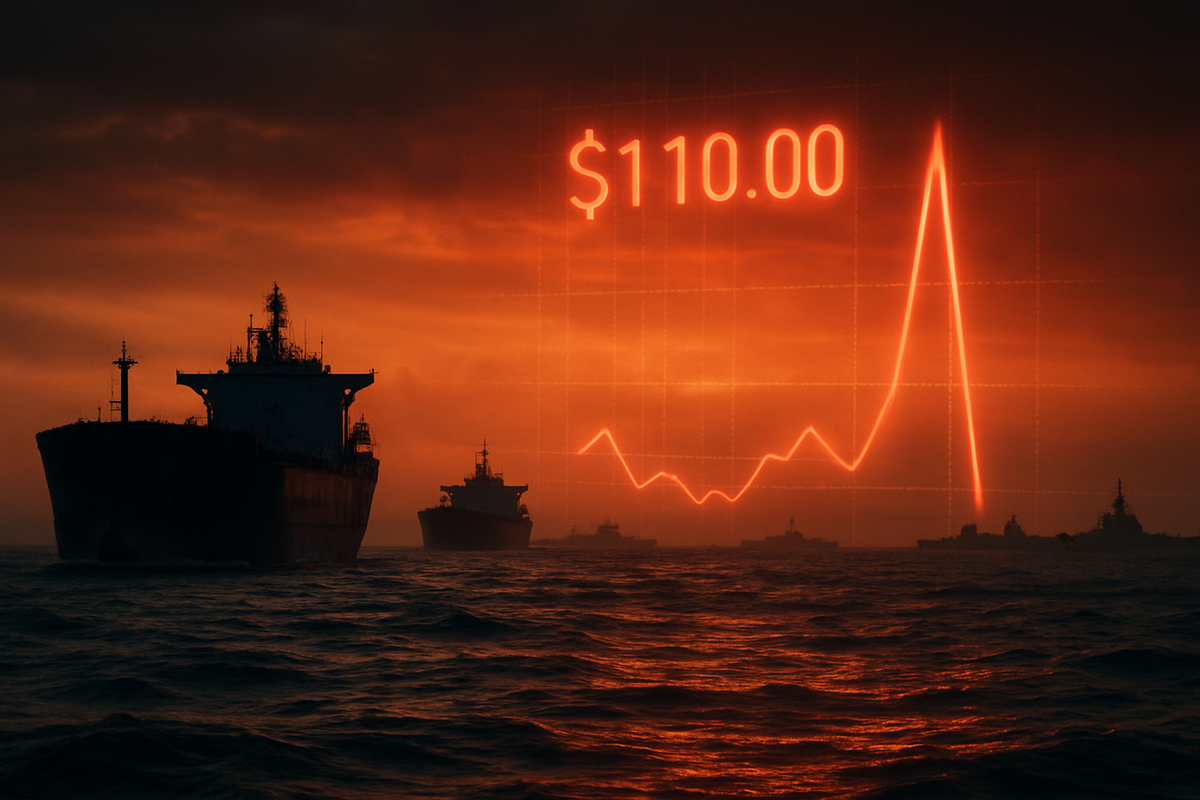
The global energy landscape fractured on April 2, 2026, as oil prices shattered the $110 per barrel ceiling, sending shockwaves through international financial markets. Brent Crude and West Texas Intermediate (WTI) both surged between 7% and 11% in a single day of frantic trading, fueled by a worsening military standoff in the Middle East that has effectively paralyzed the world’s most vital maritime energy artery. As the prospect of a prolonged regional conflict looms, the immediate implications are clear: the "cheap energy" era of the mid-2020s has vanished overnight, replaced by a "war premium" that threatens to derail the global post-pandemic recovery.
The surge has forced a violent repricing of risk across every asset class. With the Strait of Hormuz currently facing what analysts call a "virtual blockade," the loss of nearly 20% of the world’s daily oil supply is no longer a theoretical risk but a present reality. Investors are now grappling with a dual-threat environment: a massive supply-side shock to the economy and a dramatic hawkish shift in expectations for the Federal Reserve’s interest rate path, as inflation fears once again take center stage.
The Siege of the Straits: A Timeline of Escalation
The explosive rally on April 2 was triggered by a confluence of geopolitical disasters that came to a head over the last 24 hours. The primary catalyst was a televised address delivered by the U.S. administration on the evening of April 1, 2026, which signaled a decisive end to diplomatic efforts regarding Iranian regional maneuvers. This followed weeks of escalating skirmishes and airstrikes targeting Iranian interests. By the morning of April 2, reports surfaced that Iran had deployed advanced anti-ship cruise missiles to the islands of Abu Musa and the Tunbs, effectively closing the Strait of Hormuz to commercial tanker traffic.
Market data showed WTI crude skyrocketing by approximately 11.5% to reach $112.80 per barrel, while Brent Crude breached the $110 mark, settling near $110.12. This "two-strait chokehold"—referring to the simultaneous paralysis of the Strait of Hormuz and the ongoing Houthi-led disruptions in the Bab al-Mandab Strait—has created the largest supply disruption in the history of the modern oil market. According to the International Energy Agency (IEA), the global market is now staring at a daily deficit of over 10 million barrels, a gap that U.S. shale and OPEC+ spare capacity cannot bridge in the short term.
The initial industry reaction was one of controlled panic. Shipping giants have ordered all tankers in the region to "slow steam" or drop anchor outside the Persian Gulf, as insurance premiums for transit have reached prohibitive levels. In the U.S., gasoline futures jumped 14% on the news, with national averages at the pump expected to exceed $4.50 per gallon within the week. The speed of the ascent has left market participants scrambling to hedge against a "dark scenario" where oil remains above triple digits for the remainder of the year.
Market Bifurcation: The Winners and Losers of $110 Oil
The sudden surge has created a stark divide on Wall Street, with domestic energy producers and defense contractors seeing a massive influx of capital. ExxonMobil (NYSE: XOM) and Chevron (NYSE: CVX) have emerged as primary beneficiaries, with their stocks trading near all-time highs as investors seek shelter in companies with diversified, non-Middle Eastern production bases. Similarly, U.S.-based refiners like Valero Energy (NYSE: VLO) and Marathon Petroleum (NYSE: MPC) are seeing their margins, or "crack spreads," widen significantly as they process domestic crude into high-priced gasoline and diesel.
Conversely, the "losers" list is extensive and led by the transportation and technology sectors. Delta Air Lines (NYSE: DAL) and other major carriers saw their shares tumble by over 8% as jet fuel costs—already a significant portion of operating expenses—threatened to wipe out 2026 profit guidance. Logistics behemoths like FedEx (NYSE: FDX) are also under pressure, facing the prospect of having to implement emergency fuel surcharges that could dampen consumer demand.
Perhaps the most significant blow has been dealt to high-growth technology stocks. Firms like Tesla (NASDAQ: TSLA) and Amazon (NASDAQ: AMZN) saw sharp sell-offs as the 10-year Treasury yield spiked in response to rising inflation expectations. The "Great Rotation" out of growth and into value/energy is accelerating, as fund managers de-risk portfolios in anticipation of a higher-for-longer interest rate environment. In the defense sector, Lockheed Martin (NYSE: LMT) and Northrop Grumman (NYSE: NOC) saw initial gains on the prospect of increased munitions orders, though these were tempered by concerns over global supply chain bottlenecks.
Inflationary Fires and the Fed's Dilemma
The wider significance of this oil spike cannot be overstated; it effectively shatters the Federal Reserve’s narrative of a "soft landing" in 2026. Prior to the Hormuz blockade, the market had been pricing in at least two interest rate cuts for the second half of the year. Those expectations have now been deleted from the terminal rate path. With headline PCE inflation projected to jump toward 3.5% or 4.0% in the coming months, the Fed is now facing a classic "stagflationary" shock: rising prices coupled with slowing growth.
This event mirrors the 1973 oil embargo in its structural impact, but with the added complexity of modern integrated supply chains. The spike in energy costs acts as a regressive tax on the American consumer, reducing disposable income at a time when the personal savings rate is already near historical lows. If the Federal Reserve is forced to pause its easing cycle or, in a worst-case scenario, raise rates to combat energy-driven inflation, the likelihood of a U.S. recession in late 2026 or 2027 increases exponentially.
Policy implications are also shifting. There is renewed pressure on the U.S. government to further tap the Strategic Petroleum Reserve (SPR), which is already at its lowest levels in decades. The crisis is likely to reignite a fierce political debate over domestic drilling permits and the pace of the energy transition. While high oil prices theoretically accelerate the shift toward electric vehicles, the immediate cost of the materials required for that transition—many of which require energy-intensive mining and transport—is also rising.
What Comes Next: The Path to $150 or a Fragile Peace?
Looking ahead, the market's trajectory depends entirely on the duration of the Hormuz blockade. In the short term, volatility will remain the only constant. If a naval coalition is unable to secure safe passage for tankers within the next 14 days, Goldman Sachs analysts warn that Brent Crude could test $150 per barrel. Such a price level would almost certainly trigger "demand destruction," where the cost of fuel becomes so high that consumption drops off precipitously, leading to a global economic contraction.
Long-term, we may see a massive strategic pivot in global energy flows. Europe and Asia, which are more dependent on Middle Eastern crude than the U.S., will likely accelerate their search for alternative suppliers and energy sources. This could lead to a permanent premium on U.S. and West African crude. For public companies, the ability to adapt to a high-cost energy environment—through fuel efficiency, localized supply chains, or pricing power—will define the winners of the 2026 fiscal year.
Market participants should also watch for a potential "de-escalation rally." Should diplomatic backchannels succeed in reopening the Strait, oil could give back $20 of its gains in a single afternoon. However, the geopolitical trust that has been broken in the Persian Gulf is not easily mended, and the "security premium" is likely to stay baked into oil prices for the foreseeable future.
Summary and Investor Outlook
The events of April 2, 2026, mark a turning point for the markets. The surge to $110 oil is more than just a price move; it is a signal that geopolitical risk has returned as the dominant driver of global economics. The immediate impact on inflation expectations has forced a total re-evaluation of the Federal Reserve’s interest rate path, moving the "pivot" to lower rates further into the horizon and increasing the risk of a recession.
For investors, the coming months will require a defensive posture. Energy remains the primary hedge against further escalation, while consumer discretionary and transportation sectors face significant headwinds. The key metrics to watch will be the weekly SPR inventory levels, any official statements from the Federal Open Market Committee (FOMC) regarding energy-neutral inflation, and, most importantly, the movement of naval assets in the Persian Gulf. In an era of $110 oil, the margin for error for both policymakers and investors has narrowed to almost zero.
This content is intended for informational purposes only and is not financial advice.