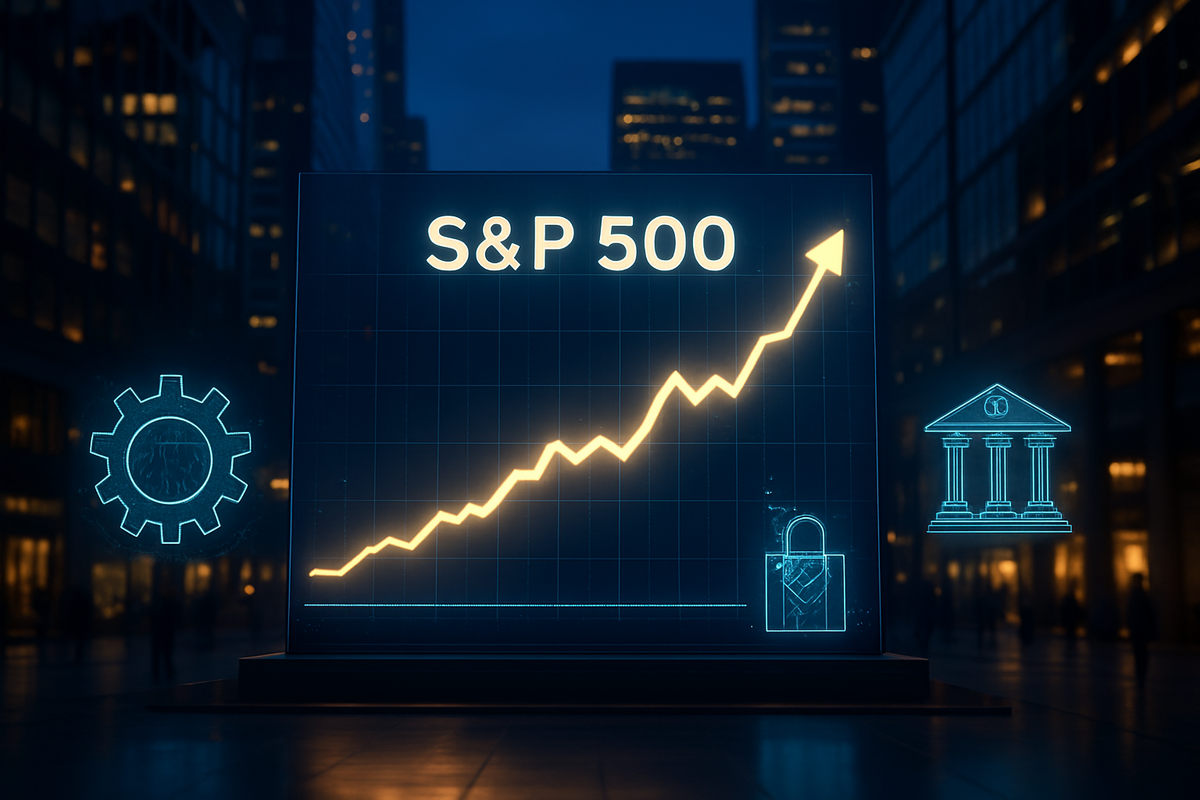
In a sweeping update to its 2026 equity outlook, Goldman Sachs (NYSE: GS) has officially raised its S&P 500 year-end price target to 7,600, signaling a continued bull run fueled by a "fundamental floor" of earnings rather than speculative fervor. The firm’s projection, released in early April 2026, rests on a robust forecast of 12% earnings-per-share (EPS) growth for the index, driven by a resilient U.S. economy and the long-awaited arrival of AI-driven productivity gains across non-technology sectors.
This bullish stance marks a significant shift in market narrative. For the past two years, equity gains were largely concentrated in a handful of massive technology firms. However, Goldman’s analysts argue that 2026 represents a "broad-based marathon" where cyclical sectors and mid-cap companies finally take the baton. As the S&P 500 moves toward the 7,600 mark—representing a double-digit total return for the year—investors are being urged to look past short-term geopolitical noise and focus on the maturing profitability of the broader market.
The 7,600 Vision: A Fundamental Floor Provided by Earnings
The cornerstone of Goldman’s optimism is the projected leap in S&P 500 EPS to between $305 and $309 for the full year 2026. This 12% year-over-year increase would mark the sixth consecutive quarter of double-digit earnings expansion, a streak not seen in over a decade. This outlook was co-authored by outgoing Chief U.S. Equity Strategist David Kostin and his successor, Ben Snider. Kostin, who is retiring after thirty years at the firm, emphasized that while the forward price-to-earnings (P/E) multiple of 22x remains historically high, it is "justified by earnings durability" and a "Goldilocks" macroeconomic backdrop.
The timeline leading to this projection follows a period of consolidation in late 2025 and early 2026, which Ben Snider described as a "tactical reset." Market volatility in March 2026 cleared out speculative "froth," allowing the current rally to be built on more stable ground. Supporting this growth is a projected U.S. real GDP growth of 2.6% for 2026, well above the consensus of 2.0%. Furthermore, the Federal Reserve is expected to continue its easing cycle, with analysts predicting another 50 basis points in rate cuts this year, bringing the terminal rate toward a stimulative 3.0%–3.25% range.
Winners of the "Broadening" Rally: From Hardware to Execution
As the market transitions from what Goldman calls Phase 2 of the AI trade (infrastructure) to Phase 3 and 4 (execution and productivity), the list of market winners is undergoing a dramatic shuffle. While the "Magnificent Seven"—led by giants like NVIDIA (NASDAQ: NVDA) and Microsoft (NASDAQ: MSFT)—were the undisputed champions of 2024 and 2025, Goldman suggests their relative dominance is cooling. The 2026 rally is expected to be led by cyclical sectors like Industrials, Financials, and Consumer Discretionary.
In the Industrial space, companies such as Caterpillar (NYSE: CAT) are expected to benefit from the "execution phase" of AI, where automated workflows and smarter logistics expand profit margins. In the Financial sector, JPMorgan Chase (NYSE: JPM) and other major banks are poised to win as the "Great Re-leveraging" begins; stabilized interest rates are encouraging corporations to issue new debt to fund massive share buybacks and dividends. Meanwhile, Amazon (NASDAQ: AMZN) and other consumer-facing giants are expected to capture the benefits of the "One Big Beautiful Bill Act" (OBBBA), a fiscal stimulus package injecting nearly $100 billion in tax refunds into the U.S. economy this spring.
Wider Significance: The AI Productivity Shift and Fiscal Tailwinds
The broader significance of Goldman's 7,600 target lies in its validation of the "AI Productivity Thesis." For years, skeptics argued that the massive capital expenditures in AI would only benefit the chipmakers. Goldman’s 2026 outlook argues the opposite: that we have reached the historical "inflection point" where technology costs fall enough for the rest of the S&P 500 to implement them profitably. This mirrors past cycles, such as the late 1990s, where the initial build-out of fiber optics eventually gave way to the lucrative "software and services" era of the 2000s.
Furthermore, the role of fiscal policy cannot be understated. The OBBBA stimulus acts as a significant tailwind, providing a buffer against the inflationary pressures of high oil prices, which briefly touched $110 per barrel in early 2026 due to ongoing Middle Eastern tensions. This fiscal-monetary "double engine"—rate cuts from the Fed and stimulus from the Treasury—is a rare alignment that historically precedes strong equity performance. However, Goldman warns that this also raises the stakes for the 2026 mid-term elections, as any shift in fiscal policy could disrupt the current growth trajectory.
What Comes Next: Strategic Pivots and Potential Wild Cards
Looking toward the second half of 2026, Goldman Sachs suggests that investors must pivot their strategies from "growth at any price" to "growth at a reasonable price" (GARP). The short-term opportunity lies in identified laggards within the S&P 500 that have yet to price in the 12% earnings growth. Over the long term, the primary challenge for the market will be maintaining these elevated valuations. If AI monetization fails to materialize in the bottom lines of non-tech companies by early 2027, the 7,600 target could face a sharp correction.
Another potential scenario involves the "bear case" target of 5,400. This outcome would likely be triggered by a "geopolitical energy shock" if oil prices remain above $110, forcing the Federal Reserve to pause or reverse its rate-cutting cycle. Conversely, a "bull case" scenario could see the index even higher if the "Great Re-leveraging" results in a share buyback boom that exceeds the firm's current estimates. Investors should prepare for a "choppy but upward" trajectory as the market digests these competing forces.
Summary: A Mature Bull Market with Room to Run
The key takeaway from Goldman Sachs' 2026 outlook is that the bull market is maturing, not ending. The 7,600 year-end target for the S&P 500 is a vote of confidence in the underlying health of Corporate America. With 12% earnings growth acting as a safety net, the transition from a narrow, tech-led rally to a broad-based recovery offers a more sustainable path forward for the index. The retirement of David Kostin and the ascent of Ben Snider marks a symbolic new chapter for Goldman's strategy, one that prioritizes the "execution" phase of the current technological revolution.
Moving forward, the market remains in a delicate balance. Investors should keep a close watch on Q2 and Q3 earnings reports to ensure that the "AI productivity gains" are actually manifesting in operating margins. Additionally, the trajectory of inflation and the impact of the OBBBA stimulus will be critical indicators of whether the 7,600 target is a conservative estimate or a best-case scenario. For now, Goldman's message is clear: the floor is solid, the breadth is expanding, and the marathon continues.
This content is intended for informational purposes only and is not financial advice.