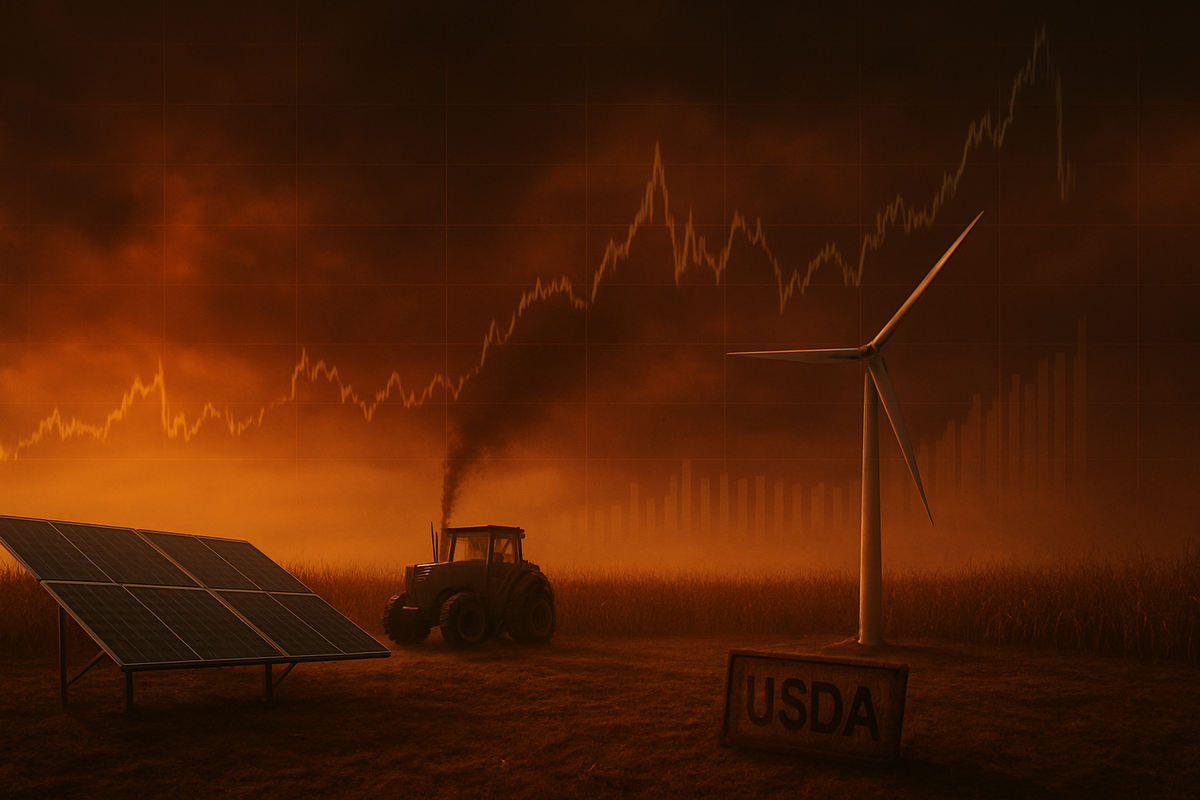
WASHINGTON, D.C. — In a move that has sent shockwaves through America’s heartland, the U.S. Department of Agriculture (USDA) officially suspended all new grant applications for the Renewable Energy for America Program (REAP) as of March 31, 2026. The decision comes at a moment of unprecedented volatility for the domestic agricultural sector, which is currently grappling with a "triple threat" of soaring diesel prices, a fertilizer supply crunch, and a massive geopolitical escalation in the Middle East. With the ongoing conflict involving Iran effectively shuttering the Strait of Hormuz, the cost of farming has transitioned from a manageable burden to an existential crisis for thousands of family-owned operations.
The suspension of REAP—a cornerstone program that previously provided billions in subsidies for solar panels, wind turbines, and energy-efficient irrigation—marks a pivot in federal policy from "green transition" to "operational survival." As energy and fertilizer costs squeeze farmer margins to their breaking points, the USDA's move signals a prioritization of immediate food security and fiscal consolidation over long-term sustainability goals. For a sector already reeling from a 50% spike in urea prices and diesel nearing $5.50 per gallon, the loss of these grants represents the removal of a critical safety net at the worst possible time.
A Perfect Storm: Geopolitics and Policy Shifts
The timeline leading to this week’s announcement began in late February 2026, when escalating tensions between the U.S. and Iran culminated in a blockade of the Strait of Hormuz. Because nearly one-third of global seaborne fertilizer and 20% of global petroleum liquid volumes pass through this narrow waterway, the immediate reaction was a violent spike in global commodity prices. Brent crude oil quickly surged past $110 per barrel, and domestic natural gas prices—the primary feedstock for nitrogen-based fertilizers—jumped significantly, leading to the closure of several marginal production facilities in Europe and Asia.
Against this backdrop, the administration accelerated a shift in domestic energy policy. On July 15, 2025, President Trump signed Executive Order 14315, titled "Ending Market Distorting Subsidies for Unreliable, Foreign-Controlled Energy Sources." This order provided the legal framework for the USDA’s recent action, with officials arguing that taxpayer funds should not be diverted into intermittent energy sources like wind and solar during a national energy emergency. By late March 2026, the USDA determined that all pending REAP applications that had not yet reached a "fully executed" status would be canceled, effective immediately.
The immediate market reaction has been one of high anxiety. Industry groups like the American Farm Bureau Federation have warned that the combination of high input costs and the loss of energy-efficiency subsidies could lead to a wave of farm bankruptcies by the end of the 2026 harvest season. Meanwhile, the USDA has been forced to redirect its focus toward the "Farmer Bridge Assistance Program," an $11 billion emergency fund designed to keep farms afloat, even as it shutters the very programs meant to lower their long-term energy dependency.
Winners and Losers: Corporate Fallout in the Ag Sector
The agricultural market in 2026 has become a landscape of winners and losers, bifurcated by access to domestic resources and exposure to global logistics. CF Industries Holdings, Inc. (NYSE: CF) has emerged as a primary beneficiary of the current crisis. While global urea prices have skyrocketed to over $720 per ton due to the Hormuz blockade, CF Industries leverages its low-cost, North American natural gas supply to export high-priced nitrogen fertilizer. The company’s stock has surged over 60% year-to-date as it captures historic margins, though it currently faces a Department of Justice investigation into potential price-fixing during this period of extreme market stress.
Conversely, Deere & Company (NYSE: DE) is facing significant headwinds. As farmers see their margins evaporate, demand for "big iron" machinery and the energy-efficient upgrades previously subsidized by REAP has cratered. Deere recently projected a 2026 net income drop of over 20%, as capital expenditures are deferred across the Corn Belt. Similarly, AGCO Corporation (NYSE: AGCO) saw its shares slide nearly 6% following the USDA announcement, as the company grapples with "meaningful demand softness" and the rising cost of components.
The grain processing giants are also feeling the squeeze. Archer-Daniels-Midland Co. (NYSE: ADM) and Bunge Global SA (NYSE: BG) are navigating a difficult "crush margin" environment. With energy-intensive processing costs rising and physical grain stocks—particularly soybeans—plummeting by 36% according to recent reports, these companies are seeing their profitability compressed. While Nutrien Ltd. (NYSE: NTR) has benefited from its Canadian potash moat, insulating it from the direct impact of the Iran conflict, it remains vulnerable to the soaring domestic logistical costs that have accompanied the rise in fuel prices.
A Paradigm Shift in Agricultural Policy
The halt of the REAP program fits into a much broader industry trend: the "re-shoring" of food and energy security. For years, the agricultural sector was moving toward a decarbonized future, heavily supported by the Inflation Reduction Act. However, the 2026 Iran conflict has shattered the illusion of a smooth transition. The industry is now witnessing a "survival of the fittest" scenario where the focus has shifted from carbon footprints to cost-per-bushel. This event echoes the energy shocks of the 1970s, where high fuel prices dictated planting decisions for nearly a decade.
There are also significant regulatory implications. The suspension of REAP grants is widely viewed as a test case for the administration’s broader plan to dismantle green energy incentives across the federal government. By citing "energy dominance" as the primary objective, the USDA is setting a precedent that could affect other agencies, such as the Department of Energy. This move has created a rift with partners in the renewable energy sector, who argue that removing these subsidies now will only deepen the U.S. farmer's dependence on volatile global oil markets in the long run.
Historically, major shifts in farm subsidies have led to permanent changes in what America grows. With nitrogen fertilizer costs at record highs, analysts are already predicting a massive shift in acreage for the 2026 season. Farmers are expected to move up to 1.5 million acres away from nitrogen-hungry corn toward soybeans, which require less chemical intervention. This shift will likely have ripple effects across global food markets, potentially driving up the price of corn-fed beef and poultry for years to come.
The Road Ahead: 2027 and Beyond
In the short term, the agricultural sector must find a way to navigate the 2026 harvest with the highest operating costs in history. The immediate challenge for farmers will be securing financing for next year's inputs without the help of REAP grants to offset energy bills. We may see a strategic pivot toward "retrofit" technologies—where companies like AGCO and CNH Industrial (NYSE: CNHI) offer precision-agriculture kits to upgrade older, less efficient machinery rather than selling new fleets. This "keep it running" mentality will likely define the market until geopolitical tensions in the Middle East subside.
Long-term, the suspension of REAP grants could lead to a consolidation of the farming industry. Smaller operations that relied on these subsidies to modernize and lower their overhead may find themselves unable to compete with larger, vertically integrated corporate farms that can better absorb energy shocks. However, this crisis may also create a market opportunity for domestic energy startups focused on "on-farm" micro-grids and small-scale modular nuclear or hydrogen solutions that do not rely on federal grant cycles for viability.
The potential scenarios for late 2026 and 2027 remain tied to the Strait of Hormuz. If the conflict with Iran is resolved and the waterway reopens, we could see a rapid "relief rally" in the agricultural sector as fertilizer and fuel prices normalize. However, if the blockade remains, the USDA may be forced to implement even more drastic measures, including direct price controls or rationing of fuel and fertilizer to ensure the domestic food supply remains stable.
Final Assessment: An Industry at a Crossroads
The USDA’s decision to halt REAP grant applications is more than just a budgetary adjustment; it is a signal that the era of government-funded green modernization in the American heartland is on a temporary, if not permanent, hiatus. The convergence of the Iran conflict and a shift toward "Energy Dominance" policies has placed the U.S. agricultural sector in a defensive crouch. For investors, the takeaway is clear: the market is currently rewarding resource-rich, domestic producers like CF Industries while punishing companies dependent on discretionary farmer spending like Deere.
Moving forward, the agricultural sector will be defined by its ability to adapt to a high-cost environment. The primary metrics for success in the coming months will be "margin protection" and "input efficiency." While the immediate future looks bleak for farm equipment manufacturers and green energy installers, the fundamental necessity of food production ensures that the sector will eventually find a new equilibrium.
Investors should watch for three things in the coming months: the status of the DOJ investigation into fertilizer pricing, the final acreage reports for the 2026 corn and soy crops, and any further executive orders that might target the remaining agricultural subsidies. As of April 3, 2026, the American farmer is in the middle of a geopolitical crossfire, and the fallout is only beginning to be felt in the global markets.
This content is intended for informational purposes only and is not financial advice.