
The end of an earnings season can be a great time to discover new stocks and assess how companies are handling the current business environment. Let’s take a look at how Planet Fitness (NYSE: PLNT) and the rest of the consumer discretionary - leisure facilities stocks fared in Q2.
The Consumer Discretionary sector, by definition, is made up of companies selling non-essential goods and services. When economic conditions deteriorate or tastes shift, consumers can easily cut back or eliminate these purchases. For long-term investors with five-year holding periods, this creates a structural challenge: the sector is inherently hit-driven, with low switching costs and fickle customers. As a result, only a handful of companies can reliably grow demand and compound earnings over long periods, which is why our bar is high and High Quality ratings are rare. Leisure facilities companies own and operate theme parks, fitness centers, bowling alleys, and other venue-based entertainment destinations, generating revenue from admissions, memberships, and on-site spending. Tailwinds include consumer preference for experiential spending, tourism recovery, and technology-enhanced guest experiences that support premium pricing. Headwinds are notable: high fixed costs, such as real estate, labor, and maintenance, make profitability highly sensitive to attendance fluctuations during economic slowdowns. Weather, pandemics, and safety incidents can disrupt operations unpredictably. Rising construction and labor costs inflate expansion budgets, while competition from at-home entertainment alternatives and other experiential options limits pricing power in many markets.
The 10 consumer discretionary - leisure facilities stocks we track reported a mixed Q2. As a group, revenues beat analysts’ consensus estimates by 1.4% while next quarter’s revenue guidance was 0.8% below.
Amidst this news, share prices of the companies have had a rough stretch. On average, they are down 11.3% since the latest earnings results.
Planet Fitness (NYSE: PLNT)
Founded by two brothers who purchased a struggling gym, Planet Fitness (NYSE: PLNT) is a gym franchise that caters to casual fitness users by providing a friendly and inclusive atmosphere.
Planet Fitness reported revenues of $365.2 million, up 7.1% year on year. This print exceeded analysts’ expectations by 2.4%. Overall, it was a satisfactory quarter for the company with a beat of analysts’ EPS estimates.
"During the second quarter, we made important progress advancing our strategies to reignite sustainable member growth," said Colleen Keating, Chief Executive Officer.
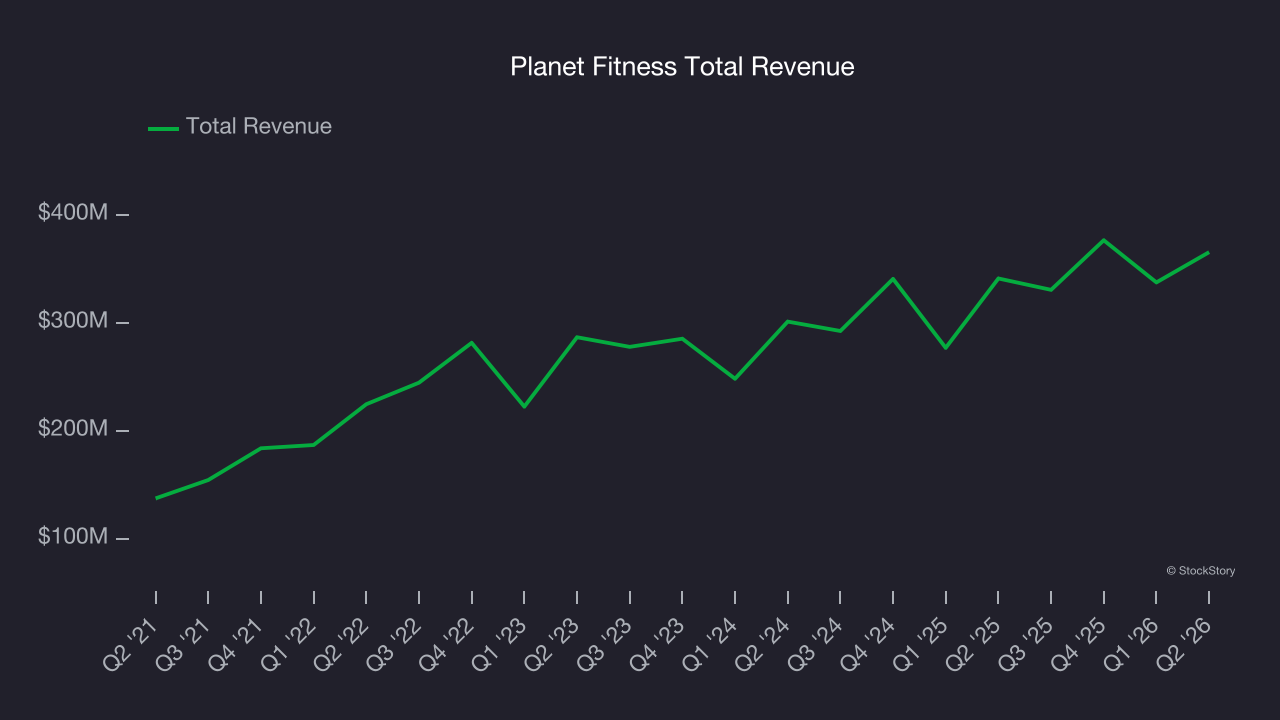
Even though it had a relatively good quarter, the market seems discontent with the results. The stock is down 15.6% since reporting and currently trades at $47.78.
Is now the time to buy Planet Fitness? Access our full analysis of the earnings results here, it’s free.
Best Q2: Sphere Entertainment (NYSE: SPHR)
Famous for its viral Las Vegas Sphere venue, Sphere Entertainment (NYSE: SPHR) hosts live entertainment events and distributes content across various media platforms.
Sphere Entertainment reported revenues of $313.6 million, up 11% year on year, outperforming analysts’ expectations by 1.8%. The business had an exceptional quarter with a beat of analysts’ EPS estimates and an impressive beat of analysts’ adjusted operating income estimates.
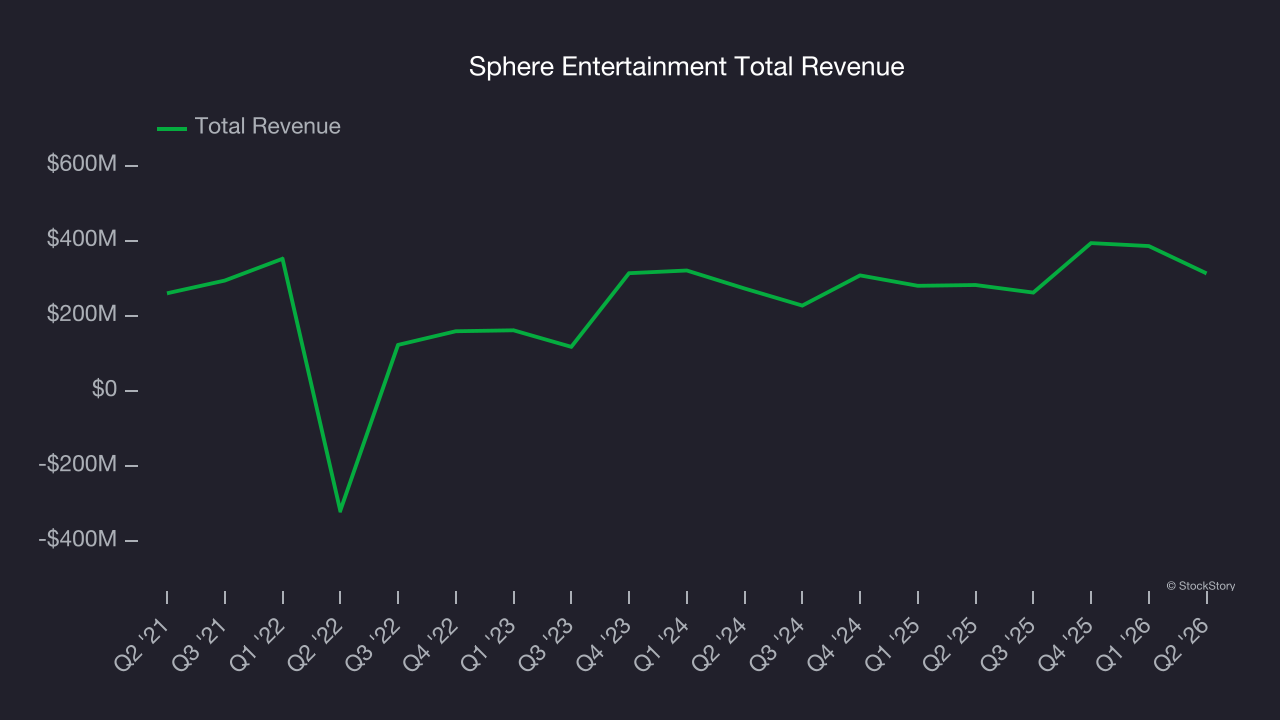
Although it had a fine quarter compared to its peers, the market seems unhappy with the results as the stock is down 23.8% since reporting. It currently trades at $106.77.
Is now the time to buy Sphere Entertainment? Access our full analysis of the earnings results here, it’s free.
Weakest Q2: Xponential Fitness (NYSE: XPOF)
Owner of Club Pilates, Stretch Lab, BFT and Pure Barre, Xponential Fitness (NYSE: XPOF) is a boutique fitness brand offering diverse and specialized exercise experiences.
Xponential Fitness reported revenues of $65.97 million, down 13.4% year on year, exceeding analysts’ expectations by 2.5%. Still, it was a disappointing quarter as it posted full-year revenue guidance missing analysts’ expectations significantly and a significant miss of analysts’ EPS estimates.
Xponential Fitness delivered the slowest revenue growth and weakest full-year guidance update in the group. As expected, the stock is down 22.4% since the results and currently trades at $4.94.
Read our full analysis of Xponential Fitness’s results here.
AMC Entertainment (NYSE: AMC)
With a profile that was raised due to meme stock mania beginning in 2021, AMC Entertainment (NYSE: AMC) operates movie theaters primarily in the US and Europe.
AMC Entertainment reported revenues of $1.60 billion, up 14.2% year on year. This result surpassed analysts’ expectations by 8.7%. Overall, it was a strong quarter as it also recorded a solid beat of analysts’ EBITDA estimates.
AMC Entertainment pulled off the biggest analyst estimate beat and fastest revenue growth among its peers. The stock is up 52.8% since reporting and currently trades at $2.97.
Read our full, actionable report on AMC Entertainment here, it’s free.
Callaway Golf Company (NYSE: CALY)
Formed between the merger of Callaway and Topgolf, Callaway Golf Company (NYSE: CALY) sells golf equipment and operates technology-driven golf entertainment venues.
Callaway Golf Company reported revenues of $612.2 million, up 2% year on year. This print topped analysts’ expectations by 1.3%. Overall, it was a strong quarter as it also produced EBITDA guidance for next quarter exceeding analysts’ expectations and full-year EBITDA guidance exceeding analysts’ expectations.
The stock is down 30.3% since reporting and currently trades at $13.63.
Read our full, actionable report on Callaway Golf Company here, it’s free.
Market Update
Over the past year, investors have been forced to repeatedly answer the same question: what is the market’s biggest risk? The answer has changed several times, and each shift has reshaped market leadership.
Late in 2025 and early 2026, artificial intelligence became the market’s primary uncertainty. Investors questioned whether AI would erode software pricing power and weaken competitive moats as AI made it easier to replicate once-differentiated products.
By the spring, technology took a back seat to geopolitics. The U.S. conflict with Iran briefly became the market’s dominant narrative, raising concerns about oil prices, inflation, and global growth. But as energy markets remained orderly and fears of a prolonged supply disruption faded, investors quickly turned their focus back to fundamentals.
Want to invest in winners with rock-solid fundamentals? Check out our Strong Momentum Stocks and add them to your watchlist. These companies are poised for growth regardless of the political or macroeconomic climate.