Looking back on modern fast food stocks’ Q1 earnings, we examine this quarter’s best and worst performers, including Sweetgreen (NYSE: SG) and its peers.
Modern fast food is a relatively newer category representing a middle ground between traditional fast food and sit-down restaurants. These establishments feature an expanded menu selection priced above traditional fast food options, often incorporating fresher and cleaner ingredients to serve customers prioritizing quality. These eateries are capitalizing on the perception that your drive-through burger and fries joint is detrimental to your health because of inferior ingredients.
The 5 modern fast food stocks we track reported a slower Q1. As a group, revenues missed analysts’ consensus estimates by 1.1%.
Amidst this news, share prices of the companies have had a rough stretch. On average, they are down 18.8% since the latest earnings results.
Sweetgreen (NYSE: SG)
Founded in 2007 by three Georgetown University alum, Sweetgreen (NYSE: SG) is a casual quick service chain known for its healthy salads and bowls.
Sweetgreen reported revenues of $161.5 million, down 2.9% year on year. This print fell short of analysts’ expectations by 1.6%. Overall, it was a slower quarter for the company with a significant miss of analysts’ EBITDA and same-store sales estimates.
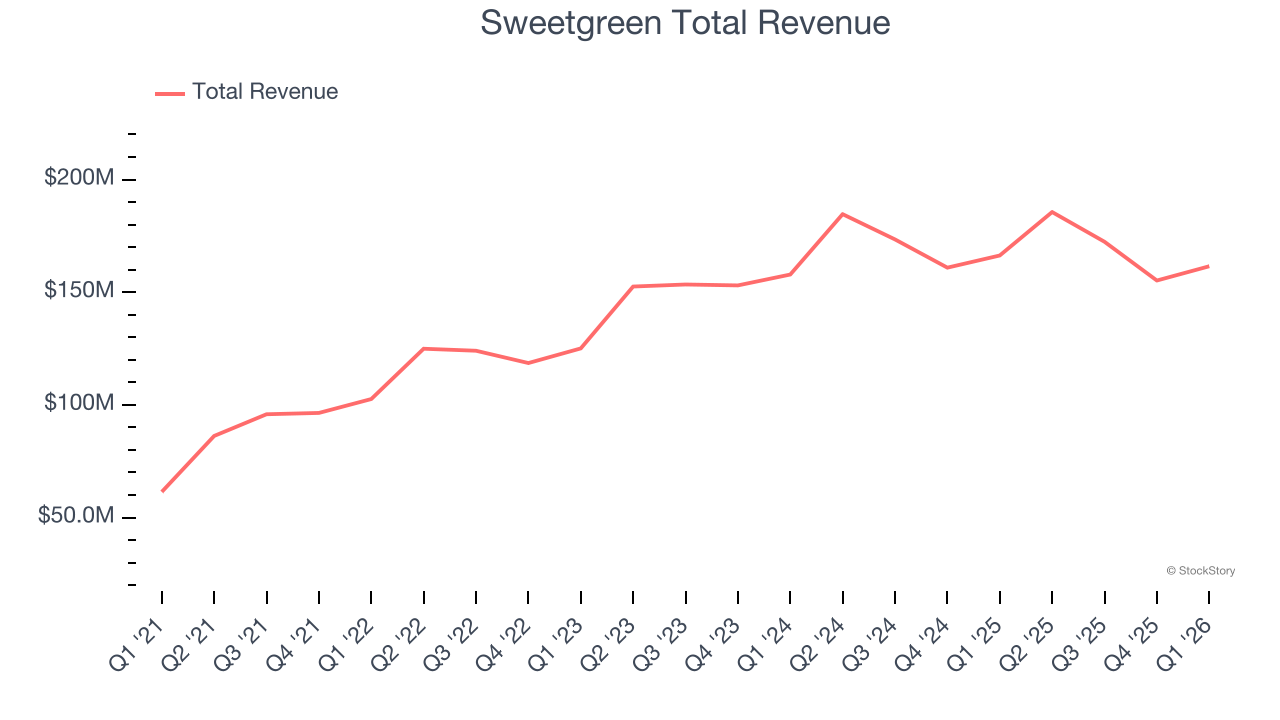
Sweetgreen delivered the slowest revenue growth of the whole group. Unsurprisingly, the stock is down 5.5% since reporting and currently trades at $6.49.
Read our full report on Sweetgreen here, it’s free.
Best Q1: Chipotle (NYSE: CMG)
Born from a desire to offer quick meals with fresh, flavorful ingredients, Chipotle (NYSE: CMG) is a fast-food chain known for its healthy, Mexican-inspired cuisine and customizable dishes.
Chipotle reported revenues of $3.09 billion, up 7.4% year on year, outperforming analysts’ expectations by 0.5%. The business had a strong quarter with a solid beat of analysts’ same-store sales and EBITDA estimates.
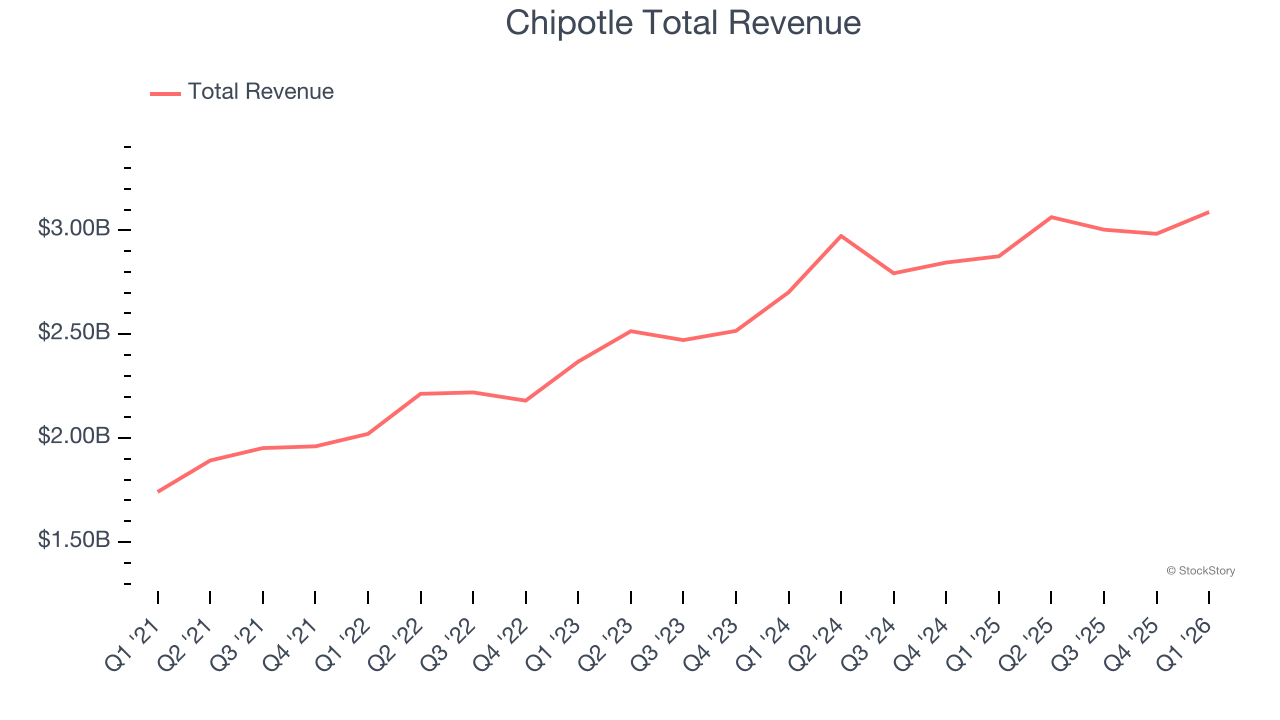
Chipotle delivered the biggest analyst estimates beat among its peers. However, the results were likely priced into the stock as it’s traded sideways since reporting. Shares currently sit at $32.67.
Is now the time to buy Chipotle? Access our full analysis of the earnings results here, it’s free.
Weakest Q1: Shake Shack (NYSE: SHAK)
Started as a hot dog cart in New York City's Madison Square Park, Shake Shack (NYSE: SHAK) is a fast-food restaurant known for its burgers and milkshakes.
Shake Shack reported revenues of $366.7 million, up 14.3% year on year, falling short of analysts’ expectations by 1.4%. It was a softer quarter as it posted a significant miss of analysts’ EBITDA and EPS estimates.
As expected, the stock is down 31.6% since the results and currently trades at $66.07.
Read our full analysis of Shake Shack’s results here.
Wingstop (NASDAQ: WING)
The passion project of two chicken wing aficionados in Texas, Wingstop (NASDAQ: WING) is a popular fast-food chain known for its flavorful and crispy chicken wings offered in a variety of sauces and seasonings.
Wingstop reported revenues of $183.7 million, up 7.4% year on year. This print came in 2.4% below analysts' expectations. It was a softer quarter as it also logged a significant miss of analysts’ same-store sales and EBITDA estimates.
Wingstop had the weakest performance against analyst estimates among its peers. The stock is down 28.2% since reporting and currently trades at $124.16.
Read our full, actionable report on Wingstop here, it’s free.
Portillo's (NASDAQ: PTLO)
Begun as a Chicago hot dog stand in 1963, Portillo’s (NASDAQ: PTLO) is a casual restaurant chain that serves Chicago-style hot dogs and beef sandwiches as well as fries and shakes.
Portillo's reported revenues of $182.6 million, up 3.5% year on year. This number met analysts’ expectations. Overall, it was a strong quarter as it also logged a beat of analysts’ EPS estimates and an impressive beat of analysts’ same-store sales estimates.
The stock is down 27.7% since reporting and currently trades at $4.14.
Read our full, actionable report on Portillo's here, it’s free.
Market Update
Late in 2025 into early 2026, there was hand wringing around artificial intelligence. For software companies, the fear was that AI would erode pricing power and compress margins as new tools made it easier to replicate what once required expensive enterprise platforms. Crypto investors had their own version of the same anxiety: if AI agents could trade, allocate capital, and manage wallets autonomously, what exactly was the long-term value of today’s crypto infrastructure?
These concerns triggered a noticeable rotation away from these sectors and into safer havens. But markets rarely dwell on one narrative for long. Spring 2026 came, and the focus shifted abruptly from technological disruption to geopolitical risk. The US’ conflict with Iran became the dominant driver of market psychology, and when geopolitics takes center stage, the script changes quickly. Investors stop debating growth rates and start worrying about oil supply, inflation, and global stability.
Want to invest in winners with rock-solid fundamentals? Check out our Top 6 Stocks and add them to your watchlist. These companies are poised for growth regardless of the political or macroeconomic climate.
StockStory’s analyst team — all seasoned professional investors — uses quantitative analysis and automation to deliver market-beating insights faster and with higher quality.