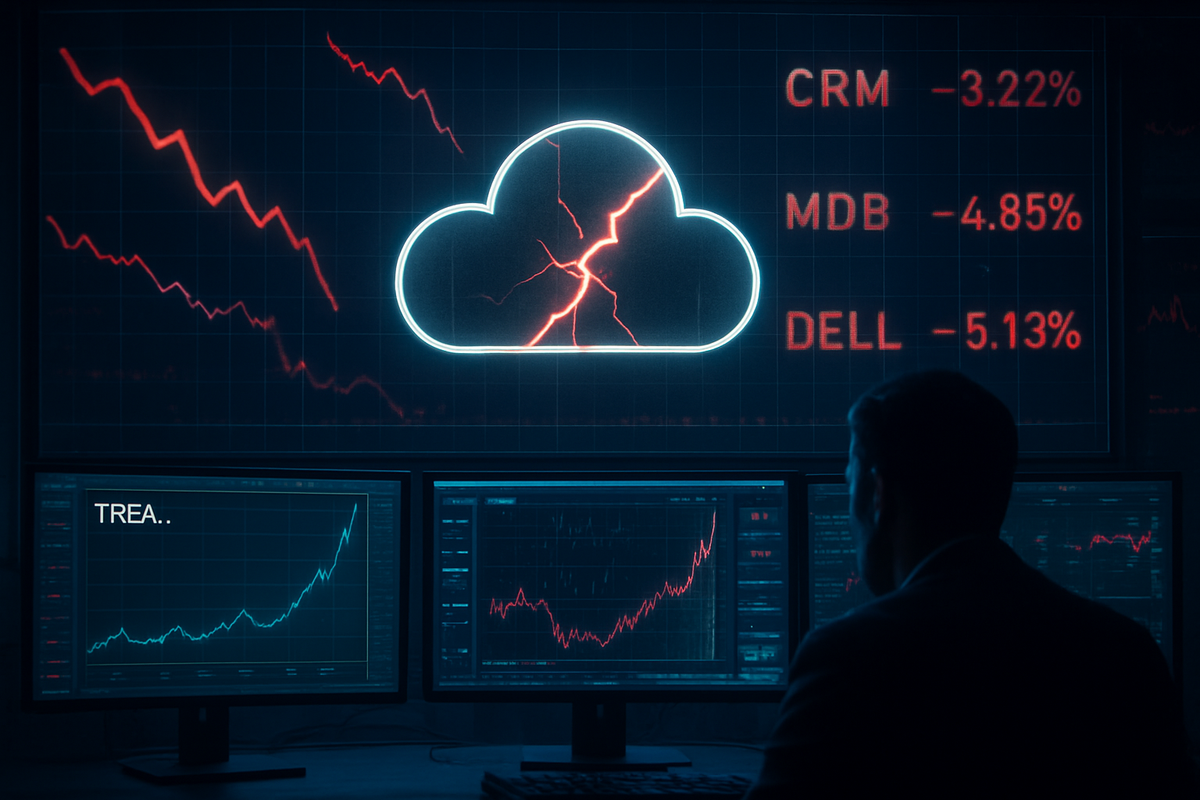
The U.S. equity markets are facing a turbulent opening bell as a "triple threat" of disappointing enterprise software earnings, surging Treasury yields, and persistent interest-rate anxiety dampens investor sentiment. Major indices are retreating from recent record highs, with premarket activity highlighting a stark divergence between traditional hardware resilience and a sudden, sharp correction in the high-growth software sector.
Traders are navigating a landscape where the "AI euphoria" that fueled much of the spring rally is being met with rigorous fundamental scrutiny. As the 10-year Treasury yield edges back toward critical resistance levels, the cost of capital is once again at the forefront of the market's collective mind, forcing a defensive posture across both the Nasdaq and the S&P 500.
The Software Sell-Off and the Catalyst of Contagion
The primary catalyst for the current market jitters was a catastrophic earnings report from Salesforce (NYSE: CRM), which sent shockwaves through the tech-heavy indices. The cloud software giant reported its first quarterly revenue miss since 2006 and issued forward-looking guidance that fell significantly short of analyst expectations. This triggered an immediate "software slaughter," as investors began to reassess the valuation premiums previously afforded to SaaS (Software as a Service) companies. The sell-off was not isolated; it quickly spread to other industry leaders, suggesting a broader slowdown in enterprise digital transformation spending.
Following the Salesforce news, the timeline of volatility accelerated as MongoDB (NASDAQ: MDB) and UiPath (NYSE: PATH) also delivered disappointing outlooks. MongoDB’s shares tumbled nearly 24% in premarket trading after the company slashed its full-year revenue and profit guidance, while UiPath saw a 30% drop following a surprise CEO transition and weakened sales targets. These events have collectively created a "crisis of confidence" in the software sector, as stakeholders worry that the massive capital expenditures being funneled into AI hardware are cannibalizing the budgets originally intended for software subscriptions and cloud services.
The technical picture for the major indices reflects this unease. The S&P 500 (INDEXSP:.INX) has retreated from its May peak of 5,321, testing support levels near 5,250. Meanwhile, the Nasdaq 100 (INDEXNASDAQ: NDX) is struggling to maintain its footing above 18,700, facing heavy resistance as the "thin breadth" of the market rally becomes increasingly apparent. With fewer than half of S&P 500 members trading above their 50-day moving averages, the market's reliance on a handful of mega-cap winners has left it vulnerable to these sector-specific shocks.
Navigating the Divide: Winners and Losers in a Bifurcated Market
While the software sector is reeling, a few notable "winners" are emerging from the premarket chaos, highlighting a shift toward value and hardware recovery. HP Inc. (NYSE: HPQ) surged approximately 17% after reporting a beat in its PC segment, signaling that the long-awaited recovery in the traditional computer market may finally be taking hold. Similarly, Gap Inc. (NYSE: GPS) provided a rare bright spot for consumer discretionary stocks, jumping 23% in premarket trading after a significant earnings beat and a raised full-year outlook, suggesting that the American consumer remains resilient despite inflationary pressures.
On the losing side, the pain is concentrated in companies that were previously seen as "AI beneficiaries" but are now facing margin pressure. Dell Technologies (NYSE: DELL) saw its shares fall over 15% despite beating earnings estimates. The decline was attributed to shrinking gross margins, a direct result of the high costs associated with building AI-optimized servers. This "sell the news" reaction indicates that investors are no longer satisfied with just "AI involvement"; they are now demanding clear evidence of AI profitability and sustainable margin expansion.
NVIDIA (NASDAQ: NVDA) remains the ultimate wildcard. While the company hit record highs above $1,100 earlier in the month, it has faced increased volatility as traders take profits to cover losses in the broader software and hardware sectors. The performance of Nvidia continues to serve as a barometer for the entire AI trade, and any sign of exhaustion in its upward trajectory could lead to a more significant market-wide correction.
Macro Headwinds and the "Higher for Longer" Reality
The current market jitters are deeply rooted in a shifting macroeconomic narrative. Throughout late May, strong economic data—including robust PMI and labor figures—has combined with "hawkish" Federal Reserve minutes to convince the market that interest rate cuts are not imminent. The "higher for longer" mantra has returned with a vengeance, causing market-implied expectations for a September rate cut to dwindle. This shift has put upward pressure on the 10-year Treasury yield, which is currently flirting with the 4.5% to 4.6% range.
Historically, when Treasury yields approach the 5.0% threshold, it triggers a mandatory re-evaluation of equity valuations, particularly for growth-oriented tech stocks whose future cash flows are discounted at higher rates. The recent "sloppy" Treasury auctions, which saw weak demand for government debt, have only added fuel to the fire, suggesting that the market is demanding higher yields to compensate for the uncertainty surrounding inflation and the Fed's next move.
This event fits into a broader industry trend where the "AI hype cycle" is transitioning into a "show-me" phase. The regulatory environment also remains a looming factor, as global authorities increase scrutiny on the competitive practices of dominant AI and cloud players. Comparisons are being drawn to the post-dot-com era, where hardware providers initially thrived while software companies struggled to find sustainable monetization models for new technologies.
The Road Ahead: Strategic Pivots and Market Opportunities
In the short term, the market's direction will likely be dictated by the Personal Consumption Expenditures (PCE) inflation report. Traders are positioning themselves defensively, awaiting confirmation of whether inflation is truly on a cooling path or if it remains stubbornly sticky. A hotter-than-expected PCE print could send yields higher and further pressure the Nasdaq, while an "in-line" report might provide the relief needed for a relief rally.
Looking further ahead, companies may need to undergo strategic pivots to regain investor trust. For software firms like Salesforce and MongoDB, the challenge will be proving that they can integrate AI features into their platforms in a way that drives incremental revenue rather than just maintaining existing subscriptions. We may see a wave of consolidation in the SaaS space as larger players look to acquire innovative AI startups at discounted valuations to bolster their competitive moats.
For investors, the current volatility presents both a challenge and an opportunity. The "software slaughter" has brought some high-quality names down to more reasonable valuation levels, but catching a "falling knife" remains a risk. A rotation into more traditional sectors, such as consumer discretionary or hardware recovery plays like HP, may offer a safer harbor until the interest rate picture becomes clearer.
Summary of Market Sentiment and Investor Outlook
The premarket jitters of late May 2024 serve as a stark reminder that even the most powerful bull markets are subject to fundamental gravity. The combination of a software sector reset, surging yields, and Fed uncertainty has created a high-volatility environment that demands caution. The key takeaway for investors is that the market's breadth remains a significant concern; as long as the rally is concentrated in a few mega-cap names, the indices will remain susceptible to sector-specific shocks.
Moving forward, the market will likely remain in a "data-dependent" holding pattern. Investors should closely watch the 10-year Treasury yield and the upcoming inflation data, as these will be the primary drivers of equity valuations in the coming months. The era of "easy money" and blind AI optimism appears to be giving way to a more disciplined market environment where earnings quality and margin preservation are paramount.
As we look toward the second half of the year, the ability of companies to turn AI potential into tangible profit will be the ultimate differentiator. While the current jitters are painful for many tech-heavy portfolios, they are a necessary part of a healthy market cycle, flushing out excess and setting the stage for the next phase of growth.
This content is intended for informational purposes only and is not financial advice