HANGZHOU, CN / ACCESS Newswire / December 15, 2025 / In response to frequent fire emergencies and rescue challenges reported across multiple regions worldwide, DEEP Robotics recently conducted a series of high-intensity, realistic exercises simulating complex fire accidents in cities.
These drills directly address the pain points of traditional firefighting: high temperatures, dense smoke, and the risk of building collapses within fire scenes have long placed frontline firefighters in life-threatening situations and made rescue operations extremely difficult. Against this backdrop, firefighting robot dogs, as the latest application of embodied intelligence in emergency response, underwent rigorous field testing. Can they replace humans in entering high-risk zones? Can they secure the "golden hour" for saving lives in the face of disaster? These drills provided compelling answers.
I. The Difficulties of Traditional Rescue: The "Life-and-Death Challenges" Firefighters Face
Traditional firefighting and rescue models are consistently hampered by numerous difficult-to-overcome obstacles. These pain points not only constrain rescue efficiency but also constantly threaten the safety of rescue personnel. Fire scenes often present hazards such as intense heat, toxic smoke, and the constant risk of structural collapse. Firefighters must conduct search and rescue in high-temperature environments, battling the fire itself while also guarding against falling debris and collapsing walls, making them highly vulnerable to injury or death.
Furthermore, fires generate thick smoke that rapidly obscures visibility for rescuers, easily creating search blind spots. This can lead to difficulties in quickly locating trapped individuals and potentially result in rescuers mistakenly entering hazardous areas due to misjudgment. Additionally, the inability to obtain real-time feedback on critical data such as ambient temperature and toxic gas concentration can hinder the formulation of effective rescue plans.
Large-scale fires require significant human resources, and rescuers have physical limits. Prolonged, high-intensity operations can lead to exhaustion, subsequently reducing search and rescue efficiency. Under conditions of manpower shortage, it is challenging to conduct comprehensive and rapid checks of all areas, increasing the risk of missing the golden rescue window.
II. The Rescue Skills of Firefighting Robot Dogs: The "Capable Assistants" in the Fireground
Today, firefighting robot dogs are gradually being deployed in actual fire rescue operations. Leveraging their unique technological advantages, they have become "capable assistants" to human rescuers, compensating for many shortcomings of traditional methods. Unfazed by extreme high-temperature environments, these robot dogs need not worry about smoke inhalation or burns. They can be equipped with thermal imagers, gas sensors, HD cameras, and other devices, allowing them to be the first to enter dangerous areas filled with dense smoke, high heat, and collapse risks. For example, DEEP Robotics' firefighting robot dogs, through multi-sensor fusion and intelligent perception systems, can identify fire sources in real time, monitor gas leaks, and construct 3D maps of the scene, providing multidimensional intelligence support to the command center.
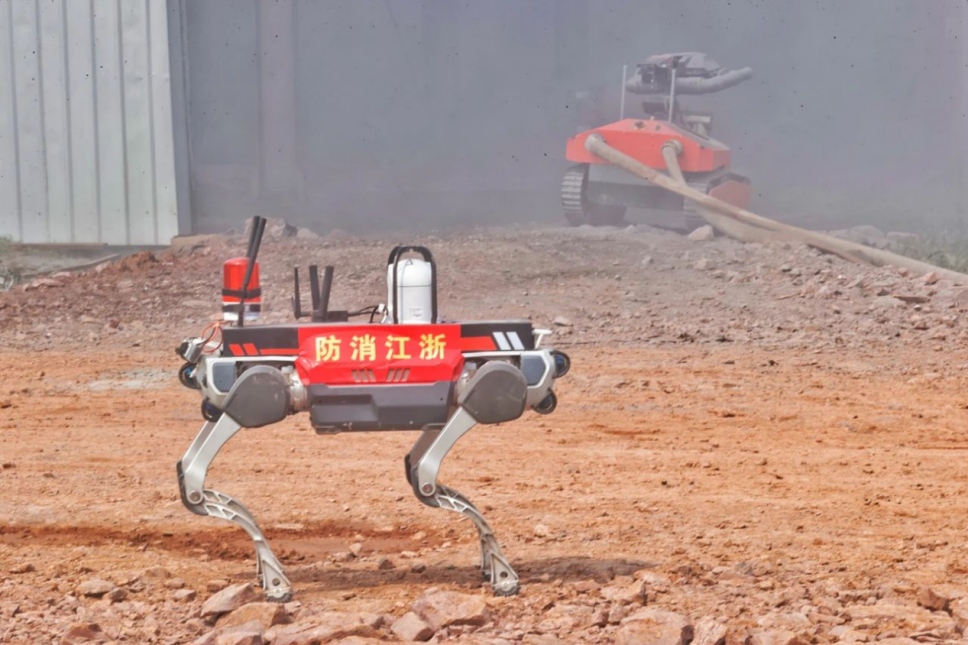
DEEP Robotics Robot Dog in a Firefighting Drill
With their compact and agile bodies, firefighting robot dogs can easily navigate narrow stairwells, underground pipes, building interlayers, and other areas difficult for humans to access. Using thermal imaging, they can identify the vital signs of trapped individuals and precisely relay their location to rescue teams, significantly improving the success rate of search and rescue in special scenarios. During the "2025 Joint Emergency Rescue Drill for Concurrent Multi-Type Accidents in Complex Scenarios," DEEP Robotics' firefighting robot dogs, operating in conjunction with a personnel search-and-rescue platform and facial recognition cameras, successfully pinpointed the locations of all seven trapped individuals, achieving precise rescue.
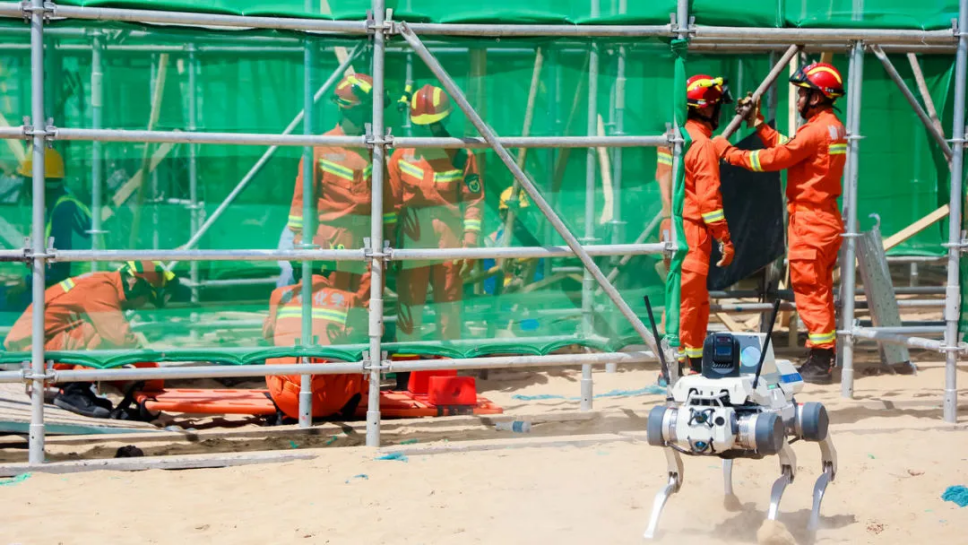
DEEP Robotics Robot Dog in the 2025 Joint Emergency Rescue Drill for Concurrent Multi-Type Accidents in Complex Scenarios
Firefighting robot dogs possess long-duration endurance, allowing them to continuously perform monitoring tasks on-site. They can track the spread of the fire, changes in building structure, and other developments in real time. They can also act as temporary communication relays, ensuring communication continuity for rescue teams in complex environments, solving the problem of communication signal loss common in traditional rescue operations.
Some firefighting robot dogs can also carry small fire suppression devices to quickly extinguish small initial fires. Simultaneously, they can deliver basic first-aid supplies, drinking water, and other materials to individuals trapped in confined spaces, buying them more survival time while awaiting subsequent professional rescue.
These capabilities have been validated in practical scenarios in multiple locations. In the field of emergency firefighting, quadruped robot dogs have established a broad application foundation, with DEEP Robotics' products holding a 90% market share due to their mature performance. From daily fire prevention patrols in West Lake forests and Zhejiang forests, to the 2025 Joint Emergency Rescue Drill for Concurrent Multi-Type Accidents in Complex Scenarios, and to simulated response exercises for natural gas pipeline leak explosions in Ordos, Inner Mongolia, these robots have participated in numerous realistic missions. They have not only significantly enhanced the overall efficiency of hazard identification and response but, crucially, by replacing humans in entering high-risk scenarios, they have added a vital layer of protection for firefighters' lives.
III. Safety Reminder: Technological Empowerment Still Requires Personal Preparedness
Although firefighting robot dogs provide new assistance in rescue efforts, fire prevention and emergency self-rescue remain crucial for everyone: Conduct regular fire hazard inspections in daily life, check household electrical and gas appliances periodically, clear clutter from hallways to prevent accelerated fire spread due to piled-up items. Master basic fire self-rescue skills, such as covering your mouth and nose with a wet towel, crawling low to escape if caught in a fire, and familiarize yourself with building emergency exits and evacuation routes to avoid missing escape opportunities due to panic during a fire. After a fire breaks out, never blindly re-enter the fire scene to retrieve belongings. If trapped, send distress signals promptly to buy time for rescue. Cooperate with the instructions of rescue personnel to ensure the safety of both yourself and the rescuers.
IV. Technological Rescue: Building a "Technological Protective Wall" for Lives
Moving from the laboratory to the fireground, the application of firefighting robot dogs is a microcosm of the upgrade in rescue technology. With the continuous advancement of embodied intelligence, future firefighting robots will possess even stronger autonomous decision-making capabilities. Companies like DEEP Robotics are already exploring next-generation rescue robots with autonomous firefighting and multi-robot collaboration capabilities, propelling the fire and rescue sector towards greater intelligence and networking.
Technological development is never about replacing human rescuers. Instead, it aims to build a more robust protective wall for lives, enabling rescue personnel to work in safer environments while minimizing the life and property losses caused by fires. Supported by the continuous progress of technology, humanity's ability to respond to disasters like fires will keep improving, building a more solid defense line for life safety.
Company: DEEP Robotics
Contact: Vivian Chen
Email: chenlingjia@deeprobotics.cn
Website: https://www.deeprobotics.cn/en
SOURCE: DEEP Robotics
View the original press release on ACCESS Newswire