Psychological Safety Metrics, Integrated Lighting Architectures, and Regulatory Compliance Redefine Passenger Experience in Urban Air Mobility by 2036
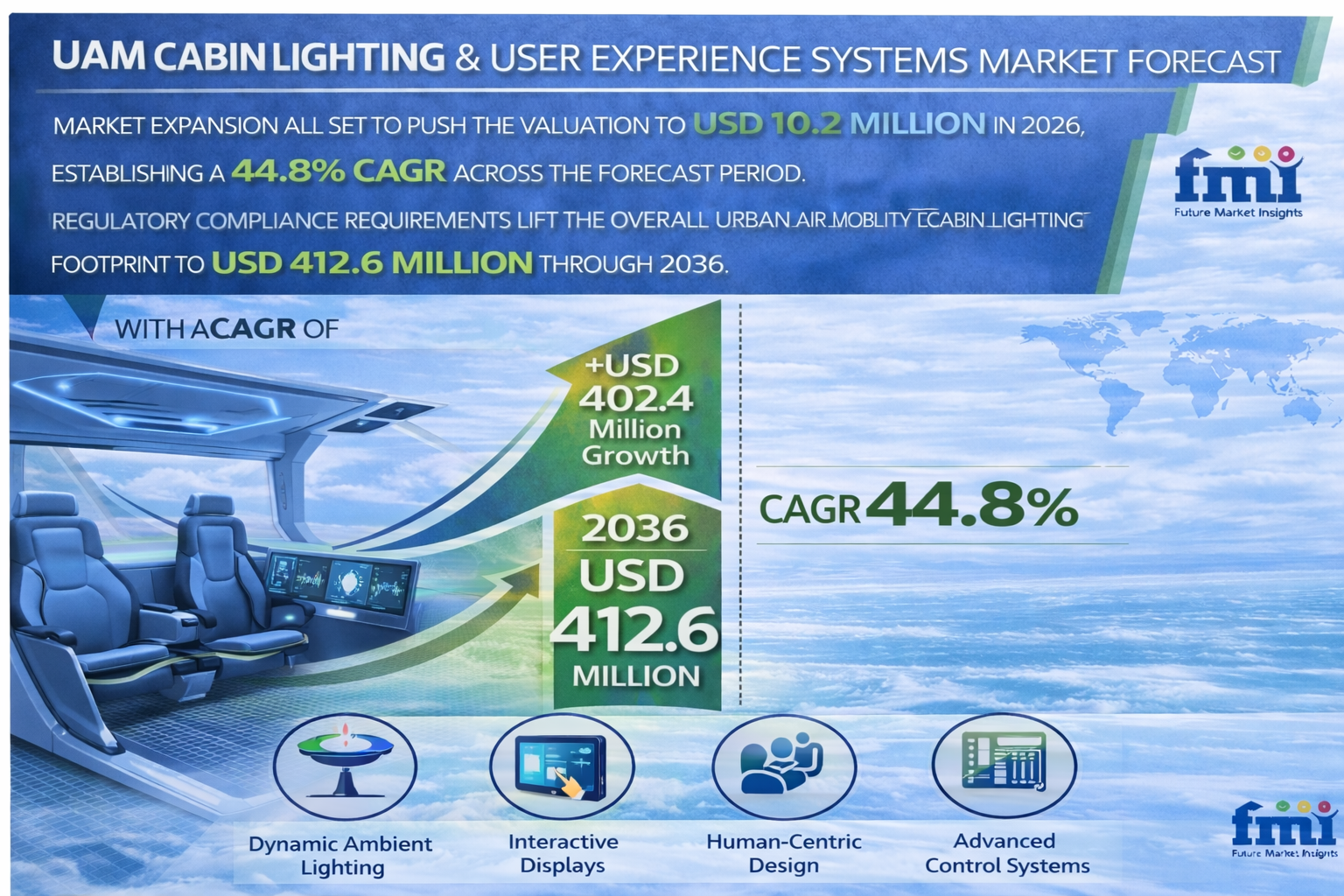
NEWARK, DE / ACCESS Newswire / March 26, 2026 / The global UAM cabin lighting and user experience systems market is entering a rapid transformation phase as urban air mobility (UAM) ecosystems prioritize passenger trust, autonomous flight safety, and immersive cabin environments. Valued at USD 7.0 million in 2025, the market is projected to reach USD 10.2 million in 2026 and surge to USD 412.6 million by 2036, registering a remarkable CAGR of 44.8% during the forecast period.
This accelerated expansion reflects a paradigm shift in cabin system design, where lighting is no longer limited to illumination but serves as a critical interface for passenger communication, behavioral guidance, and psychological reassurance. As eVTOL aircraft move toward pilotless operations, cabin lighting and UX systems are evolving into essential safety and interaction layers that directly influence certification outcomes and passenger acceptance.
Get Access of Report Sample:
https://www.futuremarketinsights.com/reports/sample/rep-gb-32442
Market Value Analysis: Psychological Safety and Certification Standards Driving Demand
Between 2026 and 2030, the UAM cabin lighting and user experience systems market is expected to witness exponential growth as OEMs finalize autonomous cabin configurations for commercial deployment. Certification authorities are increasingly mandating quantifiable psychological reassurance metrics, compelling manufacturers to integrate intelligent lighting systems capable of guiding passenger behavior during critical flight scenarios.
Airframe manufacturers are prioritizing:
Adaptive ambient lighting systems for passenger reassurance
Integrated lighting and UX control modules for weight efficiency
Visual egress guidance systems for emergency scenarios
Standardized cabin communication interfaces for autonomous operations
Delays in selecting validated lighting architectures can result in costly recertification cycles, especially if passenger behavioral studies reveal elevated anxiety levels during simulated flight testing.
From 2030 to 2036, market growth will be driven by regulatory standardization and the widespread adoption of unified cabin interface protocols, enabling seamless passenger interaction across diverse eVTOL platforms.
Technology Evolution: Behavioral Lighting and Integrated UX Redefining Cabin Systems
The evolution of UAM cabin lighting is being shaped by the convergence of human psychology, aerospace engineering, and digital interface design. Unlike traditional aviation lighting, these systems must actively influence passenger perception and decision-making in the absence of a pilot.
Key innovations include:
Dynamic mood lighting systems synchronized with flight phases
Integrated lighting and touch-control modules for reduced wiring weight
Biometric-responsive lighting environments
Low-power, high-efficiency illumination technologies
Embedded visual communication systems for autonomous guidance
A critical breakthrough lies in the development of lighting systems that reduce cognitive load while enhancing situational awareness. These systems are designed to passively guide passengers toward safe actions without requiring verbal instructions.
An industry analyst notes:
"In autonomous flight environments, lighting becomes the primary language between the aircraft and its passengers. Systems that successfully combine emotional reassurance with functional guidance will define the next generation of UAM cabin design."
Passenger Experience Engineering Becoming Central to UAM Adoption
As urban air mobility transitions toward real-world deployment, passenger experience systems are emerging as mission-critical components. These systems play a direct role in:
Building passenger trust in pilotless aircraft
Reducing anxiety during turbulence or descent phases
Guiding emergency evacuation without human intervention
Enhancing perceived comfort in compact cabin spaces
Supporting regulatory compliance for autonomous operations
This shift is redefining competitive dynamics, where UX performance is directly linked to certification success, operational scalability, and brand differentiation.
Segment Spotlight
Ambient and Mood Lighting Systems Lead (42.0%)
Dominance is driven by the need to mitigate passenger anxiety and enhance comfort during autonomous flights.
Integrated Lighting + UX Modules (38.0%)
These systems reduce wiring complexity and weight, aligning with strict payload constraints.
OEM Line-Fit Installations Lead (71.0%)
Structural integration during manufacturing ensures compliance and minimizes retrofit challenges.
4-6 Passenger Air Taxis Dominate (64.0%)
This configuration represents the most commercially viable early deployment model.
Passenger Transport Operators Lead (58.0%)
Municipal and urban transit operators are driving early adoption through large-scale fleet deployments.
Regional Insights: Middle East and North America Leading Innovation
The UAM cabin lighting and UX systems market is shaped by regional regulatory frameworks, infrastructure investments, and commercialization strategies.
Country |
CAGR (2026-2036) |
Key Growth Drivers |
|---|---|---|
United Arab Emirates |
48.9% |
State-backed premium UAM infrastructure and tourism-driven adoption |
United States |
46.2% |
Intense startup competition and early certification programs |
Saudi Arabia |
45.8% |
Sovereign investments in smart city aerial mobility networks |
Brazil |
45.1% |
Strong aerospace manufacturing base and integration capabilities |
China |
43.7% |
High-volume production targets and government-backed deployment |
India |
43.2% |
Growing urban congestion driving future commuter demand |
United Kingdom |
39.6% |
Strict regulatory validation and structured testing environments |
Opportunities: Intelligent Interfaces and Autonomous Guidance Unlock New Potential
Key growth opportunities in the market include:
Biometric-driven adaptive lighting environments
Predictive maintenance systems for lighting components
Acoustic-haptic feedback technologies replacing mechanical systems
Digital twin-based cabin simulation for certification testing
Open-architecture UX platforms enabling modular upgrades
These innovations are enabling scalable, lightweight, and intelligent cabin systems tailored for high-frequency autonomous operations.
Competitive Landscape: Certification Expertise and Integration Capability Define Leadership
The UAM cabin lighting and user experience systems market is characterized by a blend of established aerospace suppliers and agile, innovation-driven entrants.
Leading players include:
Collins Aerospace
Astronics Corporation
Diehl Aviation
Thales
Luminator Aerospace
Heads Up Technologies
Safran Cabin
Competitive differentiation is increasingly driven by:
Ability to meet psychological safety certification standards
Expertise in ultra-lightweight integrated system design
Seamless hardware-software integration capabilities
Speed of validation and deployment
Future Outlook: UX-Driven Cabin Systems Becoming Core to Autonomous Aviation
Looking ahead to 2036, UAM cabin lighting and user experience systems will become foundational to autonomous flight ecosystems.
Key trends shaping the market include:
Standardization of visual communication protocols for pilotless aircraft
Integration of AI-driven adaptive cabin environments
Expansion of modular, software-defined UX architectures
Increasing convergence of aerospace and automotive interface design
Growing emphasis on passenger psychology in certification frameworks
As urban air mobility scales globally, cabin lighting and UX systems will transition from auxiliary features to mission-critical infrastructure-ensuring safety, trust, and seamless interaction in the next generation of autonomous air transportation.
For an in-depth analysis of evolving formulation trends and to access the complete strategic outlook for the UAM Cabin Lighting and User Experience Systems Market through 2036, visit the official report page at: https://www.futuremarketinsights.com/reports/uam-cabin-lighting-and-user-experience-systems-market
Browse More Automotive Industry Reports:
Aircraft Gearbox Market - https://www.futuremarketinsights.com/reports/aircraft-gearbox-market
Two-Wheeler Aftermarket Components & Consumables Market - https://www.futuremarketinsights.com/reports/two-wheeler-aftermarket-components-market
One-Pedal Brake Control Modules Market - https://www.futuremarketinsights.com/reports/one-pedal-brake-control-modules-market
Low-Noise Low-Dust EV Brake Components Market - https://www.futuremarketinsights.com/reports/low-noise-low-dust-ev-brake-components-market
Regenerative Brake Calibration Services Market - https://www.futuremarketinsights.com/reports/regenerative-brake-calibration-services-market
About Future Market Insights (FMI)
Future Market Insights (FMI) is a leading provider of market intelligence and consulting services, serving clients in over 150 countries. Headquartered in Delaware, USA, with a global delivery center in India and offices in the UK and UAE, FMI delivers actionable insights to businesses across industries including automotive, technology, consumer products, manufacturing, energy, and chemicals.
An ESOMAR-certified research organization, FMI provides custom and syndicated market reports and consulting services, supporting both Fortune 1,000 companies and SMEs. Its team of 300+ experienced analysts ensures credible, data-driven insights to help clients navigate global markets and identify growth opportunities.
For Press & Corporate Inquiries
Rahul Singh
AVP - Marketing and Growth Strategy
Future Market Insights, Inc.
+91 8600020075
For Sales - sales@futuremarketinsights.com
For Media - Rahul.singh@futuremarketinsights.com
For web - https://www.futuremarketinsights.com/
SOURCE: Future Market Insights, Inc.
View the original press release on ACCESS Newswire