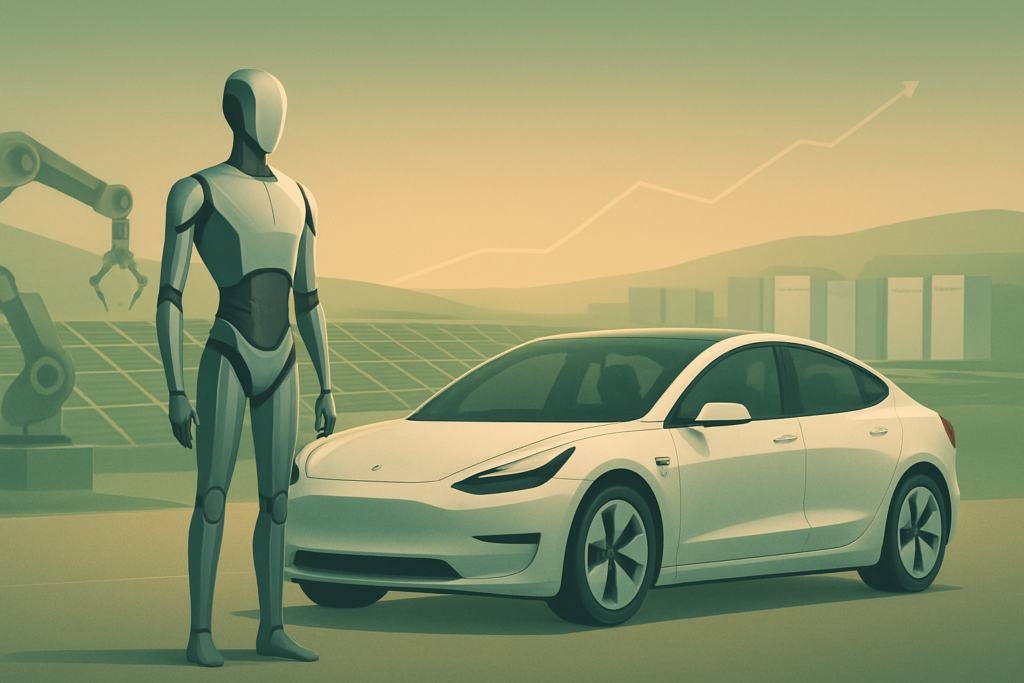
As of April 1, 2026, Tesla, Inc. (NASDAQ: TSLA) finds itself at a historic crossroads. Long celebrated—and scrutinized—as the vanguard of the electric vehicle (EV) revolution, the company has spent the last 24 months aggressively rebranding itself as an "AI and Robotics" powerhouse. The transition hasn't been without turbulence. After a challenging 2025 that saw its first major annual delivery decline, Tesla is now banking on a trio of catalysts: the mass-market "Model 2," the commercialization of its Optimus humanoid robot, and the regulatory rollout of unsupervised Full Self-Driving (FSD).
For investors, Tesla remains one of the most polarizing tickers on the market. It is a company that defies traditional automotive valuation, trading more like a high-growth software firm despite the capital-intensive realities of global manufacturing. In this deep-dive, we examine whether Tesla’s pivot to AI can restore the hyper-growth trajectory that defined its previous decade.
Historical Background
Founded in 2003 by Martin Eberhard and Marc Tarpenning—and fundamentally shaped by early investor and longtime CEO Elon Musk—Tesla's journey began with a singular "Master Plan": build a high-end sports car to prove EVs were viable, then use those profits to build increasingly affordable models.
The 2008 Roadster proved the concept, but it was the 2012 launch of the Model S that disrupted the luxury sedan market. The "production hell" of the Model 3 ramp-up in 2017-2018 nearly bankrupted the company but ultimately scaled Tesla into the mainstream. By 2020, Tesla had achieved sustained profitability, leading to its inclusion in the S&P 500 and a trillion-dollar valuation peak in late 2021. The subsequent years, 2023 through 2025, were defined by price wars in China, the launch of the polarizing Cybertruck, and a strategic shift away from high-margin luxury toward volume and autonomous services.
Business Model
Tesla’s business model is vertically integrated to a degree rarely seen in modern industry. It currently operates through three primary segments:
- Automotive: The core driver, encompassing the sale and leasing of the Model 3, Y, S, X, and Cybertruck. Revenue is supplemented by regulatory credits sold to other OEMs.
- Energy Generation and Storage: This includes the Megapack (utility-scale storage), Powerwall (residential), and Solar Roof. As of 2026, this has become the fastest-growing segment by margin percentage.
- Services and Other: This covers Supercharging (now a global standard via NACS), in-app software purchases (FSD subscriptions), insurance, and vehicle service.
Crucially, Tesla’s model is shifting toward a "razor and blade" strategy: selling hardware (cars) at lower margins to build an installed base for high-margin recurring revenue via FSD software and the burgeoning Robotaxi network.
Stock Performance Overview
Over the last decade, TSLA has been a generational wealth creator, though its path has been a rollercoaster:
- 10-Year Performance: Despite recent volatility, long-term holders have seen gains exceeding 1,200%, vastly outperforming the S&P 500.
- 5-Year Performance: The stock saw a parabolic rise in 2020-2021, followed by a significant correction in 2022 and 2024. As of early 2026, it is recovering from a "valuation reset" that occurred when automotive margins compressed in 2024.
- 1-Year Performance: The stock has seen a 15% recovery over the last 12 months, driven by the successful pilot of "Unsupervised FSD" in select markets and the initial production of the $25,000 next-gen platform.
Financial Performance
Tesla’s recent financials reflect a company in transition. After a 2024 that saw operating margins dip to 7.2%, the 2025 fiscal year was a period of consolidation.
- Revenue: 2025 revenue reached approximately $105 billion, a modest increase despite lower vehicle delivery volume, thanks to a 50% surge in Energy segment revenue.
- Margins: Automotive gross margins (excluding credits) have stabilized around 17% in Q1 2026, up from the 16% lows of 2024, as the Cybertruck ramp-up reached scale.
- Cash Position: Tesla maintains a fortress balance sheet with over $30 billion in cash and investments, allowing it to self-fund the massive "Project Redwood" (Model 2) expansion and the Houston Megafactory.
- Valuation: Trading at a forward P/E of approximately 55x, Tesla remains expensive compared to Toyota (10x) but cheaper than its historic highs of 100x+.
Leadership and Management
Elon Musk remains the polarizing center of Tesla's leadership. While his focus is often split between X (formerly Twitter), SpaceX, and xAI, his "technoking" status at Tesla is currently focused on the AI-first transition.
The leadership bench has seen notable shifts. Tom Zhu, Senior VP of Automotive, continues to oversee global production efficiency, while the board of directors remains under pressure to improve governance following the 2024 disputes over Musk’s compensation package. Despite the noise, Tesla’s engineering talent remains a top-tier magnet for AI and robotics specialists, keeping the innovation pipeline robust.
Products, Services, and Innovations
Tesla’s product lineup is currently undergoing its most significant refresh in a decade:
- Model 2 (Project Redwood): Entering mass production in mid-2026, this $25,000 vehicle uses the "Unboxed" manufacturing process to reduce costs by 50%.
- Cybertruck: Now at a 250,000-unit annual run rate, it has become a common sight on American roads and a significant revenue contributor.
- Optimus (Gen 3): Tesla has deployed thousands of its humanoid robots internally. In early 2026, the company began taking "early-adopter" orders for external industrial customers.
- FSD v14: The latest software update has moved to a completely neural-network-based stack for all driving environments, bringing the "interventions per mile" metric to an all-time low.
Competitive Landscape
The competition has never been more fierce. As of 2026:
- BYD (SZSE: 002594): The Chinese giant surpassed Tesla in total BEV volume in 2025. BYD’s vertical integration in batteries gives it a cost advantage Tesla is only now matching with the Model 2.
- Xiaomi (HKG: 1810): The smartphone maker’s entry into the EV space with the SU7 and MX11 has disrupted Tesla’s market share in China, offering superior "smart cockpit" features.
- Legacy OEMs: Ford and GM have scaled back their aggressive EV targets to focus on hybrids, leaving Tesla to compete more directly with Hyundai and Kia in the mid-range EV segment.
Industry and Market Trends
The "EV adoption S-curve" hit a plateau in 2024-2025, but 2026 shows signs of a second wind. Global trends include:
- NACS Dominance: Tesla’s North American Charging Standard is now the universal norm, turning the Supercharger network into a profitable "toll booth" for all EV drivers.
- AI Inference at the Edge: The industry is moving toward "Software-Defined Vehicles." Tesla’s lead in hardware (AI5 chips) gives it an edge in processing power.
- LFP Batteries: Lithium Iron Phosphate (LFP) has become the standard for mass-market cars due to lower costs and longer lifespans, a shift Tesla pioneered and now dominates.
Risks and Challenges
Tesla faces several "existential" risks:
- Regulatory Scrutiny: FSD remains under intense investigation by the NHTSA. Any high-profile failure of "Unsupervised" mode could lead to recalls or bans.
- Key Person Risk: The company’s valuation is inextricably linked to Elon Musk. Any further dilution of his focus or potential departure would likely trigger a massive valuation reset.
- Geopolitical Tensions: With a significant portion of production and demand in China, any escalation in US-China trade wars could disrupt Tesla’s "Giga Shanghai" operations.
Opportunities and Catalysts
- Robotaxi Launch: A dedicated Robotaxi unveiling (expected late 2026) could prove the viability of a high-margin ride-hailing service.
- FSD Licensing: Tesla is reportedly in late-stage talks with two major legacy automakers to license its FSD software, which would provide pure-margin licensing revenue.
- Energy Storage: The Megapack business is on track to represent 20% of Tesla’s total profit by 2027, providing a stable counter-cyclical hedge to auto sales.
Investor Sentiment and Analyst Coverage
Wall Street is divided. As of April 2026, the consensus is a "Hold."
- Bulls (Wedbush, Ark Invest): Argue that Tesla is the world’s largest robotics company and that the current $1.2 trillion market cap is just the beginning of the "Autonomous Age."
- Bears (GLJ Research): Contend that Tesla is a slowing car company trading at a tech multiple it can no longer justify as BYD eats its lunch.
- Retail Sentiment: Remains high, with "Tesla stans" providing a floor for the stock price that traditional fundamentals often cannot explain.
Regulatory, Policy, and Geopolitical Factors
The regulatory environment is shifting. While the Inflation Reduction Act (IRA) tax credits in the US provided a tailwind through 2024, the potential for a political shift in the 2024/2025 election cycle has led to uncertainty regarding future subsidies. Additionally, the EU’s anti-subsidy probe into Chinese-made EVs has complicated Tesla’s export strategy from Giga Shanghai to Europe, forcing more reliance on Giga Berlin.
Conclusion
Tesla enters the second quarter of 2026 in a state of "controlled transformation." The days of easy 50% year-over-year growth in car sales are gone, replaced by a more complex, high-stakes bet on artificial intelligence and energy storage.
For the long-term investor, the bull case rests on the successful ramp of the Model 2 and the wide-scale deployment of FSD. If Tesla can prove it is a robotics company first and an automaker second, its current valuation may look like a bargain in retrospect. However, if FSD remains "perpetually almost ready" and Chinese rivals continue to squeeze margins, the road ahead will be rocky. Tesla remains a high-beta play for those who believe in the future of autonomy, but it is no longer the only game in town.
This content is intended for informational purposes only and is not financial advice.