As investors close the books on 2025, a year defined by the continued—yet tiring—dominance of artificial intelligence and mega-cap technology, the financial community is turning its gaze toward a simpler, time-tested strategy for the new year. The "Dogs of the Dow" strategy, which involves purchasing the ten highest-yielding dividend stocks in the Dow Jones Industrial Average (DJIA), is gaining renewed traction as market participants brace for a "broadening out" of equity performance in 2026. With the valuation gap between growth and value stocks reaching historic extremes, many analysts believe the coming year belongs to the "Old Economy" giants that have spent the last 24 months in the shadow of the "Magnificent Seven."
The immediate implication for the market is a significant capital rotation. As of late December 2025, the projected "Dogs" for 2026 offer an average dividend yield significantly higher than the broader S&P 500, providing a much-needed margin of safety in an environment where interest rates are expected to stabilize near a "neutral" 3.0% to 3.5%. For retail and institutional investors alike, the strategy offers a disciplined way to acquire undervalued, high-quality blue-chip companies that are currently out of favor but possess the balance sheets to weather a potential 2026 economic cooling.
The 2026 Dogs: A New List for a Shifting Economy
The "Dogs of the Dow" strategy is inherently contrarian, predicated on the idea that high dividend yields are often a sign of temporarily depressed stock prices. For 2026, the list of the ten highest-yielding Dow components is led by Verizon Communications (NYSE: VZ) with a staggering 6.85% yield, followed by energy giant Chevron (NYSE: CVX) at 4.54%, and pharmaceutical leader Merck & Co. (NYSE: MRK) at 3.19%. Rounding out the top ten are Amgen (NASDAQ: AMGN), Procter & Gamble (NYSE: PG), Coca-Cola (NYSE: KO), Nike (NYSE: NKE), UnitedHealth Group (NYSE: UNH), Home Depot (NYSE: HD), and Johnson & Johnson (NYSE: JNJ).
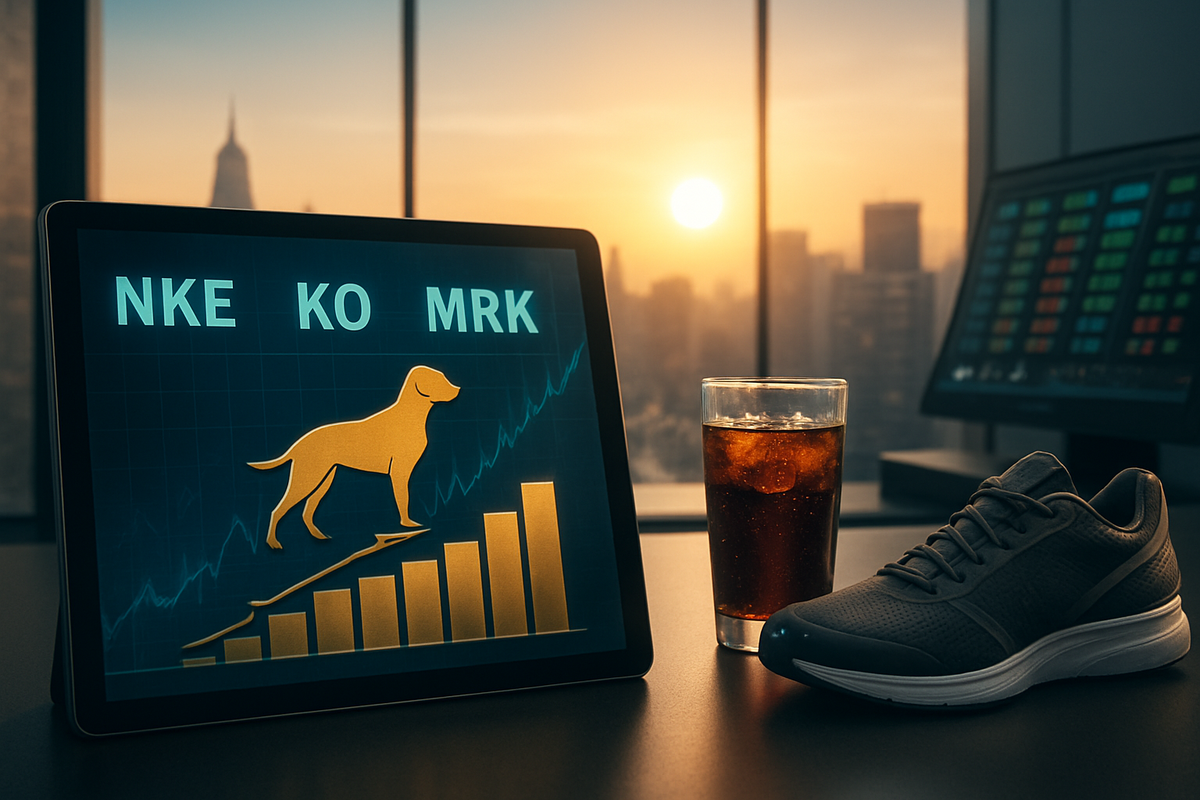
While the traditional strategy involves buying all ten, a more concentrated "4-stock play" has emerged as a favorite among tactical strategists for 2026. This variation, often called the "Smarter Puppies" play, focuses on the lowest-priced stocks among the Dogs but excludes the absolute highest yielder if it is also the lowest-priced—a move designed to avoid potential "value traps" like Verizon, which has struggled with debt and stagnant growth. For 2026, this concentrated play identifies Nike, Coca-Cola, Merck, and Procter & Gamble as the four stocks most likely to lead a value-driven recovery. This timeline of selection occurs every December 25th to 31st, as investors rebalance portfolios to capture the "January Effect" and set their yield-based foundations for the year ahead.
The Winners' Circle: Deep Dives into the Top 4
The 2026 "Top 4" play is not just a statistical anomaly; it is backed by significant corporate catalysts. Nike (NYSE: NKE) is perhaps the most compelling turnaround story in the group. After a multi-year slump in innovation, 2026 is slated to be Nike's "resurgence year" under CEO Elliott Hill. The company is timing its new product cycles, including the "Aero-FIT" cooling technology, to coincide with the 2026 FIFA World Cup and the Winter Olympics. By moving back toward wholesale partnerships, Nike is expected to reclaim lost market share from niche competitors, making its current low valuation a potential entry point for a massive rebound.
Coca-Cola (NYSE: KO) and Procter & Gamble (NYSE: PG) represent the defensive backbone of the strategy. Coca-Cola is entering a major leadership transition as Henrique Braun prepares to take the helm in March 2026, while the company leverages its sponsorship of the "America250" U.S. Semiquincentennial celebrations to drive domestic volume. Meanwhile, P&G is in the midst of a massive $1.5 billion cost-saving restructuring plan aimed at streamlining its supply chain and returning $15 billion to shareholders via dividends and buybacks in 2026. Finally, Merck & Co. (NYSE: MRK) offers a pharmaceutical hedge, with its new drug Winrevair expected to reach blockbuster status early in the year, offsetting concerns about the eventual patent cliff of its flagship cancer drug, Keytruda.
Broadening Horizons: The Great Rotation of 2026
The wider significance of the Dogs of the Dow strategy in 2026 lies in the macro-economic shift from growth to value. For the past three years, the "S&P 493"—the stocks in the S&P 500 excluding the seven largest tech names—have largely underperformed. However, analysts at firms like J.P. Morgan and Morgan Stanley are forecasting that earnings growth for these 493 companies will accelerate to roughly 9% in 2026, finally narrowing the gap with the tech sector. This "broadening out" is a healthy sign for the market, suggesting that the rally is no longer dependent on a handful of AI-related names.
Furthermore, the historical precedent for this strategy is strong. In years following a period of extreme growth concentration (similar to the 1999 Dot-com bubble or the 2021 post-COVID surge), value-oriented strategies like the Dogs of the Dow have historically outperformed. With a 35% probability of a "soft landing" recession being priced in by some economists for late 2026, the shift into "Real Economy" sectors—staples, healthcare, and energy—reflects a move toward quality and cash flow. This trend could force a re-evaluation of portfolio risk, as investors move away from speculative "growth at any price" and return to the "yield at a reasonable price" model.
What Comes Next: Risks and Strategic Pivots
Looking ahead to the first half of 2026, the primary challenge for the Dogs of the Dow strategy will be the trajectory of the Federal Reserve. If inflation remains stickier than expected and the Fed is forced to keep rates "higher for longer," the dividend yields of these blue-chip stocks may face competition from risk-free Treasury bills. However, the current consensus points toward a "neutral" rate by mid-2026, which would traditionally act as a tailwind for high-dividend payers. Investors should watch for the Q1 2026 earnings reports of Nike and Merck as the first true tests of whether these "Dogs" have the operational teeth to match their high yields.
In the long term, the success of the 4-stock play depends on these companies' ability to adapt to a post-AI-hype world. While they are "Old Economy" stocks, their adoption of AI for supply chain efficiency (as seen in P&G’s restructuring) and drug discovery (Merck’s pipeline) will be critical. A potential strategic pivot for investors might be required if the energy sector faces a sharper-than-expected downturn, which would impact the "Dog" status of Chevron. For now, the "Puppies" of the Dow represent a calculated bet on a return to normalcy and fundamental valuation.
Final Thoughts for the 2026 Investor
The Dogs of the Dow strategy for 2026 is more than just a dividend play; it is a statement of faith in the resilience of the American corporate giants. By focusing on the Top 4—Nike, Coca-Cola, Merck, and Procter & Gamble—investors are positioning themselves in companies that are not only yielding high dividends but are also undergoing significant internal transformations. The key takeaway for the coming months is that the market's "center of gravity" is shifting. The era of tech-only gains is being replaced by a more nuanced, diversified landscape where valuation once again matters.
As we move into 2026, investors should keep a close eye on consumer spending data and corporate margin expansion. If the "Dogs" can deliver on their projected earnings growth, they will likely provide both capital appreciation and a steady income stream, outperforming a broader market that may struggle with high valuations. For those looking to simplify their approach in an increasingly complex financial world, the "Dogs" are barking a clear message: sometimes, the best opportunities are the ones that have been hiding in plain sight.
This content is intended for informational purposes only and is not financial advice.