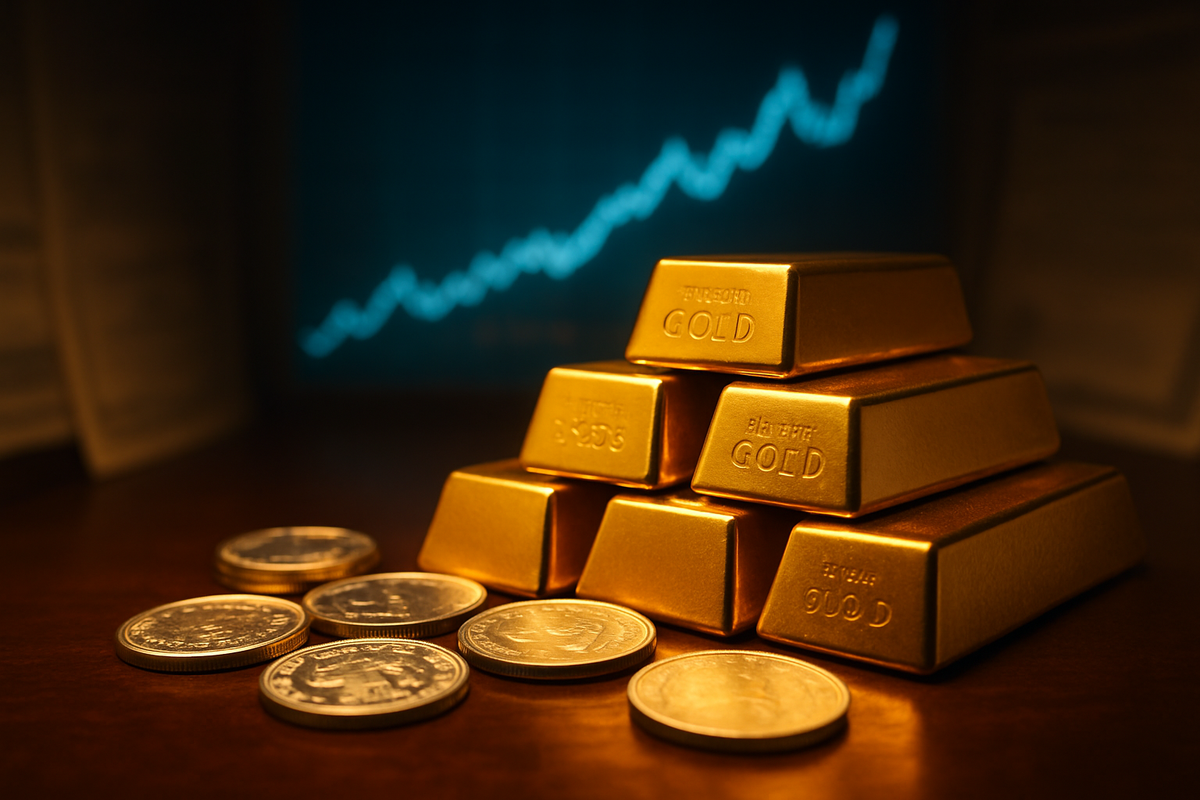
As 2025 draws to a close, a seismic shift is rattling global financial markets. Investors are aggressively rotating capital out of traditional equities and fixed-income bonds, funneling record-breaking sums into precious metals. This "flight to safety" has propelled gold and silver to unprecedented heights, with gold stabilizing above $4,500 per ounce and silver touching a historic $75 per ounce. The movement marks a fundamental transition in market sentiment, as the year-end "Santa Claus rally" in stocks is being overshadowed by a desperate search for tangible security amidst fiscal uncertainty.
The implications of this capital migration are profound. While the S&P 500 has maintained a fragile proximity to its all-time highs, the underlying breadth of the market is thinning. Institutional desks and retail traders alike are signaling a "vote of no confidence" in fiat-backed assets, driven by a ballooning U.S. national debt and a cooling but volatile geopolitical climate. This surge in demand for "hard money" is not merely a temporary hedge but appears to be a structural realignment of the global financial order as we head into 2026.
A Year of Record-Breaking Ascents
The timeline leading to this December peak began in early 2025, as the Federal Reserve initiated a series of three interest rate cuts, eventually lowering the federal funds rate to a range of 3.50%–3.75%. These cuts effectively lowered the opportunity cost of holding non-yielding assets, providing the initial spark for the gold rally. However, the momentum shifted into overdrive during the second half of the year as the "debasement trade" took center stage. Concerns over the U.S. debt-to-GDP ratio and persistent fiscal deficits led to a historic weakening of the U.S. Dollar, which fell roughly 12% against a basket of major currencies in 2025.
By the fourth quarter, the market faced a "perfect storm" of geopolitical and economic catalysts. The implementation of aggressive new trade tariffs and maritime enforcement actions in South America created a high-stakes environment for global trade. Simultaneously, central banks—the "silent architects" of this bull market—continued their relentless accumulation. Led by the People’s Bank of China and the National Bank of Poland, global central bank net purchases exceeded 1,000 tonnes for the fourth consecutive year, providing a rock-solid floor for prices and signaling to private investors that the era of "gold as the ultimate reserve" had returned.
The reaction in the silver market was even more explosive. Silver emerged as the top-performing commodity of 2025, surging over 150% year-to-date. This "silver squeeze" was fueled by a chronic structural supply deficit and a massive spike in industrial demand. As the world leaned into the "Green & Digital" transition, silver became indispensable for high-frequency AI data centers and solar energy infrastructure, leading to a decoupling of silver from its traditional role as gold’s "little brother" and establishing it as a critical strategic industrial metal.
Winners and Losers in the Metal Supercycle
The primary beneficiaries of this price explosion have been the major mining conglomerates, which have seen their profit margins expand at a dizzying pace. Newmont (NYSE: NEM), the world’s largest gold producer, has transformed into a cash-flow powerhouse. By late December 2025, Newmont’s stock was trading near $105 per share, a staggering 140% gain for the year. Despite strategic asset sales that slightly lowered its total production volume, the record-high spot prices allowed the company to report historic profitability and return significant capital to shareholders through dividends and buybacks.
Similarly, Barrick Gold (NYSE: GOLD) saw its stock price double over the course of 2025. Leveraging its "Tier One" assets in Nevada and Africa, Barrick reported quarterly free cash flow exceeding $1.3 billion in the final months of the year. Agnico Eagle Mines (NYSE: AEM) also stood out, with gains exceeding 60%, as its best-in-class cost control measures allowed it to capture nearly the full upside of the price surge. The sector also witnessed a wave of consolidation as companies sought to secure future reserves, highlighted by Gold Fields (NYSE: GFI) and its multi-billion dollar acquisition activity.
Conversely, the losers in this environment include traditional bondholders and companies heavily reliant on silver for manufacturing without adequate hedging. Manufacturers in the solar and electric vehicle sectors, such as those integrated with First Majestic Silver (NYSE: AG) or Gatos Silver (NYSE: GATO) for supply, have faced mounting cost pressures. While the miners win, the end-users of these metals are seeing their input costs skyrocket, potentially leading to inflationary pressure on green technology products in 2026.
A Structural Shift in Global Finance
The wider significance of this event lies in the shifting "barbell strategy" of modern portfolio management. In 2025, investors stopped viewing gold and technology as mutually exclusive. Instead, a new trend emerged where portfolios are heavily weighted in high-growth AI-driven tech stocks on one end and "hard assets" like gold and silver on the other. This strategy reflects a deep-seated fear of a "middle ground" failure, where traditional diversified 60/40 portfolios (stocks/bonds) fail to protect against systemic currency devaluation.
Furthermore, the trend of "de-dollarization" has moved from a fringe theory to a central market driver. Emerging markets are increasingly viewing gold as a "sanction-resistant" asset, a sentiment reinforced by the geopolitical tensions involving Israel, Iran, and Venezuela throughout the year. This shift has historical precedents, drawing comparisons to the stagflationary 1970s, yet it is modernized by the digital age's ability to move capital instantly. The ripple effects are being felt in the currency markets, where the dollar's status as the undisputed global anchor is being tested by a world that increasingly values "tangible" over "digital" or "paper" promises.
The regulatory implications are also beginning to surface. As gold and silver prices soar, there is growing talk in Washington and Brussels about new windfall taxes on mining profits or strategic stockpiling mandates for industrial metals. For competitors in the fintech space, the underperformance of "digital gold" (cryptocurrencies) relative to physical bullion in 2025 has led to a rotation of capital back into regulated, physically-backed ETFs, which saw inflows exceeding $45 billion this year.
The Road to 2026: Stability or Further Squeeze?
Looking ahead, the short-term outlook remains bullish for precious metals. Many analysts at firms like J.P. Morgan and Goldman Sachs have already revised their 2026 gold targets toward the $5,000 to $6,000 range. The primary challenge for the market will be whether mining supply can even begin to meet the voracious appetite of both central banks and industrial users. If the supply deficit in silver persists, we may see strategic pivots from tech giants who may look to invest directly in mining operations to secure their supply chains, much like the automotive industry did with lithium years ago.
Potential scenarios for early 2026 include a period of consolidation where prices stabilize after the vertical run-up of late 2025. However, any further escalation in global trade wars or a failure to address the U.S. fiscal trajectory could provide the fuel for another leg up. Investors should watch for the Federal Reserve’s first meeting of 2026; if the central bank signals a pause in rate cuts or a return to "higher for longer" to combat the inflationary effects of high metal prices, the safe-haven rally could face its first major test.
Final Reflections on the Year of Hard Assets
The end of 2025 will be remembered as the moment the "Safe Haven" trade became the "Dominant" trade. The flight to gold and silver is a clear signal that the market is prioritizing capital preservation and intrinsic value over speculative growth as the global economic landscape becomes increasingly fragmented. The staggering performance of companies like Newmont (NYSE: NEM) and Barrick Gold (NYSE: GOLD) underscores the revitalization of a sector that was once considered a relic of the past.
As we move into the new year, the key takeaway for investors is the necessity of a diversified approach that accounts for systemic risk. The "Great Rotation" is more than just a seasonal trend; it is a reflection of a world in transition. Moving forward, the relationship between the U.S. Dollar, national debt, and precious metals will be the most critical metric for any serious market participant to monitor. For now, the "gold standard" of investing has returned, and it is shining brighter than it has in decades.
This content is intended for informational purposes only and is not financial advice.