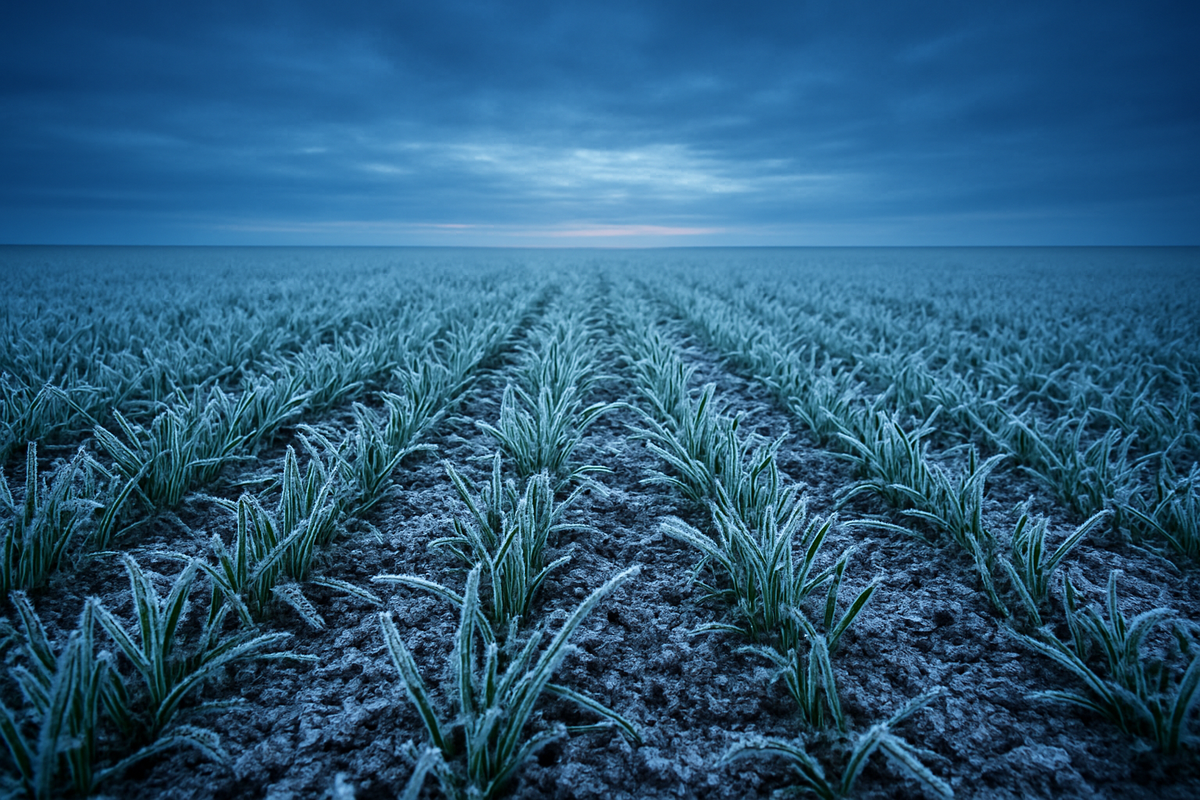
As of January 23, 2026, the global agricultural markets are facing a sudden and chilling reality. Chicago Soft Red Winter (SRW) wheat futures have experienced a sharp reversal from their recent lows, trading up approximately 1.5% to 1.6% to reach levels over 515 cents per bushel. This bullish momentum follows a period of heavy downward pressure and is primarily driven by a severe arctic blast sweeping across critical growing regions in the Northern Hemisphere. Investors and agronomists alike are sounding the alarm over "winterkill," a phenomenon where dormant wheat plants perish due to extreme temperatures, especially in areas lacking the protective insulation of snow cover.
The immediate implications are a tightening of what had previously been a very comfortable global supply cushion. While the United States Department of Agriculture (USDA) had projected record ending stocks earlier this month, the sudden arrival of "Winter Storm Fern" in the U.S. and bone-chilling freezes in the Black Sea region have introduced a significant "weather premium" into grain pricing. For a market that was largely complacent about supply, the threat of widespread crop stress has forced a rapid reassessment of 2026 production forecasts, sending ripples through the commodities exchanges in Chicago and Paris.
Detailed Event Coverage: The 2026 Arctic Surge
The rally in wheat prices began in earnest during the third week of January, following a multi-year low of 511 cents per bushel on January 12. The catalyst was a massive shift in weather patterns that brought the coldest air of the decade to the U.S. Great Plains and Midwest. In states like Minnesota and Wisconsin, wind chills plummeted to -55°F, while the critical wheat-growing corridors of northern Illinois and Iowa saw temperatures reach -35°F. The primary concern for the agricultural community is the lack of "snow blankets" in the Central and Southern Plains. Without this layer of insulation, the dormant winter wheat is directly exposed to the freezing air, significantly increasing the risk of plant death.
Simultaneously, the situation in the Black Sea—a global powerhouse for wheat exports—has grown increasingly dire. Russia’s Volga and Central Districts have been hit by temperatures ranging between -25°C and -30°C (-13°F to -22°F). Market analysts have highlighted the Rostov region as being particularly vulnerable; like the U.S. Hard Red Winter belt, much of this area is currently "exposed," meaning any prolonged freeze could decimate the 2026 harvest potential. The timeline of this price spike coincided with aggressive short-covering by hedge funds and renewed buying interest from major importers like Mexico and the Philippines, who moved to secure supplies before prices could climb further.
The initial market reaction has been swift. Traders who were heavily positioned "short"—betting on continued price declines due to high global stocks—were caught off guard by the severity of the cold. This led to a "stoic" but firm recovery in the 515-cent range for Chicago SRW futures. The industry is now in a "wait-and-see" mode, as the true extent of winterkill damage cannot fully be assessed until the spring thaw when the wheat crops emerge from dormancy.
Winners and Losers: Corporate Fallout of the Cold Snap
The volatility in the wheat market is creating a clear divide between winners and losers across the agribusiness sector. Bunge Global SA (NYSE: BG) has emerged as a significant winner in this environment. As a "logistical titan," Bunge has leveraged its recent integration of Viterra to navigate the volatility in the Black Sea and North America effectively. The company's stock reached a 52-week high of $106.05 in mid-January, as investors recognized its ability to capture higher margins during periods of supply chain uncertainty and price fluctuations. Similarly, fertilizer giants like Nutrien (NYSE: NTR) and CF Industries (NYSE: CF) are seeing a "bullish flip." Nutrien’s stock recently hit a 52-week high above $91, as farmers are expected to increase nutrient applications to salvage and strengthen any crops that survive the winter stress.
Conversely, Archer-Daniels-Midland (NYSE: ADM) is facing a more difficult landscape. Squeezed by lower oilseed crush margins and the logistical burden of managing previous surpluses, ADM has had to implement a $750 million cost-cutting initiative. The sudden rise in wheat prices adds another layer of complexity to their grain processing segments, which were already struggling with tightening margins. Equipment manufacturers like Deere & Co (NYSE: DE) are also feeling the chill. Deere recently issued an underwhelming outlook for fiscal 2026, projecting net income well below analyst estimates. The company noted that 2026 could represent the "bottom of the large ag cycle," as subdued farm cash flows and rising input costs discourage farmers from investing in new, high-end machinery.
Food processing giants are also on the defensive. General Mills (NYSE: GIS) and Kraft Heinz (NYSE: KHC) are navigating a "price cliff," where they are under pressure to lower retail prices to compete with private labels even as their own input costs, like wheat, begin to tick back up. General Mills recently reported a significant drop in operating profit, while Kraft Heinz was downgraded by major analysts who cited the risk of intensifying price wars. For these companies, a sustained rise in wheat futures represents a direct threat to their margin recovery efforts in an already sensitive consumer market.
Wider Significance: Industry Trends and Ripple Effects
This weather-driven rally fits into a broader industry trend of "extreme volatility as the new normal." While 2025 was characterized by a "paradox of plenty" with record-shattering global supplies, the events of January 2026 demonstrate how quickly a surplus can be threatened by climate instability. This event serves as a reminder that global food security remains highly sensitive to localized weather shocks, even in years of high production. The ripple effects are already being felt by international competitors; as U.S. and Russian prospects dim, exporters in Argentina and Australia may find themselves in a stronger bargaining position, potentially shifting the geopolitical balance of the grain trade for the coming year.
From a regulatory and policy perspective, the "winterkill" scare may reignite discussions around subsidized crop insurance and emergency relief funds. If the damage proves extensive, governments in Washington and Moscow may be forced to intervene to stabilize domestic food prices. Historically, this situation draws parallels to the "Great Grain Robbery" of the 1970s or the 2012 drought, where sudden supply shocks led to massive global price corrections. However, unlike those eras, the current market is equipped with more sophisticated "precision agriculture" tools, which may mitigate some of the damage through targeted intervention and better data.
Future Outlook: Strategic Pivots and Scenarios
In the short term, the market will remain hyper-focused on weather maps and snow cover depth. If a second arctic wave hits without preceding snowfall, the 515-cent floor for Chicago wheat could quickly become a launchpad for a rally toward 550 or 600 cents. Long-term, agricultural companies will likely accelerate their strategic pivots toward climate-resilient technology. We can expect to see increased investment in "autonomous-ready" equipment from firms like Deere & Co, as farmers seek to maximize efficiency in a high-stakes environment where every bushel counts.
Market opportunities will likely emerge in the "precision upgrade" space. As farmers deal with damaged crops, the demand for specialized fertilizers and biologicals that can stimulate plant recovery will likely surge, benefiting companies like Nutrien. Conversely, the challenge for food processors will be to find "remarkability" in their products—innovating enough to justify higher prices to a consumer base that is increasingly "tapped out" by years of inflation. The ultimate scenario will depend on the "green-up" in March and April; if the wheat wakes up and the damage is minimal, the current rally may prove to be a short-lived technical correction in a bear market.
Market Wrap-Up: Key Takeaways for Investors
The January 2026 wheat rally serves as a potent reminder that the "ag cycle" is never truly predictable. Key takeaways include the resilience of logistical giants like Bunge, the vulnerability of food processors to input spikes, and the enduring power of weather to override even the most bearish fundamental data. As the market moves forward, the "tug-of-war" between record global ending stocks and immediate production risks will continue to define price action.
Investors should closely monitor the USDA's upcoming spring reports and keep a keen eye on the "condition ratings" for the U.S. winter wheat crop. Furthermore, the performance of the fertilizer sector—specifically the stock prices of Nutrien and CF Industries—will act as a bellwether for how much stress the farming community expects to manage. While the surplus of 2025 provided a safety net, the frost of 2026 has shown that the net is thinner than many had hoped.
This content is intended for informational purposes only and is not financial advice.