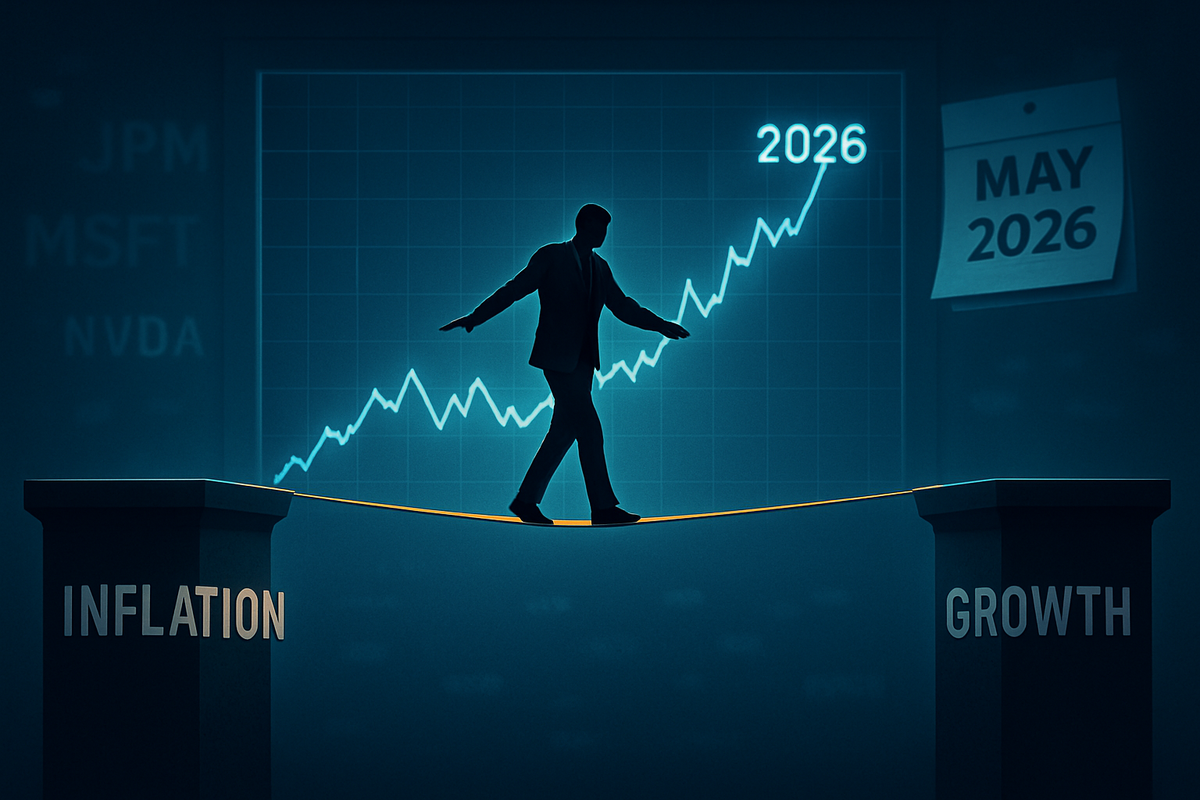
As the sun rises on 2026, the financial world finds itself at a delicate crossroads. Following a year of tentative easing and a surprisingly resilient labor market, the Federal Reserve has signaled that the path to "neutral" interest rates will be far more arduous and gradual than many had hoped. With the federal funds rate currently sitting at a target range of 3.50%–3.75% after a final 25-basis-point cut in December 2025, investors are grappling with a "slow-cut" regime that prioritizes extinguishing the final embers of sticky inflation over aggressive economic stimulus.
The immediate implications are clear: the era of ultra-low rates is not returning anytime soon. As of January 6, 2026, market participants are pricing in a high probability of a pause at the upcoming January meeting, with the eyes of the world fixed on the first half of the year. The looming expiration of Chair Jerome Powell’s term in May 2026 has added a layer of political and institutional uncertainty, effectively creating a "policy pause" as the administration deliberates on the next steward of the world’s most powerful central bank.
A Divided Committee and the December 'Dot Plot'
The final Federal Open Market Committee (FOMC) meeting of 2025, held on December 10, was marked by an unusual level of internal discord. While the committee ultimately agreed to a 25-basis-point reduction, the accompanying Summary of Economic Projections (SEP) revealed a deeply fractured "dot plot." The median forecast for the end of 2026 now stands at 3.4%, suggesting that the Fed anticipates only one additional rate cut for the entire upcoming year. This hawkish tilt surprised many who expected a more aggressive pivot toward 3%.
The timeline leading to this moment was defined by a 2025 "soft landing" that proved almost too successful. Throughout the past year, the U.S. economy defied recessionary fears, with real GDP growth for 2026 now projected at a robust 2.3%. However, this resilience came with a cost: Core PCE inflation has remained stubbornly parked at 2.5%, refusing to descend to the Fed's 2% target. Key players like Chicago Fed President Austen Goolsbee and Kansas City’s Jeffrey Schmid emerged as the primary "hawks" during the December meeting, voting for a hold and citing the risks of reigniting price pressures through premature easing. Conversely, new appointee Stephen Miran emerged as a vocal dove, dissenting in favor of a 50-basis-point cut to prevent a "cracking" labor market.
Winners and Losers in a 'Higher-for-Neutral' World
In this environment of high-but-stable rates, the market is bifurcating into distinct groups of winners and losers. Financial giants like JPMorgan Chase & Co. (NYSE: JPM) and Bank of America (NYSE: BAC) are emerging as primary beneficiaries. These institutions are successfully maintaining healthy Net Interest Margins (NIM) as they keep deposit costs relatively low while benefiting from higher yields on their loan portfolios. Analysts at Goldman Sachs (NYSE: GS) have noted that the "slow-cut" environment allows these "fortress" banks to avoid the margin compression that typically follows rapid rate collapses.
Conversely, the "losers" are found in sectors where debt remains a heavy burden. Smaller regional banks like KeyCorp (NYSE: KEY) continue to struggle with high funding costs and depressed values in their long-dated bond portfolios. In the technology sector, the divide is equally sharp. "Quality growth" titans with massive cash reserves, such as Microsoft Corp. (NASDAQ: MSFT) and Alphabet Inc. (NASDAQ: GOOGL) are winning as their balance sheets act as a natural hedge. However, capital-intensive firms like Intel Corp. (NASDAQ: INTC) find themselves squeezed by the high cost of financing massive foundry expansions. Meanwhile, in the housing market, the "6% mortgage floor" remains a significant headwind for homebuilders like D.R. Horton (NYSE: DHI), who are seeing demand cool as buyers wait for a more meaningful drop in borrowing costs.
The 'Powell Transition' and Wider Economic Significance
The broader significance of the current Fed outlook cannot be overstated, as it coincides with a historic leadership transition. Jerome Powell’s term expires on May 15, 2026, and the search for his successor is already injecting volatility into the Treasury markets. Historically, the Fed tends to avoid major policy shifts during a leadership change to maintain institutional stability. This "lame duck" period suggests that the first half of 2026 will likely see a series of pauses or very cautious moves, regardless of the economic data.
This event fits into a broader trend of "fiscal-monetary tension." While the Fed is attempting to cool the economy, fiscal policy remains expansionary, with ongoing government spending and potential tariff-related inflationary pressures keeping bond yields elevated. The 10-year Treasury yield is forecasted to remain between 4.00% and 4.25% through much of 2026, a far cry from the sub-2% levels seen in the previous decade. This suggests a permanent shift in the "neutral rate," or R-star, indicating that the global economy may have moved into a new era of higher capital costs and structural inflation.
What Comes Next: The 2026 Roadmap
Looking ahead to the first half of 2026, the market is bracing for a "wait-and-see" first quarter. According to the CME Group (NASDAQ: CME) FedWatch Tool, there is an 80% probability that the Fed will hold rates steady at its January meeting. The real action is expected in the second quarter. If inflation data for February and March shows a definitive move toward 2%, a 25-basis-point cut in April or June becomes the base case. However, any signs of a "re-acceleration" in prices could force the Fed to pause through the entirety of the first half of the year.
Strategic pivots will be required for both corporations and investors. We are likely to see an "AI monetization" phase, where companies like Nvidia Corp. (NASDAQ: NVDA) must prove that their productivity gains can offset higher interest expenses. For the public, the "K-shaped" recovery remains a risk; while wealthy households benefit from high asset prices and interest income, lower-income consumers continue to face the brunt of high credit card and mortgage rates.
Summary and Investor Outlook
The Federal Reserve's 2026 outlook is one of cautious normalization in the face of persistent structural challenges. The key takeaways for the start of this year are the slowing pace of rate cuts, the upward revision of GDP growth, and the looming shadow of the Powell transition. While the Fed's median projection suggests only one more cut this year, market participants remain slightly more optimistic, betting on two reductions by December.
Moving forward, the market will likely be driven by "data-dependency" in its purest form. Investors should keep a close watch on Core PCE releases and the monthly "JOLTS" labor reports for any signs of cooling that could trigger an earlier-than-expected cut. The search for a new Fed Chair will also be a major catalyst; a hawkish appointment could send yields soaring, while a more dovish choice might finally provide the relief the housing and small-cap sectors have been desperate for. For now, the mantra for 2026 is clear: patience is not just a virtue, but a necessity.
This content is intended for informational purposes only and is not financial advice.