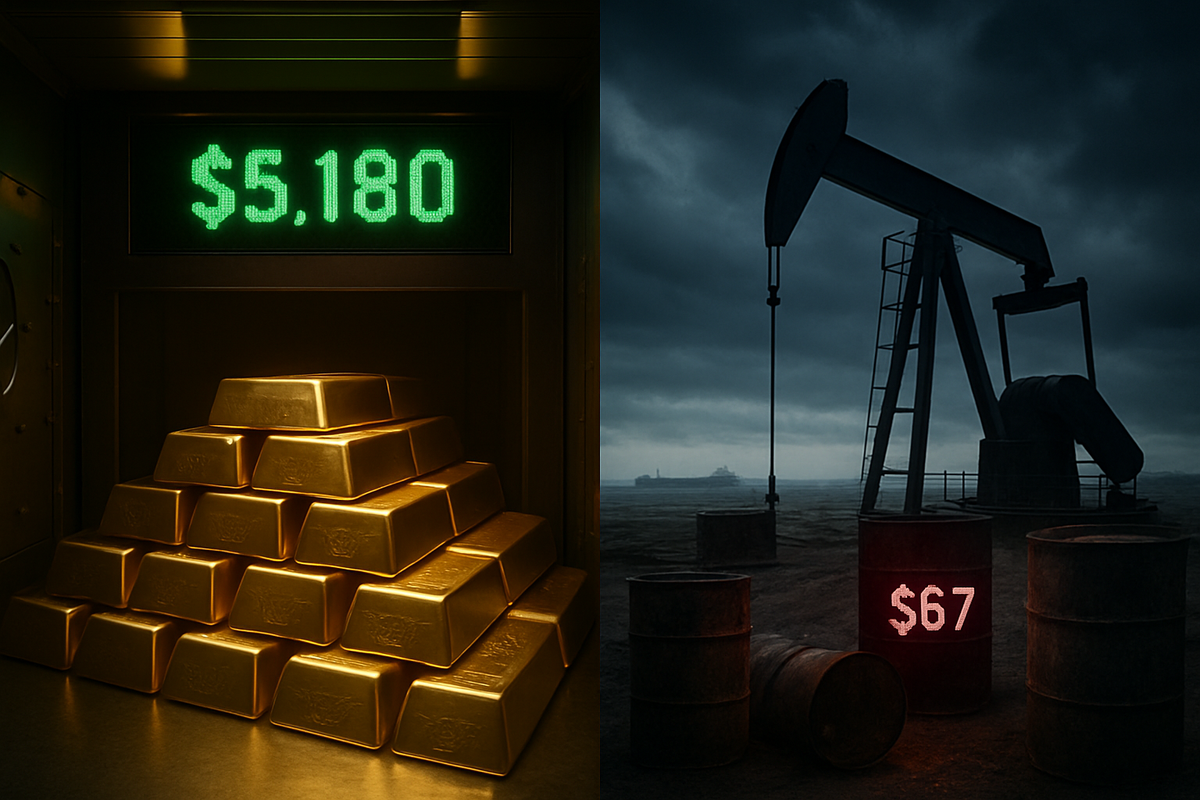
NEW YORK — In a historic divergence of the commodities market, gold futures have surged past the $5,180 mark this morning, February 24, 2026, as investors flee to the ultimate safe haven amid escalating global trade tensions. Meanwhile, West Texas Intermediate (WTI) crude remains mired in volatility, struggling to maintain its footing near $67 per barrel as a massive supply glut and slowing industrial demand weigh heavily on energy markets.
This widening gap represents a "perfect storm" of geopolitical and macroeconomic factors. While the "yellow metal" is being revalued as a stateless insurance policy against systemic risk, oil is increasingly viewed as a casualty of a cooling global economy and a transition toward a less carbon-intensive future. The decoupling marks a significant departure from historical trends where both commodities often moved in tandem during periods of dollar weakness or high inflation.
The Path to $5,180: A Timeline of Fragility
The current market environment is the culmination of a two-year shift in global trade policy. The primary catalyst for today's price action was the implementation of a universal 15% tariff policy by the United States earlier this year, which triggered a wave of retaliatory measures from the European Union and China. This "trade isolationism" has crippled international shipping and manufacturing, causing investors to seek refuge in assets that carry no counterparty risk.
Leading up to this moment, central banks—most notably in emerging markets—have been aggressively diversifying their reserves away from the U.S. dollar. By the start of 2026, central bank gold purchases reached an all-time high, accounting for nearly 30% of global annual production. This institutional demand, coupled with a surge in gold-backed ETF inflows, has created a supply-demand imbalance that forced gold prices into uncharted territory above $5,000.
In contrast, the oil market has been overwhelmed by the "Supply Wave of 2025." Massive production increases from non-OPEC nations, including the U.S., Guyana, and Brazil, have finally hit the market just as global demand growth has begun to plateau. The result is a persistent inventory build that has kept WTI crude capped in the $65–$70 range, despite the inflationary pressures that usually drive commodity prices higher.
Winners and Losers in the New Commodity Era
The divergence has created a stark divide within the S&P 500, with precious metals miners emerging as the undisputed winners. Newmont (NYSE: NEM) has seen its profit margins expand to record levels near 70%, even as it manages rising labor and equipment costs. With gold at $5,180, Newmont’s free cash flow generation has allowed it to significantly hike its dividend and pursue aggressive share buybacks, making it a darling of institutional portfolios. Similarly, Barrick Gold (NYSE: GOLD) has leveraged its "Tier One" assets to capitalize on the price surge, utilizing advanced AI exploration tools to lower its all-in sustaining costs (AISC) relative to the broader market.
On the other side of the ledger, energy giants are being forced into a defensive posture. ExxonMobil (NYSE: XOM), while still profitable due to its low-cost operations in the Permian Basin and Guyana, has faced stagnant revenue growth as the $67 oil environment limits its upside. The company recently announced a workforce reduction of over 2,000 positions to preserve capital and maintain its dividend commitment in a "lower-for-longer" price scenario.
Chevron (NYSE: CVX) has fared slightly better by pivoting its portfolio toward natural gas and LNG, which have decoupled from the crude oil slump. However, the company’s stock remains under pressure as investors move capital out of cyclical energy stocks and into "defensive growth" sectors. For the oil majors, the challenge is no longer about finding more oil, but about maintaining relevance in a world where trade barriers and the electric vehicle transition are structural headwinds to demand.
Analyzing the Wider Significance: A Break from Tradition
The divergence between gold and oil is more than just a pricing anomaly; it is a signal of a fundamental shift in the global economic order. Historically, high gold prices were often accompanied by high oil prices, as both served as hedges against a falling dollar. In 2026, however, gold is responding to "systemic fragility"—the fear that the global financial system is becoming too fractured to support traditional fiat currencies.
This event fits into a broader trend of "de-dollarization" and the "weaponization of trade." As nations use tariffs and sanctions as primary foreign policy tools, the global supply chain becomes less efficient, which is inflationary for goods but deflationary for the energy needed to move those goods. Furthermore, the rise of renewable energy and EVs in China has begun to erode the "marginal barrel" of oil demand, meaning that even a geopolitical crisis in the Middle East no longer triggers the same explosive price rallies seen in decades past.
Regulatory shifts are also playing a role. Stricter ESG mandates and carbon taxes in Europe have increased the cost of traditional energy production, while simultaneously making gold—a finite, durable asset—more attractive to "impact-conscious" institutional investors looking for a store of value that doesn't rely on the carbon cycle.
Looking Ahead: Pivots and Scenarios
In the short term, analysts expect gold to remain elevated as long as trade tensions persist. However, the $5,200 level will likely act as a psychological resistance point, potentially leading to a period of consolidation. For the mining sector, the next challenge will be managing political risk, as governments in resource-rich nations may look to implement "windfall taxes" on the massive profits being generated by the likes of Newmont and Barrick Gold.
For the energy sector, the road ahead is one of consolidation and cost-discipline. We may see a new wave of mergers and acquisitions as larger players like ExxonMobil and Chevron look to acquire smaller, high-efficiency producers to lower their average breakeven costs. The potential for a "hard landing" in the global economy remains the biggest downside risk for oil; if a full-scale global recession takes hold due to trade wars, WTI could potentially test the $50 level.
The Wrap-Up: Investors Watch for a New Floor
The events of February 24, 2026, serve as a stark reminder that the old rules of commodity trading are being rewritten. Gold’s ascent to $5,180 is a vote of no confidence in global stability, while oil’s stagnation at $67 is a reflection of a world that is oversupplied and increasingly fragmented.
For investors, the key takeaway is the importance of distinguishing between "monetary assets" and "industrial commodities." Moving forward, the market will be watching the Federal Reserve closely; if the central bank begins to cut rates to offset the damage from trade tariffs, gold could see yet another leg up. Conversely, any de-escalation in trade rhetoric could provide the relief needed for oil to re-sync with the broader commodity complex. For now, however, the "Great Decoupling" remains the defining story of the 2026 financial markets.
This content is intended for informational purposes only and is not financial advice.