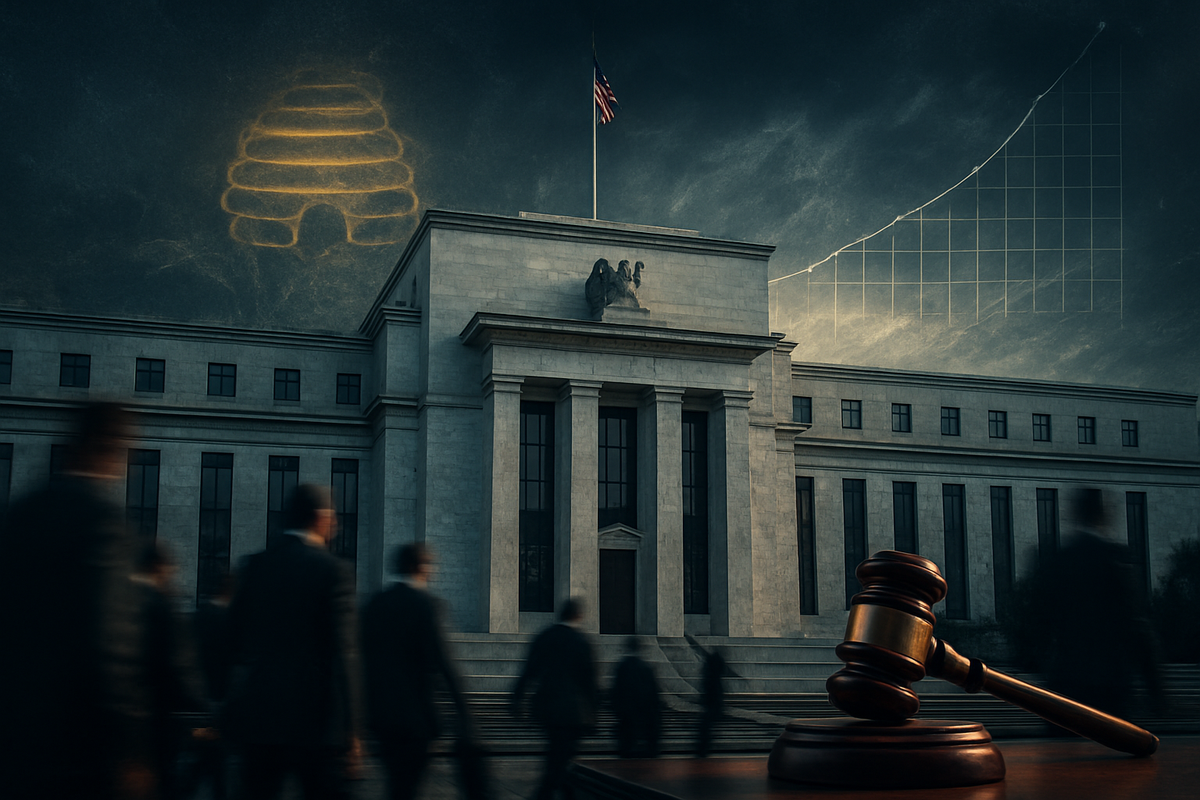
The nomination of Kevin Warsh to lead the Federal Reserve has ignited a firestorm in Washington, pitting the White House against a group of determined Republican senators and paralyzing the world’s most powerful central bank. As of February 6, 2026, the transition of power at the Fed—intended by President Donald Trump to be a swift "regime change"—has instead ground to a halt. The blockade, led by Senator Thom Tillis (R-NC), is not just a procedural hiccup; it is a fundamental challenge to the political independence of the monetary system, occurring while the sitting Chair, Jerome Powell, faces an unprecedented Department of Justice investigation over "lavish" renovations at the Fed’s headquarters.
The immediate implications for the market are profound. While the prospect of a Warsh-led Fed initially sent shockwaves through the precious metals and cryptocurrency markets, the current political deadlock has introduced a "volatility premium" into U.S. Treasury yields. Investors are now forced to navigate a landscape where the "hawkish dove" philosophy of Kevin Warsh—a strategy of cutting interest rates while aggressively shrinking the Fed’s massive balance sheet—remains in limbo, leaving the trajectory of the U.S. economy and the stability of the dollar hanging in the balance.
The Marble and Beehives Scandal: A Nomination Paralyzed
The path to Kevin Warsh’s nomination was paved with tension. On January 30, 2026, President Trump officially tapped Warsh to succeed Jerome Powell, whose term is set to expire in May. However, the announcement was immediately met with a wall of opposition from Senator Thom Tillis, who has effectively shuttered the Senate Banking Committee's confirmation process. Tillis’s "blockade" is a principled stand against what he characterizes as the "weaponization" of the DOJ. The department, under U.S. Attorney Jeanine Pirro, is currently investigating Powell for allegedly misleading Congress regarding a $2.5 billion renovation of the Marriner S. Eccles Building—a project critics claim included "extravagant" features such as rooftop gardens and beehives.
Tillis has made it clear: he will not vote for any Fed nominee until the "frivolous" probe into Powell is closed. With a razor-thin 13-11 Republican majority on the Banking Committee, Tillis’s refusal to participate creates a 12-12 deadlock, preventing Warsh’s name from reaching the Senate floor. This political drama follows a decade-high volatility event on the day of the nomination, when gold prices plummeted 10% and silver crashed nearly 27%, as traders anticipated Warsh would pivot away from the inflationary "debasement" hedges that characterized the Powell era.
Winners and Losers: Banking Giants vs. Tech Titans
A transition to Warsh would represent a seismic shift in the "yield curve" dynamics of the U.S. market. The biggest winners in a Warsh-led economy appear to be the nation’s largest commercial lenders. JPMorgan Chase & Co. (NYSE: JPM) and Bank of America Corp. (NYSE: BAC) are poised to benefit from a "bear steepener" on the yield curve. Warsh’s preference for lower short-term rates, combined with a refusal to suppress long-term rates through balance sheet expansion, would widen Net Interest Margins (NIM), allowing these banks to borrow cheaply and lend at higher rates. Analysts at Loop Capital have already signaled bullish targets for JPM, citing the potential for a deregulation wave under a Warsh chairmanship.
Conversely, the "losers" list is topped by high-valuation technology firms and precious metals miners. NVIDIA Corp. (NASDAQ: NVDA), the poster child of the AI revolution, faces significant valuation headwinds as long-term Treasury yields climb. As the 10-year yield spiked to 4.28% following the nomination news, the "discount rate" applied to future tech earnings rose, causing a re-valuation of growth stocks. Similarly, gold mining giants like Newmont Corp. (NYSE: NEM) and Barrick Gold Corp. (NYSE: GOLD) saw their share prices hammered as the market unwound bets on a "dovish" Fed that would tolerate higher inflation.
The "Hawkish Dove" Philosophy and Industry Ripples
The Warsh candidacy signifies more than just a change in personnel; it is a challenge to the "data-dependent" model that has defined the Fed for a generation. Warsh advocates for a "forward-looking" approach that leverages real-time market signals and productivity gains from AI to justify lower benchmark rates. This puts him in direct alignment with Treasury Secretary Scott Bessent, suggesting a level of fiscal-monetary coordination not seen in decades. This "partnership" approach has drawn sharp criticism from Democrats like Senator Elizabeth Warren (D-MA), who views the move as an attempt to turn the Fed into a political arm of the Treasury.
The broader industry ripple effects are already being felt in the mortgage market. Even as Warsh signals a desire to cut the Fed Funds Rate, his plan to aggressively sell Mortgage-Backed Securities (MBS) and shrink the Fed’s $6.6 trillion balance sheet could keep mortgage rates high. This "liquidity withdrawal" poses a risk to real estate developers and could lead to a repeat of the 2019 repo market spike if the Fed's "plumbing" is tightened too quickly. The transition moves the market away from a "central bank safety net" toward a more volatile, market-driven environment.
The Road Ahead: Deadlock or Breakthrough?
The short-term outlook is dominated by the March confirmation hearings—or the lack thereof. If Senator Tillis maintains his blockade, the Trump administration may be forced to choose between pressuring the DOJ to drop the Powell investigation or finding a way to bypass the Banking Committee entirely. A protracted deadlock could leave the Federal Reserve without a confirmed Chair in May, forcing an interim leadership situation that would almost certainly rattle global markets.
In the long term, investors must prepare for a "strategic pivot" in how the Fed manages the economy. If Warsh is eventually confirmed, the market will likely see a rapid downsizing of the Fed’s footprint in the bond market. This will create opportunities for private capital to fill the void, but it also carries the risk of a "liquidity shock." Companies with strong cash flows and low debt will be well-positioned to weather this "market-driven" era, while those dependent on cheap, Fed-subsidized capital may find the new regime unforgiving.
Conclusion: A Turning Point for the Dollar
The battle over Kevin Warsh is a defining moment for the future of the American economy. The key takeaway for investors is that the "Powell Era" of predictable, backward-looking data dependency is coming to an end, regardless of whether Warsh survives the Tillis blockade. The market is already pricing in a more aggressive, strategic central bank that prioritizes productivity and balance sheet health over market hand-holding.
Moving forward, the market will remain in a state of "political suspension." Investors should keep a close eye on the Senate Banking Committee and any signs of a truce between the White House and Senator Tillis. The most significant metric to watch in the coming months will be the spread between 2-year and 10-year Treasury yields; a widening gap will signal that the market is already betting on a "Warsh Shock," even if the man himself has yet to take the seat.
This content is intended for informational purposes only and is not financial advice