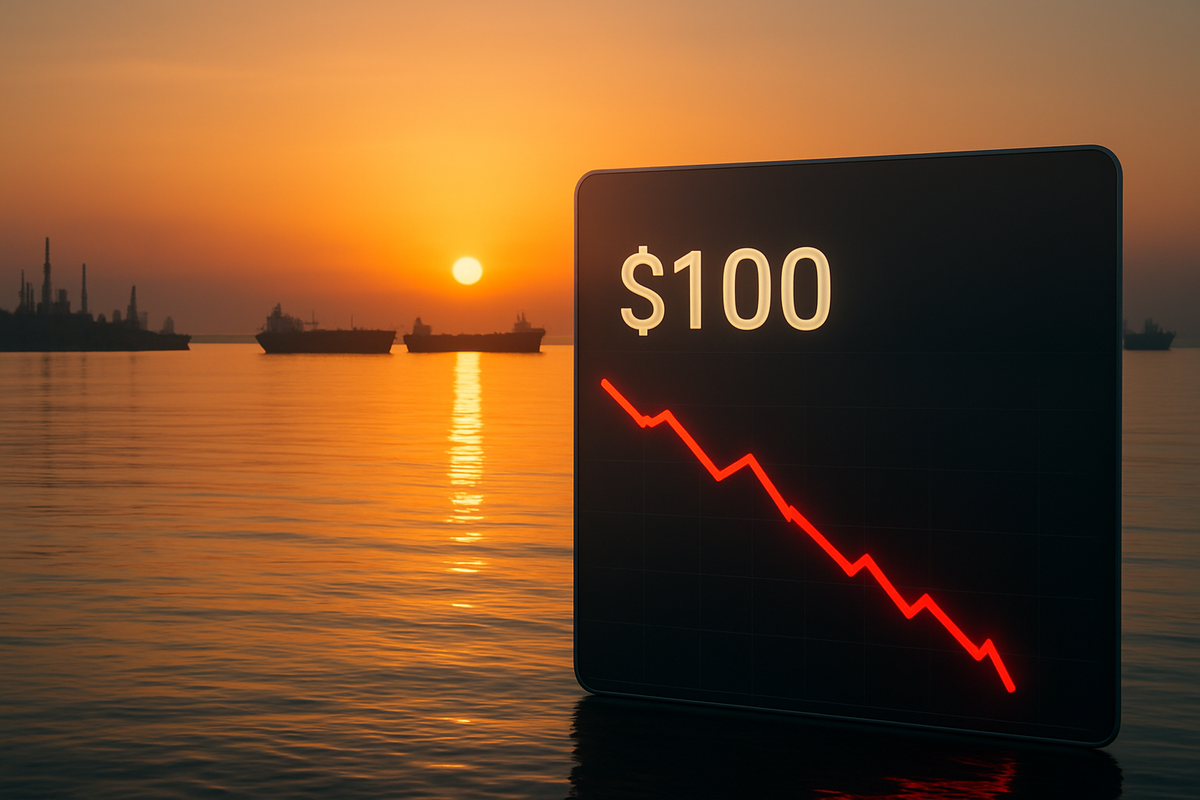
Global energy markets are experiencing a seismic shift today, April 1, 2026, as Brent crude oil futures plummeted toward the psychological $100 mark, hovering just above $101 in early trading. The sharp reversal follows a dramatic diplomatic breakthrough late yesterday that signaled an end to the month-long military hostilities between Iran and Western forces. For months, the "war premium"—the added cost to a barrel of oil due to geopolitical risk—had kept prices artificially high, but that protective layer is now evaporating as quickly as it formed, bringing immediate relief to a global economy that was teetering on the edge of a stagflationary crisis.
The sudden retreat in oil prices has sent shockwaves through the financial markets, sparking a massive "relief trade." While energy-heavy indices are feeling the weight of the price drop, broader equity markets have surged on the hope that lower energy costs will provide a much-needed cooling effect on persistent inflation. As the threat of a prolonged closure of the Strait of Hormuz recedes, investors are recalibrating their portfolios, moving away from "war-hedge" positions and back into consumer-facing and growth-oriented sectors.
The Collapse of the Geopolitical Risk Premium
The volatility that defined the first quarter of 2026 reached its zenith in March, following "Operation Epic Fury"—a series of precision strikes by U.S. and regional allies against Iranian infrastructure. During the height of the conflict, Brent crude skyrocketed to nearly $120 per barrel, with analysts at Goldman Sachs (NYSE: GS) estimating that at least $14 of that price was a direct "war premium" based on the risk of a total Persian Gulf supply shutdown. The timeline of this crisis moved with terrifying speed: from the initial strikes on February 28 to the effective blockade of the Strait of Hormuz, the global energy supply chain seemed to be in a state of permanent fracture.
However, the tide turned late on March 31, 2026, when a surprise joint communiqué was released via regional mediators. The diplomatic breakthrough, reportedly involving back-channel negotiations facilitated by neutral intermediaries, indicated a provisional maritime security agreement to reopen the Strait of Hormuz. President Trump signaled a potential withdrawal of U.S. forces within weeks, stating the primary objective of neutralizing immediate threats had been met. This sudden pivot from the brink of total war to a fragile peace has effectively stripped the risk premium from the market overnight, causing Brent to shed nearly $20 in just a few trading sessions.
Initial market reactions have been swift and decisive. Trading desks in London and New York reported record-high volumes as algorithmic traders and hedge funds liquidated long oil positions. The "valuation gravity" that many analysts had warned about during the $120 peak has finally set in, leaving the market to search for a new floor based on physical supply and demand rather than geopolitical fear.
Market Divergence: Energy Retracts as Transport Gains
The sharp drop in oil prices has created a stark divide among public companies. Major U.S. oil producers, which had been the darlings of the market throughout the conflict, are now facing a period of cooling expectations. Chevron (NYSE: CVX), which recently reported a Q1 earnings beat with an EPS of $1.52, saw its shares soften in early morning trading as investors anticipated a reduction in upstream margins. While Chevron remains well-positioned due to its capital efficiency and strong balance sheet, the narrative has shifted from "windfall profits" to "sustainability in a $100-barrel environment."
Similarly, ExxonMobil (NYSE: XOM) and ConocoPhillips (NYSE: COP) have faced selling pressure. ExxonMobil, which hit a 52-week high of $171 just days ago, is now being scrutinized for its refining margins, which tend to contract when crude prices drop rapidly. ConocoPhillips, often viewed as a pure play on crude production, is particularly sensitive to this price retreat; despite Morgan Stanley recently raising its price target to $149, the stock is seeing a notable pullback as the "war-hedge" trade unwinds.
Conversely, the sectors that were most punished by high fuel costs are today’s winners. Delta Air Lines (NYSE: DAL) and United Airlines (NYSE: UAL) have seen their shares surge by more than 5% in early trading. For the transport and logistics sectors, sub-$100 oil represents a massive reduction in operational overhead. Analysts suggest that if Brent continues its drift toward the $70s or $80s, the airline industry could see a significant revision in 2026 profit forecasts, turning what was expected to be a dismal year for travel into one of recovery.
Deflating the Inflationary Threat
Beyond individual stock performance, the wider significance of this oil price drop lies in its impact on the global macroeconomic outlook. Heading into April, U.S. headline inflation was projected to hit a staggering 4.9% by early summer if oil remained at its war-time peak. With Brent now testing the $100 support level, economists are revising those figures downward, with current projections suggesting inflation could decelerate to the 3.2%–3.5% range by the end of the year. This shift is a game-changer for central bank policy.
The Federal Reserve had been maintaining a highly restrictive interest rate stance to combat the energy-driven inflation spike. The easing of the Iran conflict and the subsequent drop in crude prices gives the Fed "breathing room" to potentially pause further hikes or even signal rate cuts in late 2026. This potential pivot is already being reflected in the bond market, where yields on the 10-year Treasury have stabilized as the "inflationary panic" subsides.
Historically, this event mirrors the oil price volatility seen in previous decades, but with a modern twist: the speed of information and the dominance of algorithmic trading have compressed what used to be a months-long price adjustment into a matter of days. The ripple effects will likely be felt in the renewable energy sector as well; while high oil prices traditionally accelerate the transition to green energy, a rapid return to cheaper fossil fuels could momentarily slow the urgency of that shift, though policy mandates in the E.U. and U.S. remain a significant counter-force.
The Path Ahead: Supply Dynamics and OPEC+ Response
As the "war premium" vanishes, the market’s focus is shifting back to the fundamentals of supply and demand. The short-term outlook depends heavily on how quickly Iranian oil can return to the market and whether the Strait of Hormuz remains reliably open. If the maritime security agreement holds, we could see an additional 1.5 to 2 million barrels per day of supply reintegrated into global flows, which would place further downward pressure on prices.
However, the long-term question remains: how will OPEC+ respond? The cartel has historically been quick to implement production cuts when prices fall too far, too fast. If Brent threatens to drop below $80, a strategic pivot from the Saudi-led group is almost certain. Investors should also watch for how major U.S. shale producers respond; while they benefited from the March spike, many have remained disciplined in their capital spending, and a return to $100 oil might actually be welcomed as a "stable" middle ground compared to the extreme volatility of $120.
In the coming months, the challenge for companies like Chevron and ExxonMobil will be to prove they can deliver value in a decelerating price environment. The market will transition from a focus on geopolitical headlines to a focus on operational efficiency and dividend sustainability.
Conclusion: A New Phase for Global Markets
The events of April 1, 2026, mark a definitive turning point for the year. The sharp drop in oil prices is more than just a fluctuation in a commodity chart; it is a signal that the extreme geopolitical risks of the first quarter are being replaced by a more stable, albeit fragile, diplomatic reality. The removal of the "war premium" has provided a lifeline to the broader economy, offering a clear path toward lower inflation and more accommodative monetary policy.
Moving forward, the market will likely see a rotation away from energy and defense stocks into consumer discretionary, tech, and transport sectors. While the energy giants like Chevron (NYSE: CVX) remain profitable at $100 per barrel, the period of easy, war-driven gains is over. Investors should keep a close eye on the official reopening of trade routes in the Persian Gulf and any statements from the Federal Reserve regarding the revised inflation outlook.
Ultimately, while the relief is palpable today, the underlying tensions in the Middle East have not been entirely resolved. The "peace dividend" of April 2026 is welcome, but as history has shown, the energy markets are never more than one headline away from their next major shift.
This content is intended for informational purposes only and is not financial advice.