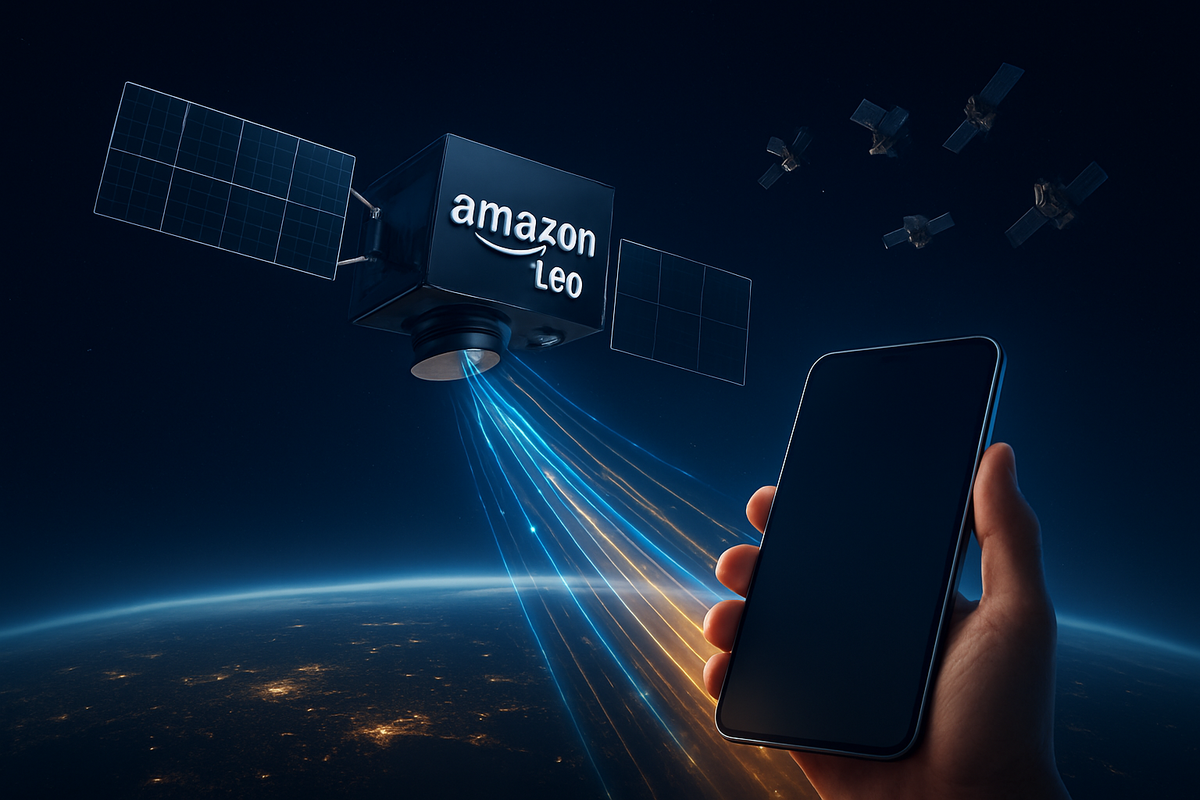
In a move that fundamentally reshapes the global telecommunications landscape, Amazon (NASDAQ: AMZN) announced today, April 14, 2026, a definitive agreement to acquire satellite communications pioneer Globalstar (NYSE American: GSAT) for approximately $11.6 billion. The all-cash-and-stock deal, valued at $90.00 per share, marks Amazon's most aggressive play yet to challenge the dominance of SpaceX’s Starlink in the rapidly expanding low Earth orbit (LEO) internet sector. By bringing Globalstar under its wing, Amazon secures critical spectrum licenses and an established orbital infrastructure, effectively fast-tracking its own satellite venture, recently rebranded as "Amazon Leo."
The immediate implications of the deal are profound, particularly for the burgeoning "Direct-to-Device" (D2D) market. Amazon gains immediate access to Globalstar’s globally licensed L-band and S-band spectrum, which are essential for connecting standard smartphones directly to satellites without the need for specialized ground terminals. This acquisition not only solidifies Amazon’s infrastructure but also secures a high-profile "Tripartite Alliance" with Apple (NASDAQ: AAPL), ensuring that the iPhone’s emergency satellite features will now be powered by Amazon’s network.
The Deal of the Decade: Integrating Globalstar into Amazon Leo
The $11.6 billion transaction represents a staggering premium for Globalstar, whose stock skyrocketed in pre-market trading following the announcement. Under the terms of the agreement, Globalstar shareholders can elect to receive $90.00 in cash or 0.3210 shares of Amazon common stock for each share held. The merger has already received written consent from Thermo Funding II, LLC, which controls over 57% of Globalstar’s voting power, effectively bypassing the need for a lengthy shareholder vote. The deal is expected to close in early 2027, pending standard regulatory reviews by the Federal Communications Commission (FCC) and international telecommunications bodies.
The timeline leading to this blockbuster announcement began in late 2025 when Amazon accelerated its Project Kuiper launches, eventually rebranding the division as "Amazon Leo" to signal its transition into commercial services. While Amazon had successfully deployed over 200 satellites by early 2026, it faced a significant hurdle: spectrum licensing. By acquiring Globalstar, Amazon effectively "buys" a seat at the regulatory table that would have otherwise taken a decade to build through international filings. Globalstar’s existing fleet of 24 satellites will be integrated into Amazon’s expanding constellation, providing immediate operational redundancy.
Initial market reactions have been overwhelmingly positive for Amazon, though analysts are closely watching the regulatory response. Industry insiders suggest that Amazon’s move was a "strategic necessity" after SpaceX (Private) reached a milestone of 10 million Starlink users earlier this year. By acquiring a proven asset like Globalstar, Amazon is no longer just a "challenger" in the satellite space; it is now a vertically integrated powerhouse capable of bundling satellite connectivity with its Prime memberships and AWS cloud services.
Winners, Losers, and the Shifting Alliance of Big Tech
The clearest winner in this transaction is Globalstar itself, which saw its valuation leap from a niche satellite operator to a central pillar of Amazon’s global infrastructure. However, Apple (NASDAQ: AAPL) also emerges as a strategic victor. While Apple previously held a 20% stake in Globalstar and utilized 85% of its network capacity for Emergency SOS features, the new long-term agreement with Amazon guarantees the continuity and expansion of these services. Apple users can expect enhanced satellite-based messaging and even high-bandwidth data features in future iPhone models, all powered by the Amazon Leo backbone.
On the other side of the ledger, SpaceX faces its most formidable competitor to date. While Starlink currently enjoys a massive head start in terms of satellite count and user base, Amazon’s deep pockets and integration with the iPhone ecosystem present a unique threat. SpaceX’s "Starlink Mobile" partnerships with terrestrial carriers like T-Mobile (NASDAQ: TMUS) may find it difficult to compete with a service that is natively integrated into the world’s most popular consumer hardware. Furthermore, traditional telecommunications companies may find themselves on the losing end as the "Direct-to-Device" revolution threatens to bypass terrestrial towers entirely for many core services.
Other satellite players, such as Iridium Communications (NASDAQ: IRDM), may feel the heat as Amazon scales. While Iridium has long-standing contracts with the Department of Defense and industrial sectors, the entry of a trillion-dollar tech giant into the MSS (Mobile Satellite Services) spectrum space creates a new level of pricing pressure and competition for engineering talent. For investors, the consolidation suggests that the "Wild West" era of independent satellite startups is ending, replaced by a battle of the titans.
Spectrum Wars and the New Regulatory Frontier
This acquisition fits into a broader industry trend where spectrum—the invisible radio frequencies that carry data—has become more valuable than the hardware itself. For Amazon, Globalstar wasn’t just about satellites; it was about the globally harmonized 2.4 GHz S-band. As the world moves toward 6G and ubiquitous satellite connectivity, owning licensed spectrum that works internationally is the ultimate competitive advantage. This move mirrors past industry shifts, such as the massive terrestrial spectrum auctions of the 2010s, but on a global, orbital scale.
The regulatory implications will be the primary hurdle. The FCC has been increasingly vocal about space debris and orbital traffic. Amazon will need to prove that its "Amazon Leo" constellation—which aims to reach over 3,200 satellites—can coexist safely with Globalstar’s aging fleet and the thousands of Starlink satellites already in orbit. Furthermore, the Amazon-Apple partnership may draw antitrust scrutiny from regulators concerned about a "walled garden" for satellite connectivity that excludes smaller device manufacturers.
Historically, this event draws comparisons to the early days of the cellular industry, where rapid consolidation led to a few dominant players. However, the stakes are higher in orbit. The "ripple effect" of this deal will likely force other tech giants, such as Google (NASDAQ: GOOGL) or Microsoft (NASDAQ: MSFT), to reconsider their own satellite strategies. Whether through partnerships or their own acquisitions, the tech sector is realizing that to control the cloud, you must first control the sky.
The Road to 2028: What Comes Next for Amazon Leo
In the short term, Amazon must focus on the logistics of the merger and the continued deployment of its "Amazon Leo" hardware. The company has stated it aims to have at least half of its planned constellation operational by mid-2026 to satisfy FCC license requirements. The integration of Globalstar’s ground stations and telemetry systems will be a massive undertaking for the AWS division, which is expected to handle the heavy lifting of data processing for the new network.
Looking toward 2028, the market is bracing for the launch of "Amazon Leo Direct," a consumer-facing service that will likely offer voice and data connectivity directly to standard smartphones. This would represent the final evolution of the Globalstar acquisition: turning a niche emergency feature into a mainstream utility. The strategic pivot for Amazon will be transitioning from a "provider of infrastructure" for Apple to a "global carrier" in its own right, potentially offering satellite data plans as a premium add-on to Amazon Prime.
The challenges remain significant. Technical hurdles in D2D technology—such as managing signal interference and power consumption on handheld devices—are still being refined. Moreover, the "Space Race 2.0" will require billions in ongoing capital expenditure. Investors should monitor Amazon's quarterly CAPEX closely, as the cost of building, launching, and maintaining a 3,000+ satellite network will test even Amazon's formidable balance sheet.
Final Assessment: A Permanent Shift in Global Connectivity
Amazon’s $11.6 billion acquisition of Globalstar is a watershed moment that signals the end of the experimental phase for LEO satellite internet. By securing the spectrum and the partnerships necessary to challenge SpaceX, Amazon has ensured that the future of global connectivity will be a duopoly between two of the most ambitious companies in history. The move effectively de-risks Project Kuiper (Amazon Leo) by providing it with a proven revenue stream from Apple and a clear path to regulatory compliance.
For the market, this deal confirms that satellite connectivity is no longer a "niche" service for mariners and hikers; it is the next frontier of the consumer smartphone experience. As Amazon Leo moves toward its full commercial launch, the boundaries between tech companies and telecommunications providers will continue to blur. Investors should watch for further consolidation in the satellite sector and pay close attention to the upcoming 2027 closing date for any regulatory "divestiture" requirements.
The significance of April 14, 2026, will likely be remembered as the day the "Cloud" finally moved into the stars. With Amazon and SpaceX now locked in a high-stakes orbital competition, the ultimate winner will likely be the consumer, who can look forward to a world where "dead zones" are a thing of the past.
This content is intended for informational purposes only and is not financial advice.