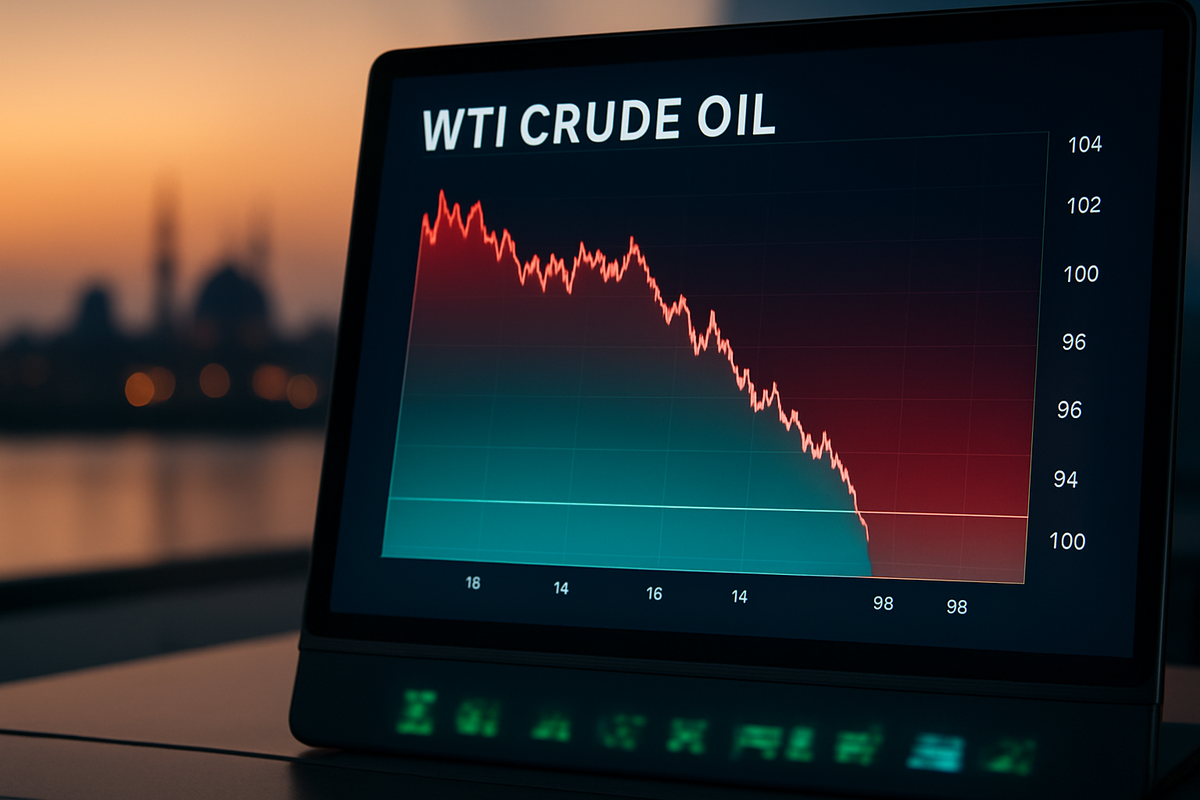
The global energy landscape shifted dramatically this week as West Texas Intermediate (WTI) crude oil plummeted below the psychological $100 threshold, settling near $96 per barrel. This sharp correction comes on the heels of a surprising diplomatic breakthrough in the Middle East, which has significantly lowered the geopolitical risk premium that has haunted markets since early 2026. For U.S. investors, the cooling of energy prices is more than just a reprieve at the pump; it represents a critical turning point in the battle against stagflation, offering a glimmer of hope that the economy might avoid a deeper downturn.
The sudden retreat in oil prices has triggered a "risk-on" rally across Wall Street. As the cost of energy—a primary input for almost every sector of the economy—begins to normalize, the specter of high inflation paired with stagnant growth is starting to fade. Markets that were previously bracing for a prolonged period of energy-driven volatility are now recalibrating their expectations for the remainder of the year, focusing on the potential for improved corporate margins and a less aggressive Federal Reserve.
Breaking the $100 Ceiling: A Timeline of De-escalation
The journey to $96 oil was preceded by a period of intense anxiety. In the first quarter of 2026, WTI crude had surged to nearly $115 per barrel, driven by escalating tensions in the Persian Gulf and fears of a total blockade of the Strait of Hormuz. This "war premium" added roughly $20 to the price of every barrel, as traders priced in the worst-case scenario of a major supply disruption. However, the tide turned over the weekend when a surprise summit in Muscat led to a tentative ceasefire and a commitment to reopening contested shipping lanes.
The reaction on the trading floors was instantaneous. On Monday morning, WTI crude opened lower and continued its descent as news of the diplomatic progress was verified by international observers. By mid-week, the front-month contract had shed nearly 15% of its value, marking one of the most significant three-day declines in energy prices since the 2020 pandemic. The de-escalation has been credited to a coalition of regional powers and international mediators who successfully negotiated a framework for long-term stability, effectively removing the immediate threat to global supply.
Key stakeholders, including the major national oil companies and OPEC+ members, have signaled a cautious but cooperative stance. While some members of the alliance were initially hesitant to see prices fall below $100, the broader consensus is that a global economic collapse triggered by high energy costs would ultimately hurt producers more. The strategic decision by Saudi Arabia to maintain current production levels rather than cutting to support prices further accelerated the downward move, signaling to the market that the era of triple-digit oil may be coming to a close.
Winners and Losers: Corporate America Reacts
The impact of the energy cooldown is being felt acutely across the stock market. Leading the "winner" column are the major airlines and transportation companies, which see fuel as their largest variable cost. Delta Air Lines (NYSE: DAL) and United Airlines Holdings (NASDAQ: UAL) saw their stock prices jump by over 6% in midday trading as analysts began revising earnings estimates upward for the peak summer travel season. Similarly, logistics giant FedEx Corporation (NYSE: FDX) surged as lower diesel costs promised to improve margins for its ground and air shipping divisions.
Conversely, the energy sector is facing a period of consolidation. Integrated supermajors like ExxonMobil (NYSE: XOM) and Chevron Corporation (NYSE: CVX), which had seen record profits during the $100+ era, saw their shares retreat as the prospect of lower realized prices for their crude production weighed on sentiment. While these companies remain highly profitable, the loss of the "war premium" means their upside potential is now tied more closely to operational efficiency and downstream refining margins rather than commodity price surges.
Upstream shale drillers, such as Occidental Petroleum (NYSE: OXY), are also under pressure. These companies are highly leveraged to the spot price of WTI, and the move toward $90 could force a reassessment of capital expenditure plans for the second half of 2026. For companies with higher break-even costs in the Permian Basin, $96 oil represents a much tighter margin environment than the triple-digit prices they had grown accustomed to earlier in the year.
Easing the Stagflation Squeeze
The broader significance of this event cannot be overstated. Throughout 2025 and early 2026, the primary narrative for US investors was "stagflation"—a toxic mix of high inflation driven by energy costs and slowing GDP growth. By April 15, 2026, this narrative had reached a fever pitch, with many economists predicting a formal recession. The fall of oil below $100 acts as a "pressure release valve" for the entire economy, potentially lowering the Consumer Price Index (CPI) and giving the Federal Reserve more room to pause its rate-hiking cycle.
This shift mirrors historical precedents, such as the lifting of the oil embargo in 1974 or the 2015 Iran Nuclear Deal, where diplomatic resolutions provided much-needed relief to global markets. In the current context, lower oil prices translate directly into lower input costs for manufacturing and cheaper shipping for consumer goods. This helps to break the "wage-price spiral" that many feared was becoming entrenched. As energy-driven inflation cools, consumer sentiment—which has been at multi-year lows—is expected to see a significant rebound, supporting domestic spending.
Furthermore, the policy implications are vast. The U.S. administration, which has been under pressure to release more from the Strategic Petroleum Reserve (SPR), now finds itself in a position where it may be able to begin refilling the reserve at more favorable prices. This creates a "floor" for the market in the long term, but in the short term, it removes the political urgency that has often led to market-distorting interventions.
The Road to $80: What Comes Next?
Looking ahead, the energy market is entering a phase of discovery. The short-term focus will be on whether the Middle East ceasefire holds and if the diplomatic framework can be translated into a permanent treaty. If stability is maintained, many analysts believe WTI could drift further toward the $80-$85 range by the end of the year, especially if global demand continues to soften due to the lagged effects of high interest rates.
Strategic pivots will be required for both investors and corporations. Investors who have been overweight in energy as a hedge against inflation may need to rotate back into growth sectors like technology and consumer discretionaries. For the energy companies themselves, the focus will likely shift from "growth at all costs" to "capital discipline" and "shareholder returns," as the easy gains from rising commodity prices disappear. We may also see an increase in M&A activity as larger players look to acquire smaller, high-cost producers at a discount.
Market opportunities are likely to emerge in "petroleum-sensitive" industries that have been beaten down over the past six months. From chemical manufacturers to paint companies and food producers, any business that relies on plastic packaging or intensive shipping is now a potential "buy" candidate. However, the challenge will be identifying which companies have maintained their pricing power during the inflationary period, as they stand to gain the most from falling input costs.
Final Assessment: A New Market Regime
The cooling of the energy market in April 2026 marks a significant transition from a period of geopolitical crisis to one of relative stabilization. The drop of WTI to $96 per barrel has effectively "broken the back" of the stagflation narrative that dominated the first quarter of the year. While the global economy is not out of the woods yet, the removal of the energy price spike provides a much-needed tailwind for equity markets and a reprieve for the average consumer.
For investors, the key takeaway is that the "commodity supercycle" narrative is currently being challenged by diplomatic reality. Moving forward, the market will likely be more sensitive to fundamental supply-and-demand metrics rather than headline-driven fear. The actions of OPEC+ in the coming months will be crucial; if the group chooses to defend the $90 floor with production cuts, we could see a period of range-bound trading. However, if they prioritize market share, prices could have further to fall.
In the coming months, keep a close eye on the core inflation data and the Federal Reserve's rhetoric. If the drop in oil prices leads to a meaningful decline in inflation expectations, we could be looking at a "Goldilocks" scenario for the second half of 2026—where growth remains stable and inflation finally returns to its 2% target. For now, the cooling of the energy markets is a welcome development that suggests the worst of the 2026 energy shock may be behind us.
This content is intended for informational purposes only and is not financial advice.