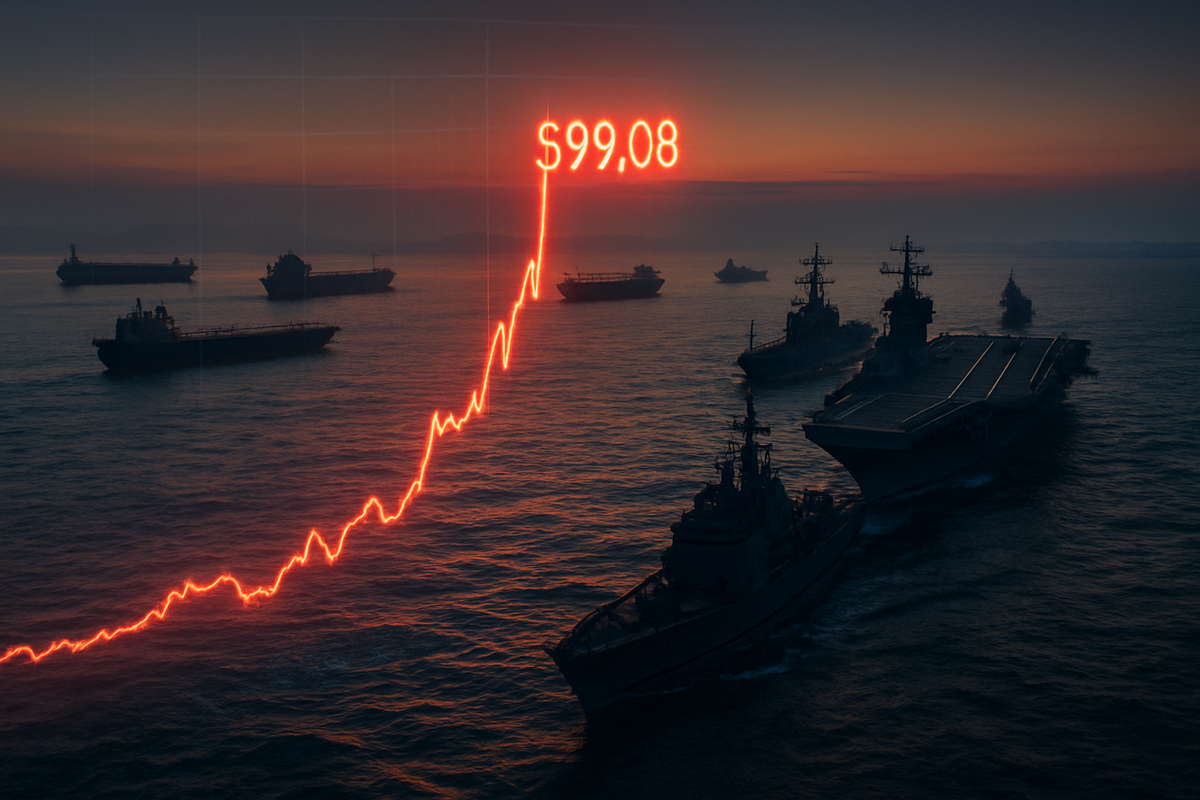
The global energy landscape was thrust into a state of acute crisis this week as West Texas Intermediate (WTI) crude oil prices surged to $99 per barrel, following a United States-led naval blockade of the Strait of Hormuz. The blockade, a dramatic escalation in the ongoing "2026 Iran War," has effectively shuttered the world’s most critical maritime chokepoint, through which approximately 20% of the world’s petroleum liquids and liquefied natural gas (LNG) typically flow. This unprecedented military maneuver has ignited a firestorm of volatility across financial markets, with investors and geopolitical analysts scrambling to assess the duration and depth of the supply disruption.
The immediate implications are staggering: shipping transits through the Strait have plummeted by nearly 97%, and global energy security has reached its most precarious point since the oil shocks of the 1970s. As WTI hovers just shy of the triple-digit psychological barrier, the ripple effects are being felt from the pump in the American Midwest to the industrial hubs of East Asia. The blockade has not only removed millions of barrels of Iranian crude from the market but has also effectively trapped the exports of regional neighbors like Kuwait and Qatar, who lack viable alternative routes to reach global consumers.
A Timeline of Escalation and Market Shock
The seeds of the current crisis were sown in February 2026 with the launch of "Operation Epic Fury" by the United States and "Operation Roaring Lion" by Israel—coordinated military strikes aimed at Iranian nuclear infrastructure. The conflict reached a fever pitch following the death of Iranian Supreme Leader Ali Khamenei during the initial strikes, triggering a cycle of Iranian drone and missile retaliations against regional U.S. bases. By early April, a fragile ceasefire brokered by international mediators began to fray as high-level peace talks in Islamabad, led by U.S. Vice President JD Vance, collapsed after 21 hours of failed negotiations on April 12.
Following the breakdown of diplomacy, President Donald Trump announced an immediate U.S. naval blockade on April 13, 2026, targeting all vessels entering or departing Iranian ports. The market reaction was instantaneous. WTI crude for May delivery skyrocketed 8.6%, briefly touching $104.88 in intraday trading before settling at $99.08. This "war premium" reflects the sudden loss of roughly 7.7 million barrels per day (mbpd) of net global supply. The blockade was strictly enforced on April 14, evidenced by the interception of the Rich Starry, a sanctioned tanker attempting to exit the Strait with a cargo of methanol, which was turned back by U.S. naval forces.
The International Energy Agency (IEA) has responded with its largest-ever coordinated release of 400 million barrels from Strategic Petroleum Reserves (SPR), including a staggering 172 million barrels from the U.S. alone. Despite this intervention, physical spot prices for crude in Europe have spiked as high as $150 per barrel, driven by immediate anxiety over cargo arrivals. Shipping companies have largely declared the Strait a "no-go zone," as war-risk insurance premiums have made commercial transit through the Persian Gulf economically unviable for most independent operators.
Key stakeholders, including the OPEC+ alliance, are now grappling with a fragmented market. While Saudi Arabia has attempted to mitigate the impact by ramping up its East-West Pipeline (Petroline) to its maximum capacity of 7 mbpd, the logistical bottlenecks at Red Sea ports mean that only a fraction of the lost Gulf volume can be replaced. Meanwhile, China—the primary purchaser of Iranian oil—finds itself the most vulnerable major economy, relying on its 1.3 billion-barrel strategic reserve to keep its industrial sector afloat during the maritime standstill.
Corporate Winners and Losers in a High-Price Environment
The surge in oil prices has created a stark divide between market winners and losers. U.S.-based integrated oil majors with significant domestic production are emerging as the primary beneficiaries. ExxonMobil (NYSE: XOM) saw its shares peak at $176 in late March and remain resilient near $148 as investors view its Permian Basin and Guyana assets as safe havens from Middle Eastern risk. Similarly, Chevron (NYSE: CVX) has outperformed the broader market, trading near $186, as it prioritizes domestic U.S. output that bypasses the Hormuz chokepoint. Pure-play shale producers like Occidental Petroleum (NYSE: OXY), ConocoPhillips (NYSE: COP), and Diamondback Energy (NASDAQ: FANG) have also seen increased investor interest, as the high-price environment boosts the profitability of North American extraction.
The shipping and tanker industry is witnessing a "perfect storm" of record profits and extreme risk. Frontline (NYSE: FRO) and CMB.TECH (NYSE: CMBT), formerly Euronav, have seen spot rates for Very Large Crude Carriers (VLCCs) on non-Gulf routes surge to a record $423,736 per day. However, these gains are tempered by the total loss of revenue from the Persian Gulf route and the skyrocketing cost of vessel insurance. Companies specializing in LNG transport, such as Teekay (NYSE: TK), are also in high demand as European and Asian buyers look to replace pipeline gas and Gulf LNG with shipments from the U.S. and West Africa.
Conversely, the "losers" of this event are concentrated in the transportation and industrial sectors. Major airlines, including Delta Air Lines (NYSE: DAL) and United Airlines (NASDAQ: UAL), are facing a massive spike in jet fuel costs, which could lead to a wave of surcharges and reduced flight frequencies. Retailers and logistics firms are also under pressure as the cost of diesel impacts the entire global supply chain. Furthermore, multinational corporations with heavy manufacturing footprints in China are bracing for higher energy costs and potential power rationing, which could disrupt the production of everything from consumer electronics to automotive parts.
Geopolitically, Russia has emerged as a surprise short-term winner. In a move to stabilize global prices, the U.S. Treasury issued temporary waivers allowing Russian crude to flow more freely to Asia. This "sanctions paradox" has allowed Moscow to earn an additional $150 million per day in revenue, according to some estimates, as the world prioritizes energy volume over political isolation. This shift has complicated the long-term Western strategy of decoupling from Russian energy, highlighting the desperate need for supply in the face of the Hormuz blockade.
Wider Significance: A New Era of Energy Sovereignty
The 2026 Hormuz blockade fits into a broader historical trend of "energy sovereignty," where nations are increasingly treating energy supply chains as national security liabilities. This event is being compared to the 1973 oil embargo and the 1979 Iranian Revolution, though the IEA suggests the current crisis is more severe due to the absolute volume of oil and gas at risk. Unlike the 1970s, however, the U.S. is now the world’s top producer and a net exporter, which has shifted its policy from "energy independence" to "energy dominance." This dominance is being used as a diplomatic lever to secure maritime cooperation and influence the energy policies of allies and adversaries alike.
The blockade is also serving as a dual-edged sword for the global energy transition. On one hand, the extreme price of fossil fuels has acted as a "security shield" for renewables, leading to a 14% surge in solar and an 8% increase in wind generation within the first month of the crisis. Analysts are now framing decarbonization not just as a climate goal, but as "resilience," providing immunity to maritime chokepoint volatility. On the other hand, the Middle East accounts for a significant portion of global aluminum and high-purity metal production. The disruption of these shipments has led to a 20% rise in the cost of renewable hardware, potentially slowing the long-term roll-out of green infrastructure.
Regulatory and policy implications are shifting rapidly. The U.S. Department of Energy has introduced a "Pragmatic Exchange Structure" for the SPR, where refiners "borrow" barrels and must return them with a premium later, effectively refilling the reserve at no cost to taxpayers. Domestically, there is a push to suspend the Jones Act to expedite coastal shipping and a rollback of various fuel efficiency and EV mandates to provide immediate relief to consumers facing gas prices between $4 and $6 per gallon. These moves signal a temporary pivot toward prioritizing affordability and availability over environmental regulations.
Historically, crises of this magnitude have led to permanent shifts in consumer behavior and industrial strategy. The 1973 crisis birthed the IEA and the 55-mph speed limit; the 2026 blockade is expected to leave a legacy of mandated "energy sovereignty" and a permanent move away from "just-in-time" energy procurement. The fragmentation of OPEC+ also suggests a future where regional alliances and secure pipelines, like Saudi Arabia’s Petroline, become more important than collective production quotas.
The Road Ahead: Scenarios and Strategic Pivots
In the short term, the market remains on a knife-edge. If the blockade continues through the second quarter of 2026, analysts from Goldman Sachs and Wood Mackenzie warn that oil prices could breach the $120 mark, with some "doomsday" scenarios projecting $200 per barrel if Iran successfully activates its Houthi allies to block the Bab al-Mandab Strait in the Red Sea. Such a move would cut off the only alternative export route for Saudi oil, effectively strangling the global energy market.
Strategic pivots are already underway. Energy-intensive companies are looking to diversify their power sources, with a renewed interest in small modular nuclear reactors (SMRs) and localized microgrids. For oil companies, the focus is shifting toward "short-cycle" production, such as shale, which can be brought online quickly to take advantage of price spikes, rather than long-term, multi-billion dollar offshore projects that are vulnerable to geopolitical shifts. Market opportunities may emerge in the development of synthetic fuels and advanced battery storage as the world seeks to decouple from the "Persian Gulf chokepoint."
The potential for a "diplomatic off-ramp" remains, though it appears distant. Any resolution would likely require a new security framework for the Middle East that includes guarantees for maritime transit and a cooling of the U.S.-Iran conflict. Until then, the market must adjust to a "new normal" of high volatility and persistent supply anxiety. Investors should be prepared for a period of "deglobalization" in energy markets, where local production and secure, bilateral trade agreements carry a significant premium.
Conclusion: Watching the Tides
The U.S. blockade of the Strait of Hormuz and the subsequent jump in WTI to $99 mark a watershed moment for the global economy. The event has exposed the fragility of the world's energy lifelines and the limitations of strategic reserves in the face of a total maritime shutdown. Key takeaways include the emergence of the U.S. as a critical energy stabilizer, the fragmentation of traditional energy alliances like OPEC+, and the acceleration of energy sovereignty as a core pillar of national security.
Moving forward, the market will likely remain characterized by high volatility and a "war premium" that won't dissipate until commercial traffic resumes through the Strait. Investors should watch for the administration's next steps regarding SPR refills, the potential for escalation in the Red Sea, and the ability of China to sustain its economy on reserves alone. The lasting impact of this crisis will be a fundamental re-evaluation of how energy is traded and transported, with a clear preference for routes that avoid the world's most dangerous chokepoints.
As the situation evolves, the focus will remain on the resilience of the U.S. shale sector and the ability of global diplomacy to provide a pathway toward maritime stability. For now, the world remains in a high-stakes waiting game, with the price of oil serving as a barometer for global tension.
This content is intended for informational purposes only and is not financial advice.