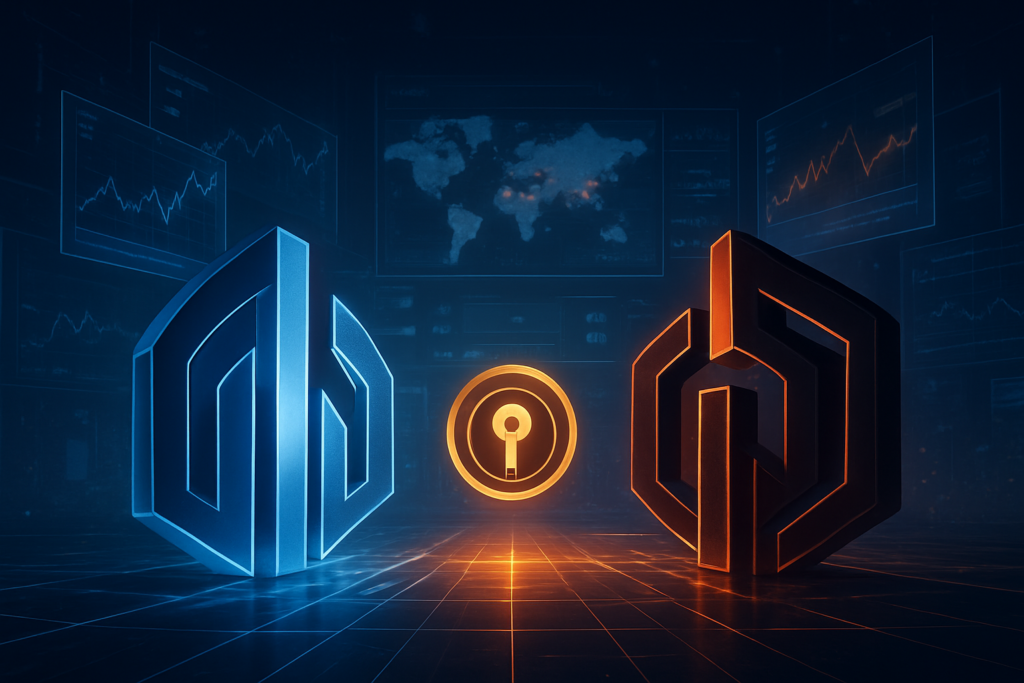
In a move that has sent shockwaves through the burgeoning "information economy," Polymarket has officially staged its return to the United States. Following a multi-year exile by federal regulators, the world’s largest prediction market platform successfully bypassed the typical years-long licensing process by executing a strategic $112 million acquisition of QCX, a Commodity Futures Trading Commission (CFTC)-regulated derivatives exchange and clearinghouse. As of January 20, 2026, this "regulatory shortcut" has transformed the competitive landscape, setting the stage for a high-stakes showdown with its chief rival, Kalshi.
Traders are currently pricing in a high probability that Polymarket’s U.S. arm will achieve parity with its global volume by the end of Q3 2026. This market sentiment is driven by the platform's aggressive integration with traditional financial infrastructure and its recent high-profile partnerships. However, the move has ignited a fierce rivalry with Kalshi, which has spent years building its brand as the "compliant" alternative. As prediction markets transition from niche crypto-products to mainstream financial tools, the battle between these two giants represents more than just a fight for market share; it is a battle for the soul of the predictive era.
The Market: What's Being Predicted
The central focus of traders today is the rapid expansion of Polymarket US, the platform’s domestic, regulated entity. Unlike the crypto-native global site, Polymarket US operates as a registered Designated Contract Market (DCM) and Derivatives Clearing Organization (DCO)—licenses it inherited through the acquisition of QCX (collectively QCX, LLC and QC Clearing LLC). This structure allows Polymarket to list event contracts that are cleared and settled within the U.S. financial system, providing a degree of legitimacy that was once its greatest weakness.
Currently, the primary "meta-market" being traded across platforms involves the comparative volume growth of Polymarket US versus Kalshi. In early 2026, Kalshi remains the leader in regulated U.S. volume, holding approximately 66.4% of the market, largely due to its deep integration with Robinhood (NASDAQ: HOOD). However, Polymarket’s volume has surged by 40% month-over-month since its limited December 2025 relaunch. Liquidity on the new platform is being bolstered by institutional market makers like Susquehanna International Group (SIG), which has expanded its operations to support Polymarket’s new regulated order books.
The resolution criteria for these competition markets typically hinge on official CFTC quarterly reports or verified third-party data providers like ElectionBettingOdds or VolumeWatch. Traders are closely monitoring the "Self-Certification" filings Polymarket submitted in late 2025, which include contracts for athletic point spreads, Federal Reserve interest rate hikes, and even the outcomes of specific state-level legislative sessions.
Why Traders Are Betting
The sudden shift in the prediction market hierarchy is being driven by a "perfect storm" of regulatory clarity and massive capital infusion. Polymarket’s acquisition of QCX was not just a legal maneuver; it was backed by a landmark $2 billion strategic investment from the Intercontinental Exchange (NYSE: ICE), the parent company of the New York Stock Exchange. This partnership has given Polymarket a seat at the table with the world’s largest institutional investors, many of whom are betting that prediction markets will eventually replace traditional polling and even some forms of weather and economic forecasting.
Furthermore, traders are reacting to the divergent strategies of the two platforms. While Kalshi has doubled down on sports-centric "event parlays" to attract the retail betting crowd, Polymarket is positioning itself as the "Bloomberg of Truth," focusing on geopolitical risk and macroeconomic indicators. Notable "whale" activity has been observed in markets related to the 2026 midterm elections, where Polymarket’s historical accuracy in 2024 has given it a reputational edge over traditional media outlets like CNN or the New York Times.
Public sentiment is also heavily influenced by the high-profile figures backing these platforms. Polymarket has strengthened its domestic ties by adding Donald Trump Jr. (via 1789 Capital) to its advisory board, while Kalshi has aligned itself with the traditional Wall Street guard, securing endorsements from veterans at Charles Schwab (NYSE: SCHW) and Sequoia Capital. This political and financial polarization is creating unique trading opportunities for those who believe one "camp" has a superior information network.
Broader Context and Implications
The Polymarket-QCX deal marks the end of the "Wild West" era for prediction markets. By choosing to buy their way into compliance, Polymarket has acknowledged that the path to global dominance must run through the U.S. regulatory framework. This has massive implications for the broader fintech sector. We are seeing a "convergence" where prediction markets are becoming indistinguishable from traditional derivatives exchanges like those operated by the CME Group (NASDAQ: CME).
However, this newfound legitimacy has brought about a new theater of conflict: state-level regulation. In just the last week of January 2026, the Nevada Gaming Control Board filed a lawsuit against Polymarket to halt its sports-related contracts, arguing they constitute unlicensed gambling. This mirrors a broader trend where federal approval (via the CFTC) is being challenged by state gaming commissions who fear a loss of tax revenue and oversight.
Historically, prediction markets have been more accurate than pundits because they require participants to "put their money where their mouth is." The current rivalry is essentially a stress test for this theory. If Polymarket can maintain its predictive accuracy while scaling within a regulated framework, it could fundamentally change how corporations hedge risk. For example, airline companies might use these markets to hedge against geopolitical instability in specific regions, rather than just relying on fuel futures.
What to Watch Next
The immediate focus for the market is the progression of the Public Integrity in Financial Prediction Markets Act of 2026, also known as the "Torres Bill." If passed, this legislation would ban federal employees from trading on prediction markets, a move that Kalshi supports to increase market "integrity" but which Polymarket critics argue is a veiled attempt to limit the platform's information advantage.
Key dates to watch include:
- February 12, 2026: The deadline for Polymarket to respond to the Nevada cease-and-desist order. A loss here could force a temporary withdrawal from several "gaming-heavy" states.
- March 2026: The expected launch of Polymarket’s full integration into the Intercontinental Exchange (NYSE: ICE) trading terminals, which would allow hedge funds to trade event contracts directly alongside equities and bonds.
- Q2 2026 Earnings: Watch for Interactive Brokers (NASDAQ: IBKR) and its subsidiary ForecastEx to report whether they have gained ground against the two market leaders, as they offer the lowest-fee alternative for institutional traders.
Bottom Line
The return of Polymarket to the U.S. via the QCX acquisition represents a pivotal moment in financial history. It signifies that prediction markets are no longer a "niche" interest for crypto enthusiasts but a core pillar of the modern financial system. The rivalry with Kalshi has created a competitive "arms race" that is driving innovation, lowering fees, and increasing the depth of these markets.
For the average observer, the takeaway is clear: the "Information Economy" is here to stay. Whether Polymarket’s aggressive "legalization via acquisition" strategy ultimately triumphs over Kalshi’s "compliance-first" pedigree remains to be seen, but the real winner is the market itself. As these platforms grow in liquidity and legitimacy, the world gains a more transparent, data-driven way to look into the future.
The odds favor a split market—one where Kalshi dominates the retail sports-betting crossover and Polymarket reigns supreme as the institutional engine for geopolitical and economic forecasting. But in a world where everything is a market, the only certain bet is that the volatility is just beginning.
This article is for informational purposes only and does not constitute financial or betting advice. Prediction market participation may be subject to legal restrictions in your jurisdiction.
PredictStreet focuses on covering the latest developments in prediction markets.
Visit the PredictStreet website at https://www.predictstreet.ai/.