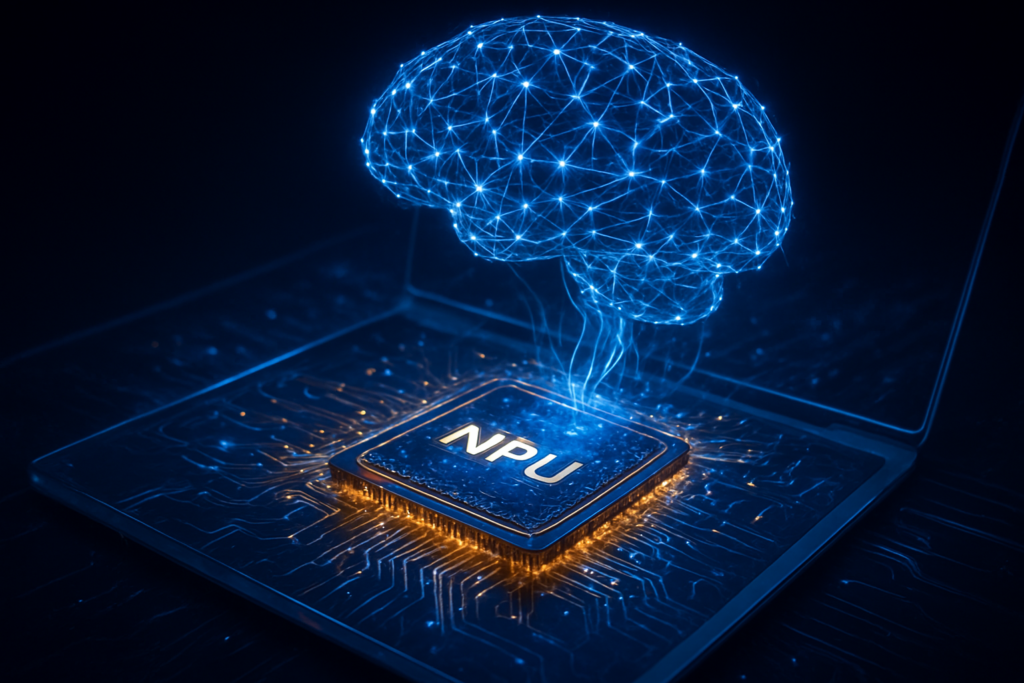
The dawn of 2026 marks a definitive turning point in the history of computing: the era of "Cloud-Only AI" has officially ended. Over the past 24 months, a quiet but relentless hardware revolution has fundamentally reshaped the architecture of personal technology. The Neural Processing Unit (NPU), once a niche co-processor tucked away in smartphone chips, has emerged as the most critical component of modern silicon. In this new landscape, the intelligence of our devices is no longer a borrowed utility from a distant data center; it is a native, local capability that lives in our pockets and on our desks.
This shift, driven by aggressive silicon roadmaps from industry titans and a massive overhaul of operating systems, has birthed the "AI PC" and the "Agentic Smartphone." By moving the heavy lifting of large language models (LLMs) and small language models (SLMs) from the cloud to local hardware, the industry has solved the three greatest hurdles of the AI era: latency, cost, and privacy. As we step into 2026, the question is no longer whether your device has AI, but how many "Tera Operations Per Second" (TOPS) its NPU can handle to manage your digital life autonomously.
The 80-TOPS Threshold: A Technical Deep Dive into 2026 Silicon
The technical leap in NPU performance over the last two years has been nothing short of staggering. In early 2024, the industry celebrated breaking the 40-TOPS barrier to meet Microsoft (NASDAQ: MSFT) Copilot+ requirements. Today, as of January 2026, flagship silicon has nearly doubled those benchmarks. Leading the charge is Qualcomm (NASDAQ: QCOM) with its Snapdragon X2 Elite, which features a Hexagon NPU capable of a blistering 80 TOPS. This allows the chip to run 10-billion-parameter models locally with a "token-per-second" rate that makes AI interactions feel indistinguishable from human thought.
Intel (NASDAQ: INTC) has also staged a massive architectural comeback with its Panther Lake series, built on the cutting-edge Intel 18A process node. While Intel’s dedicated NPU 6.0 targets 50+ TOPS, the company has pivoted to a "Platform TOPS" metric, combining the power of the CPU, GPU, and NPU to deliver up to 180 TOPS in high-end configurations. This disaggregated design allows for "Always-on AI," where the NPU handles background reasoning and semantic indexing at a fraction of the power required by traditional processors. Meanwhile, Apple (NASDAQ: AAPL) has refined its M5 and A19 Pro chips to focus on "Intelligence-per-Watt," integrating neural accelerators directly into the GPU fabric to achieve a 4x uplift in generative tasks compared to the previous generation.
This represents a fundamental departure from the GPU-heavy approach of the past decade. Unlike Graphics Processing Units, which were designed for the massive parallelization required for gaming and video, NPUs are specialized for the specific mathematical operations—mostly low-precision matrix multiplication—that drive neural networks. This specialization allows a 2026-era laptop to run a local version of Meta’s Llama-3 or Microsoft’s Phi-Silica as a permanent background service, consuming less power than a standard web browser tab.
The Great Uncoupling: Market Shifts and Industry Realignment
The rise of local NPUs has triggered a seismic shift in the "Inference Economics" of the tech industry. For years, the AI boom was a windfall for cloud giants like Alphabet (NASDAQ: GOOGL) and Amazon, who charged per-token fees for every AI interaction. However, the 2026 market is seeing a massive "uncoupling" as routine tasks—transcription, photo editing, and email summarization—move back to the device. This shift has revitalized hardware OEMs like Dell (NYSE: DELL), HP (NYSE: HPQ), and Lenovo, who are now marketing "Silicon Sovereignty" as a reason for users to upgrade their aging hardware.
NVIDIA (NASDAQ: NVDA), the undisputed king of the data center, has responded to the NPU threat by bifurcating the market. While integrated NPUs handle daily background tasks, NVIDIA has successfully positioned its RTX GPUs as "Premium AI" hardware for creators and developers, offering upwards of 1,000 TOPS for local model training and high-fidelity video generation. This has led to a fascinating "two-tier" AI ecosystem: the NPU provides the "common sense" for the OS, while the GPU provides the "creative muscle" for professional workloads.
Furthermore, the software landscape has been completely rewritten. Adobe and Blackmagic Design have optimized their creative suites to leverage specific NPU instructions, allowing features like "Generative Fill" to run entirely offline. This has created a new competitive frontier for startups; by building "local-first" AI applications, new developers can bypass the ruinous API costs of OpenAI or Anthropic, offering users powerful AI tools without the burden of a monthly subscription.
Privacy, Power, and the Agentic Reality
Beyond the benchmarks and market shares, the NPU revolution is solving a growing societal crisis regarding data privacy. The 2024 backlash against features like "Microsoft Recall" taught the industry a harsh lesson: users are wary of AI that "watches" them from the cloud. In 2026, the evolution of these features has moved to a "Local RAG" (Retrieval-Augmented Generation) model. Your AI agent now builds a semantic index of your life—your emails, files, and meetings—entirely within a "Trusted Execution Environment" on the NPU. Because the data never leaves the silicon, it satisfies even the strictest GDPR and enterprise security requirements.
There is also a significant environmental dimension to this shift. Running AI in the cloud is notoriously energy-intensive, requiring massive cooling systems and high-voltage power grids. By offloading small-scale inference to billions of edge devices, the industry has begun to mitigate the staggering energy demands of the AI boom. Early 2026 reports suggest that shifting routine AI tasks to local NPUs could offset up to 15% of the projected increase in global data center electricity consumption.
However, this transition is not without its challenges. The "memory crunch" of 2025 has persisted into 2026, as the high-bandwidth memory required to keep local LLMs "warm" in RAM has driven up the cost of entry-level devices. We are seeing a new digital divide: those who can afford 32GB-RAM "AI PCs" enjoy a level of automated productivity that those on legacy hardware simply cannot match.
The Horizon: Multi-Modal Agents and the 100-TOPS Era
Looking ahead toward 2027, the industry is already preparing for the next leap: Multi-modal Agentic AI. While today’s NPUs are excellent at processing text and static images, the next generation of chips from Qualcomm and AMD (NASDAQ: AMD) is expected to break the 100-TOPS barrier for integrated silicon. This will enable devices to process real-time video streams locally—allowing an AI agent to "see" what you are doing on your screen or in the real world via AR glasses and provide context-aware assistance without any lag.
We are also expecting a move toward "Federated Local Learning," where your device can fine-tune its local model based on your specific habits without ever sharing your raw data with a central server. The challenge remains in standardization; while Microsoft’s ONNX and Apple’s CoreML have provided some common ground, developers still struggle to optimize one model across the diverse NPU architectures of Intel, Qualcomm, and Apple.
Conclusion: A New Chapter in Human-Computer Interaction
The NPU revolution of 2024–2026 will likely be remembered as the moment the "Personal Computer" finally lived up to its name. By embedding the power of neural reasoning directly into silicon, the industry has transformed our devices from passive tools into active, private, and efficient collaborators. The significance of this milestone cannot be overstated; it is the most meaningful change to computer architecture since the introduction of the graphical user interface.
As we move further into 2026, watch for the "Agentic" software wave to hit the mainstream. The hardware is now ready; the 80-TOPS chips are in the hands of millions. The coming months will see a flurry of new applications that move beyond "chatting" with an AI to letting an AI manage the complexities of our digital existence—all while the data stays safely on the chip, and the battery life remains intact. The brain of the AI has arrived, and it’s already in your pocket.
This content is intended for informational purposes only and represents analysis of current AI developments.
TokenRing AI delivers enterprise-grade solutions for multi-agent AI workflow orchestration, AI-powered development tools, and seamless remote collaboration platforms.
For more information, visit https://www.tokenring.ai/.