DALLAS - February 2, 2026 (NEWMEDIAWIRE) - New consumer survey findings from the American Heart Association show that nearly six in every ten American adults still incorrectly believe only those with special training should perform Hands-Only CPR.[1] The perpetuation of this myth can be the difference between life and death as science tells us immediate CPR is proven to improve outcomes.[2] Because most cardiac emergencies happen outside of a hospital setting, the fastest way for anyone to be a “first responder until help arrives” and save a life is to call 9-1-1 and immediately take action with Hands-Only CPR. Research indicates Hands-Only CPR can double or even triple a person’s chance of survival.[2]
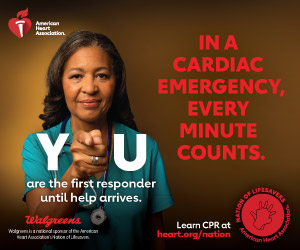
Launching this February during Heart Month 2026, the Heart Association’s theme, You Are the First Responder Until Help Arrives, reinforces a simple truth: you don’t need medical credentials to save a life; all you need is basic knowledge, courage and the willingness to act. Today, bystanders step in with CPR only about 41% of the time.[3] The American Heart Association, a global force changing the future of health for all, is working to change that.
“People tell us they’re afraid they’ll ‘do it wrong’ or think CPR requires having a certification or taking class before they can help,” said Stacey E. Rosen, M.D., FAHA, volunteer president of the American Heart Association and senior vice president of women’s health and executive director of the Katz Institute for Women’s Health of Northwell Health in New York City. “Here’s what matters - if a teen or adult collapses: call 911, then push hard and fast in the center of the chest. Your hands can keep blood flowing until professionals arrive.”
Each year in the United States, more than 350,000 cardiac arrests happen outside of a hospital and about 90% are fatal.[4] Most occur at home, where a loved one may be the only one nearby to help. Kristen Walenga, 47 at the time, of Frankfort, Ill., was the only adult at home when she collapsed from sudden cardiac arrest while making breakfast one Saturday morning. Her 15-year-old son, Eddie, who had learned CPR from the American Heart Association’s Kids Heart Challenge program when he was in middle school, knew what to do and immediately took action. With his other siblings calling 911 for help, he started chest compressions until paramedics arrived. Kristen survived because of her child’s preparation and courage.
To bust the “special training” myth, it is important to understand that Hands-Only CPR for teens and adults has two simple steps: (1) call 911; and (2) push hard and fast in the center of the chest at 100–120 beats per minute, about the tempo of “Stayin’ Alive” or “Uptown Funk.” If an automated external defibrillator (AED) that can shock a heart back into a normal rhythm is available, turn it on and follow the voice prompts. For infants and children, CPR must include breaths.
You can learn CPR today with fast, flexible options for everyone. During American Heart Month, the Heart Association invites people to choose the path that fits their life, at home, at work or at school.
- Watch and learn the basics of Hands-Only CPR.
- Take a class to build confidence and learn when to add breaths, how to use an AED and how to help children and infants. Find a CPR class at heart.org/nation.
- Bring CPR to your circles by asking your school, workplace, faith community or gym to develop cardiac emergency response plans (CERPs), host CPR awareness activities and secure an AED.
Many people hesitate and some groups, including women and Black adults, are still less likely to receive CPR. The Heart Association’s focus specifically addresses barriers such as concerns about doing it “wrong,” fear of legal ramifications and worries about inappropriate contact, as well as the persistent belief that special training is required, a perception that is even more common in historically excluded communities.
“CPR is a civic duty. Heroism is not limited to uniforms, it is everyday people stepping up for others,” said Rosen. “Strong communities are built by preparedness. Whether you’re at home, the gym, or a child’s soccer game, cardiac arrest can happen anywhere, and you will most likely be saving the life of someone you know and love. Being prepared and willing to help strengthens the fabric of our nation.”
“You Are the First Responder” aligns with the Heart Association’s Nation of Lifesavers initiative, sponsored nationally by Walgreens, to turn more bystanders into lifesavers and double survival from out-of-hospital cardiac arrest by 2030.
Additional Resources:
- Multimedia is available on the right column of release link.
- American Heart Association health resource: How to perform Hands-Only CPR (Video) (in Spanish, Mandarin)
- American Heart Association news release: Quick CPR from lay rescuers can nearly double survival for children after cardiac arrest (Nov. 2025)
- American Heart Association news release: Learning to save lives can start as early as age 4, according to new scientific statement (May 2023)
- American Heart Association Fact Sheets on Heart and Brain health topics
- Free, online Support Network for survivors and caregivers
- Follow us on X @HeartNews
About the American Heart Association
The American Heart Association is a relentless force for a world of longer, healthier lives. Dedicated to ensuring equitable health in all communities, the organization has been a leading source of health information for more than one hundred years. Supported by millions of volunteers, we fund groundbreaking research, advocate for the public’s health and provide resources to save and improve lives affected by heart disease and stroke. Connect with us on heart.org, Facebook, X or by calling 1-800-AHA-USA1.
Media inquiries: 214-706-1173
Tracie Bertaut, 504-722-1695; tracie.bertaut@heart.org
Public inquiries: 1-800-AHA-USA1 (242-8721)
heart.org and stroke.org
[1] American Heart Association Annual CPR Perceptions Survey. Available upon request.
[2] Del Rios M, Bartos JA, Panchal AR, Atkins DL, Cabañas JG, Cao D, Dainty KN, Dezfulian C, Donoghue AJ, Drennan IR, Elmer J, Hirsch KG, Idris AH, Joyner BL, Kamath-Rayne BD, Kleinman ME, Kurz MC, Lasa JJ, Lee HC, McBride ME, Raymond TT, Rittenberger, JC, Schexnayder SM, Szyld E, Topjian A, Wigginton JG, Previdi JK. Part 1: executive summary: 2025 American Heart Association Guidelines for Cardiopulmonary Resuscitation and Emergency Cardiovascular Care. Circulation. 2025;152(suppl):S284–S312. doi: 10.1161/CIR.0000000000001372
[3] 2024 CARES Annual Report: https://mycares.net/sitepages/uploads/2025/2024_flipbook/index.html?page=32
[4] Palaniappan LP, Allen NB, Almarzooq ZI, Anderson CAM, Arora P, Avery CL, Baker-Smith CM, Bansal N, Currie ME, Earlie RS, Fan W, Fetterman JL, Barone Gibbs B, Heard DG, Hiremath S, Hong H, Hyacinth HI, Ibeh C, Jiang T, Johansen MC, Kazi DS, Ko D, Kwan TW, Leppert MH, Li Y, Magnani JW, Martin KA, Martin SS, Michos ED, Mussolino ME, Ogungbe O, Parikh NI, Perez MV, Perman SM, Sarraju A, Shah NS, Springer MV, St-Onge M-P, Thacker EL, Tierney S, Urbut SM, Van Spall HGC, Voeks JH, Whelton SP, Wong SS, Zhao J, Khan SS; on behalf of the American Heart Association Council on Epidemiology and Prevention Statistics Committee and Stroke Statistics Committee. 2026 Heart disease and stroke statistics: a report of US and global data from the American Heart Association. Circulation. Published online January 21, 2026. doi: 10.1161/CIR.0000000000001412
View the original release on www.newmediawire.com