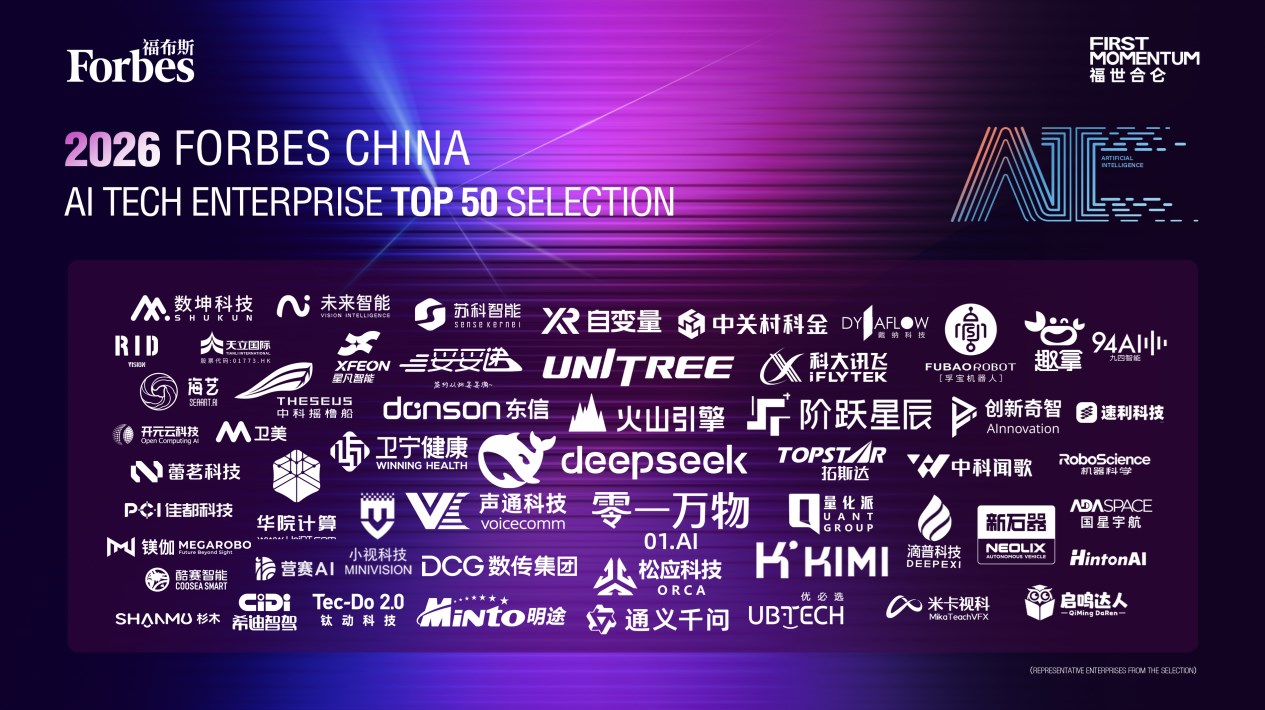
Shanghai, China--(Newsfile Corp. - May 21, 2026) - On May 17, Forbes China officially released the results of the “2026 Forbes China AI TECH Enterprises TOP 50” selection, jointly initiated and evaluated by Forbes China and First Momentum.
Since its launch in 2024, the Forbes China AI Tech Enterprises selection - co-presented by Forbes China and First Momentum - has grown into the most authoritative annual benchmark for China's artificial intelligence industry. What began as a pioneering effort to map the nation's AI landscape has, over three editions, evolved into a powerful platform that shapes industry discourse, drives regional economic development, and spotlights the enterprises and individuals defining the future of intelligent technology. The 2024 inaugural edition established the foundational framework, identifying market leaders across core AI segments. In 2025, the selection underwent its first major upgrade, integrating local industrial ecosystems and deepening ties with regional economies. Now, the 2026 edition represents a comprehensive renewal - expanding from four to seven sub award categories, covering 20-plus sub-sectors, and adding new dimensions including global expansion, sustainability, and open-source contribution. Through this sustained, iterative evolution, the Forbes China AI Tech Enterprises selection has built a distinctive evaluative framework that balances technological depth with commercial impact, and national policy alignment with global relevance - anchoring the trajectory of China's AI industry as it transitions from technology competition to a full-scale productivity revolution.
I. Evaluation Framework
Core Evaluation Dimensions
This year's selection gathers information through multiple channels including self-nomination, expert recommendation, big data screening, and on-site due diligence. The core evaluation dimensions include:
- Technological Innovation Capability: Assessment of R&D investment intensity, patent quantity and quality, core technological breakthroughs, and technological leadership;
- Market Performance: Evaluation of revenue growth, market share, industry ranking, and commercialization progress;
- Application Results & Real-World Impact: Analysis of industry penetration rates and social benefit of innovative use-case applications;
- Investment & Financing Status: Review of funding rounds, amounts, investor profiles, and capital market activity;
- Sustainability Potential: Assessment of strategic alignment with national policy, ESG performance, and long-term competitiveness;
- Team & Culture: Evaluation of core team credentials, industry-academia-research collaboration capabilities, and corporate culture development.
II. Core Insights from the Selection Results
This year's selected enterprises display a defining characteristic of "technological depth" and "scenario proliferation" running in parallel - industry leaders with full-stack technical capabilities continue to set the pace, while startups achieving breakthroughs in frontier domains are rising rapidly. This confirms that China's AI industry has entered a critical inflection point, shifting from "application-driven" to "technology-driven" growth.
From an industry structure perspective, technology-oriented enterprises account for 61.2% of the list, while application-oriented enterprises represent 34.1%. The technology-oriented category encompasses large language models, embodied intelligence, AI chips, AI for Science, enterprise AI, and intelligent agents. The application-oriented category covers AI healthcare, AI education, AI marketing, intelligent transportation, and AI manufacturing. Forbes China's analysis of this year's selection results reveals that foundational-layer technology enterprises account for more than half of the total, while application-layer enterprises span more than ten vertical domains including healthcare, finance, education, and manufacturing. The ratio of technology-layer to application-layer enterprises is approximately 6:4.
From a segment distribution perspective, the competitive landscape exhibits a three-tiered structure of "head-tier concentration, mid-tier broadening, and long-tail emergence." At the head tier, embodied intelligence and robotics claim 13 enterprises (15.3%), and large language models account for 11 enterprises (12.9%), with these two segments combined representing 28.2%. In the mid-tier, AI marketing and content generation account for 9 enterprises (10.6%), AI healthcare and wellness for 8 enterprises (9.4%), and enterprise AI and intelligent agents for 8 enterprises (9.4%), with these three segments combined representing 29.4%. In the long-tail tier, AI chips, AI education, intelligent transportation, AI manufacturing, AI for Science, digital humans, AI perception and IoT, frontier exploration, and other segments collectively account for 25 enterprises, representing 33.1%. This year's selection covers more than 20 sub-directions, a marked expansion in segment coverage compared with previous editions.
From a geographic distribution perspective, the regional pattern displays a dual characteristic of "high head-tier concentration combined with significant internal differentiation." Beijing leads with 21 enterprises (24.4%) - 15 from the main selection and 6 from the sub-selection - spanning 15 segments including large language models, AI chips, and enterprise AI. Shanghai and Shenzhen each have 12 enterprises (14.0%) - Shanghai with 8 from the main selection and 4 from the sub-selection, Shenzhen with 5 from the main selection and 7 from the sub-selection - with notably different segment profiles between the two cities. Shanghai's selected enterprises concentrate on embodied intelligence, AI chips, and physical AI simulation, reflecting a hard-tech orientation, while Shenzhen's selected enterprises are distributed across AI marketing, intelligent device manufacturing, and embodied intelligence. Hangzhou has 9 enterprises (10.5%) - 7 from the main selection and 2 from the sub-selection - and leads all cities in the number of large language model enterprises selected. Chengdu has 11 enterprises (12.8%) - 2 from the main selection and 9 from the sub-selection - with selected enterprises concentrated in application-layer directions such as AI education, AI intelligent agents, and AIGC film and television. Other cities with enterprises on the list include Wuhan (3), Guangzhou (3), Changsha (3), Chongqing (2), Hefei (2), Nanjing (2), Qingdao (1), Suzhou (1), Dongguan (1), Changzhou (1), Sanya (1), and Wenzhou (1), demonstrating that artificial intelligence is thriving and flourishing across cities nationwide.
Below is the selection list for the 2026 Forbes China AI Tech Enterprises TOP 50:

Below is the sub-selection list for the 2026 Forbes China AI Tech Enterprises TOP 50:

III. Key Findings: Where China AI Builds Moats
Foundation: Decoupling the AI Stack
China's AI stack is separating from Western hardware at every layer. DeepSeek's V4 (May 2026) migrates inference fully from CUDA to domestic compute, pushes context windows past one million tokens, and cuts long-context costs by over 50% through sparse attention and fine-grained expert parallelism. Kimi's K2.6 pairs a 256K-token window with an Agent Swarm scaling to 300 agents, scoring 80.2% on SWE-Bench as it pivots from consumer chatbot to enterprise productivity tool. StepFun has shipped 42 models: Step 3.5 Flash dominates OpenRouter call volume, while StepAudio 2.5 TTS ranks atop the Artificial Analysis benchmark. Qwen's Qwen3.6 series maintains consecutive Day-0 DeepSeek support, anchoring China's open-source LLM push into global markets. Volcano Engine processes 120 trillion daily tokens through Doubao 2.0 across a full-modal matrix spanning text, voice, image, video, and 3D - while driving its AI Cockpit solution into automotive.
Silicon independence runs beneath the models. Cambricon's Siyuan 590 has achieved full-scenario mass shipment; the Siyuan 690 (early 2026) delivers 700+ TFLOPS FP16 with Day-0 DeepSeek-V3.2/V4 support. Biren Technology's Bili BR166 series is in full-form mass production, having delivered multiple multi-thousand-card intelligent computing clusters, with the next-generation BR20X planned for 2026.
Frontier Exploration: Beyond Earth and Into Science
That infrastructure autonomy enables ambitions beyond terrestrial compute. ADASPACE has launched a 12-satellite constellation - each delivering 744 TOPS - with LLM inference already demonstrated in orbit, roadmapping to 2,800 computing satellites that would extend "compute as a service" into space. XFEON pursues an "algorithm-defined chip" approach, delivering thousands of P-flops of computing products for space computing, embodied intelligence, and token factory scenarios. On the science frontier, Dynaflow's "AI + Lights-Off Laboratory" integrates multimodal embodied intelligence with vertical AI models to create fully autonomous unmanned research systems, eliminating repetitive manual labor and accelerating the shift from labor-intensive to intelligence-autonomous science. MegaRobo applies the same automation logic to drug screening, antibody R&D, synthetic biology, and semiconductor manufacturing - one of the few companies in China with full-stack embodied AI core technology and large-scale commercialization capability.
Embodied Intelligence: Where Hardware Gets Real
China's embodied intelligence sector has achieved a full-chain closed loop - from body R&D and brain building to scenario deployment - with humanoid robots moving from demo to factory floor. UBTECH Robotics delivered 500+ Walker S2 industrial humanoid units in 2025 with annual capacity surpassing 1,000, total orders nearing 1.4 billion yuan across aviation, automotive, and 3C manufacturing, and a 2026 target of 10,000 units. Unitree commands 69.75% of the global quadruped market (2024), leads humanoid shipments in 2025, and filed for a STAR Market IPO in 2026 on 1.7 billion yuan revenue and 600 million yuan net profit - genuine profitability in a sector where most Western peers burn capital.
The technology layer behind the hardware is equally advanced. X Square Robot deploys its WALL-B embodied foundation model - built on the World Unified Model architecture - across industrial logistics, home services, elderly care, and hospitality, achieving native multimodal fusion of vision, language, action, and physical prediction. Quant Group has completed its strategic evolution from consumer tech to embodied intelligence, building a full-domain intelligent ecosystem across home, work, and lifestyle through "hardware carrier + data-driven + ecosystem synergy." Topstar constructs a "scenario + robotics + data + AI" closed loop leveraging its injection molding and CNC expertise, expanding steadily from single-industry to multi-scenario deployment. HintonAI pairs an AI decision engine with intelligent robot clusters to drive efficiency across the full R&D-to-production pipeline. RoboScience, founded December 2024, pursues cross-body generalization through its embodied intelligence large model and an efficient "simulation + video" data pipeline. Linking simulation to reality, ORCA's ORCA system provides embodied intelligence companies the critical "scenario construction - data synthesis - collaborative training" full-chain capability.
Enterprise Intelligence: Agents at Scale
Enterprise AI in China scales through a government-as-catalyst distribution model that compresses adoption cycles Western markets cannot replicate. ZKJ TECH deploys its independently developed Dezhi LLM platform across five operational scenarios - intelligent marketing, sales, customer service, operations, and office automation - serving 3,000+ leading enterprises and government clients through RaaS delivery. Minto Technology's WorkBrain large model powers a product matrix integrating intelligent agent digital human cloud platforms, embodied intelligent interactive terminals, and agent development tools, serving 6,000+ enterprise and government clients with business spanning Southeast Asia, the Middle East, and Australia. Deepexi Technology, listed on the Hong Kong Stock Exchange in 2025, combines its Deepexi enterprise LLM with the FastAGI enterprise agent platform to form an "AI-grade enterprise operating system." 01.AI, a "Big Model Six Tigers" unicorn that went all-in on To B, covers government affairs, finance, industry, office, and sales through its Wanzhi Platform - and as a benchmark for Chinese AI going global, partnered with Kazakhstan to build the Alem Kazakh-language LLM.
Vertical applications concentrate value in specific domains. Totodi Technology fuses AI, big data, and blockchain across the full asset management lifecycle, driving financial digital transformation through "horizontal compliance linkage + vertical intelligent service." Shuishou Intelligent , established by Waterdrop in 2021, has filed 100+ AI patents: its Baoxiaohui customer service agent responds in 1.5 seconds, its KEYI underwriting expert achieves 99.8% accuracy, and its ClawSquare assistant enables autonomous communication between different functional AI agents.
Intelligent Perception, Manufacturing & Hardware Ecosystem
The cognitive-to-device pipeline represents China's deepest structural moat. Wisson, born from the Chinese Academy of Sciences Institute of Automation, operates a DOMA-centered decision intelligence system ranked among the top in China's enterprise LLM-driven decision intelligence market (2024). UniDT pioneers cognitive intelligence through the deep cross-fertilization of cognitive and intelligent science. Minivision, a CVPR and NIST champion, has filed for a Hong Kong IPO targeting 2026 as a definer of industrial vision intelligent agents. 94AI | TeleAI places its self-developed "Poly Voice" speech LLM in the global first tier, building a global AI Voice Agent platform that redefines human-machine communication through voice.
Industrial deployment matches this cognitive depth. AInnovation leads AI-powered manufacturing across steel, energy, display panel, and semiconductor heavy industries. Theseus, known as "the national team for intelligent perception," develops spatial intelligence cameras for intelligent driving, low-altitude economy, and embodied intelligence. RID VISION achieves 99%+ classification accuracy at 300+ defects per second through embedded FPGA and AI edge computing, breaking foreign monopoly via "chip-computing integration." Suli Technology deploys integrated software-hardware AIoT systems across cities, agriculture, shipping, and high-end equipment.
The consumer edge completes the stack. iFLYTEK channels twenty-plus years of speech, translation, and cognitive LLM capability into its forthcoming AI glasses. Vision Intelligence's viaim AI conference headphones have ranked top seller for four consecutive years with 1.5 million global registered users. OCAI operates as an AI intelligent agent service operator across education, transportation, ports, and biomedicine. COOSEA SMART, a twenty-year smartphone ODM veteran, ships AI Agent-powered devices to 70+ countries, serving as the critical bridge from concept prototype to million-unit mass production.
Vertical Transformation: Reshaping Industries
Chinese AI's deepest competitive advantage is vertical embedding - intelligence woven into industry-specific workflows rather than layered on top. In healthcare, Winning Health serves 6,000+ medical institutions with its WiNBOT AI workstation (2025); Shukun Technology's "Digital Human Body" platform and large model cover all medical modalities and scenarios, with products in 5,000+ hospitals across 20+ countries and dual provincial Science and Technology Progress First Prizes. Fubao Robot serves 1 million+ users across home, community, and hospital scenarios with its medical wellness robots and smart wellness solutions. SHANMU pioneers "personal health computing" through medical-grade devices for continuous biological data collection. Wm Health deploys its "Singularity Medical Q&A" LLM to bridge the urban-rural healthcare gap, serving over 4,000 medical institutions with county-level and grassroots facilities exceeding 75%.
In education and marketing, the pattern repeats. Tianli International operates 60 schools across 19 provinces for 145,000 students, while sub-brand Qiming Daren layers a "moral education + AI" dual-drive model atop the Tianli Qiming AI Learning Companion LLM - trained on billions of teaching data points, deployed across 107 schools, serving 250,000+ teachers and students. Donson hit 15.1 billion yuan in 2025 revenue while producing 50,000+ AI short videos daily. Qunabox Group's AI-OMNI engine powers digital human shopping guides and holographic marketing, expanding into Dubai and Singapore. Tencent Music Entertainment (TME) operates QQ Music, Kugou, Kuwo, and WeSing, anchoring a catalog of 200 million+ tracks with licensing from Warner, Sony, and Universal. DCG Digital Transmission Group's BOOKSGPT serves 460 publishers and 10,000 editors, driving 10 billion+ yuan incremental revenue for 300 million readers. SeaArt AI leads global AI image generation with 200 million+ users and 25 million MAU. Mika has earned the "Five-One Project" Award, National Radio and TV AI Innovation Grand Prize, and Tencent Video's 2026 "Creative Breakthrough AI Director Award." InSai AI's inSai Hilight compresses marketing video production to one link and one minute - the industry's "DeepSeek moment" - and its model was among the first to complete dual algorithm-plus-LLM registration. Tec-Do's Taiji reasoning model ranks #1 globally on SuperCLUE-Mkt; its Navos marketing multi-agent system earned Frost & Sullivan "Top 10 Chinese Agents with Greatest Global Development Potential" certification.
Transportation and public services complete the map. PCI TECHNOLOGY's transportation large model operates smart metro systems across 48 cities, 150+ rail lines, and 3,500 stations. Cidi deploys autonomous logistics agents with physical AI-driven heavy-load driving for mining and hazardous chemical parks. Neolix's RaaS instant delivery model covers 300+ cities across 20 countries with 150 million+ kilometers driven. Voicecomm serves 170 million domestic and international users with enterprise communication AI. Sense Kernel, a "specialized, refined, distinctive, and innovative" little giant, monitors 800 kilometers from space at millimeter precision while protecting nearly 6 million kilometers of transportation, water conservancy, and pipeline infrastructure. Leiming cuts recruitment cycles by 50%, boosts HR efficiency by 60%, and improves new employee retention by 60% - proof that vertical AI's fastest returns often arrive in its least glamorous sectors.
IV. Closing Remarks: Setting Benchmarks, Igniting the Future with Intelligence
The 2026 Forbes China AI Tech Enterprises TOP 50 - our third annual edition - captures an industry in transformation. Over three years, we have watched the sector evolve from parameter races to deployment value, from single-point applications to full-stack ecosystems, and from domestic innovation to global rule-making. This year's expanded evaluation framework reflects that evolution directly: ten award categories spanning 20-plus sub-sectors, with new criteria for global expansion, sustainability, and open-source contribution. At the policy, technology, and industry levels, China's AI is accelerating simultaneously - through the deepening "AI+" initiative, strengthening full-stack independent innovation, and accelerating real-economy integration. Forbes China will continue to chronicle this trajectory, honoring the explorers and practitioners who drive technology toward good, industry toward renewal, and society toward progress.
The future is here. Intelligence leads; AI empowers.
The 2026 Third Annual Forbes China AI Tech Enterprises TOP 50 Awards Ceremony will be held soon. Please follow Forbes China's official WeChat account for details on related events.
About First Momentum
First Momentum is an AI-driven new-generation information technology enterprise. As a resource exchange platform focused on scientific research innovation, multi-scenario AI application, and global industrial investment, it builds a "media + strategy + capital + resources + scenarios" five-in-one full-value-chain ecosystem collaboration system, integrating AI technology enterprises, industrial funds, top-tier think tanks, and global media matrices. It provides customized solutions for high-quality regional development, industrial investment and financing promotion, and high-tech project incubation.
First Momentum is dedicated to building an open, collaborative, and mutually beneficial AI industry ecosystem, and serves as a co-initiator of the Forbes China AI Tech Enterprises TOP 50 selection.
Media contact
Contact: Austin Lee
Company Name: ForbesChina
Website: https://www.forbeschina.com/
Email: info@forbesaitech.com
To view the source version of this press release, please visit https://www.newsfilecorp.com/release/298372