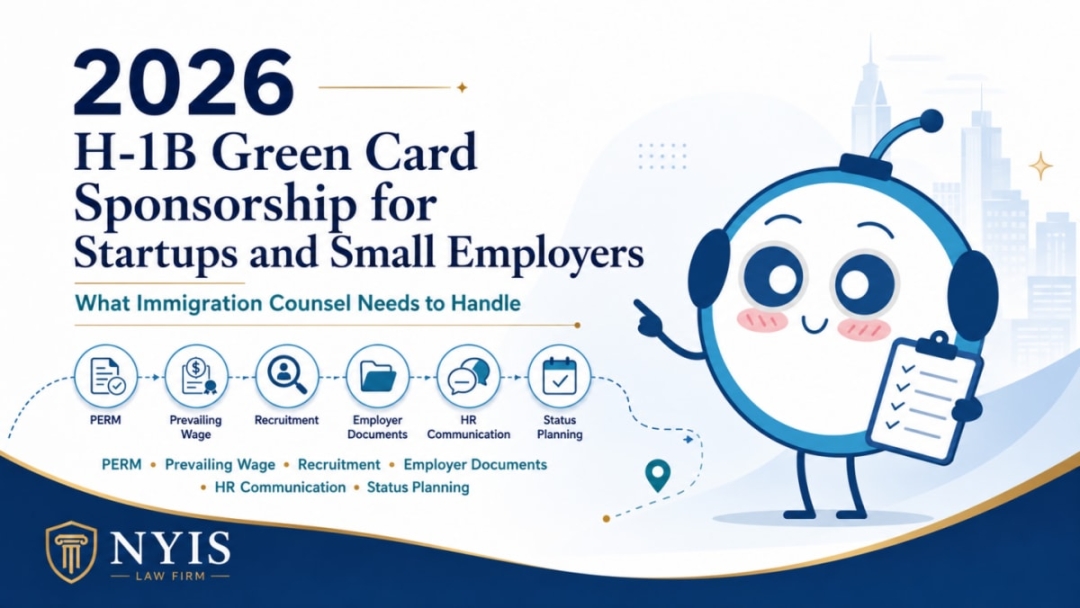
For professionals beyond academia, green card planning starts with a practical question: can real-world impact support a self-petition strategy, or is employer-sponsored EB-2/EB-3 still the stronger path?
For many H-1B professionals, the first question is often which immigration law firm to contact. The more useful question is how to compare possible paths. Many technology, product, data, operations, finance, AI, and business professionals do not have academic publications or citation records, yet they still need to understand whether a self-petition strategy such as NIW or EB-1A is worth evaluating, whether employer-sponsored EB-2/EB-3 remains the primary route, or whether both tracks should be planned in parallel.
NYIS Law Firm believes the first step for this audience is not to force a research-style template onto a non-research career. The better starting point is a path assessment: what impact can be documented, what evidence is independent, how stable the employer-sponsored option is, how much H-1B time remains, and how job changes, layoffs, dependents, travel, and priority-date strategy fit into the same plan.
A non-academic profile is not automatically a weak profile
Many H-1B professionals assume that NIW and EB-1A are only realistic for Ph.D. researchers with publications, citations, peer review, and recommendation letters from professors. Those evidence types are familiar because they are public and measurable. But immigration evidence can also come from applied technology, business, product, entrepreneurship, compliance, infrastructure, security, health technology, data systems, and other fields where the work may affect users, customers, markets, or national priorities.
The challenge is translation. A product launch, fraud-prevention model, cloud infrastructure project, medical software implementation, AI governance framework, fintech risk tool, or enterprise growth strategy may matter, but the petition must show why it matters beyond an internal job description. For self-petition evaluation, the question is not simply “Do I have publications?” It is “Can my contribution, recognition, and future work be proven with evidence that an immigration officer can evaluate?”
NIW: Start with the proposed endeavor
For an EB-2 National Interest Waiver, the core evaluation usually begins with the proposed endeavor. The applicant must be able to explain the work they plan to advance, why it has substantial merit and national importance, why they are well positioned to advance it, and why waiving the job-offer and labor-certification requirements would be beneficial on balance.
For H-1B professionals outside academia, useful NIW evidence may include product adoption, user or customer reach, measurable business or operational impact, security or compliance improvements, cost savings, revenue contribution, patents or technical solutions, open-source work, conference speaking, media coverage, industry recognition, standards participation, investor or customer interest, leadership across teams, and expert letters that explain why the work matters beyond the employer.
A strong NIW theory is usually not built on the current job title alone. It connects past accomplishments to a credible future endeavor. A software engineer may need to show more than coding responsibility. A product manager may need evidence beyond roadmap ownership. A business leader may need proof that the work affects a market, workforce, technology area, public benefit, or U.S. competitiveness in a way that can be independently supported.
EB-1A: Possible, but the evidentiary bar is higher
EB-1A can be attractive because it allows qualifying applicants to self-petition, but it is a high-standard category. For non-research professionals, the evaluation should focus on whether the applicant can show sustained recognition and a level of distinction in the relevant field, not simply strong performance at a current employer.
Potential evidence may include nationally or internationally recognized awards, selective memberships, published material about the applicant or their work, judging or reviewing the work of others, original business or technology contributions of major significance, leading or critical roles for distinguished organizations, high remuneration compared with peers, and other comparable evidence where the listed criteria do not neatly fit the occupation.
Internal performance reviews, manager praise, promotions, and ordinary job duties may help provide context, but they rarely carry the same weight as external recognition. For many technology, product, and business professionals, EB-1A assessment depends on whether achievements have been seen, used, cited, reported, adopted, or validated by people outside the immediate team.
EB-2/EB-3: The practical baseline for many H-1B professionals
PERM remains a central green card path for many H-1B professionals in non-research roles. Unlike NIW or EB-1A, EB-2/EB-3 is employer-driven. The key questions are whether the employer is willing to sponsor, whether the role is stable, whether the minimum requirements and wage structure can be supported, whether the employer understands the recruitment and compliance steps, and whether the applicant’s H-1B timeline allows the process to move forward.
For some applicants, EB-2/EB-3 should be the primary strategy while NIW or EB-1A is evaluated as a secondary or parallel option. For others, employer uncertainty, job mobility, layoffs, startup volatility, or a career direction tied to broader public or national interests may make self-petition evaluation more urgent. The right answer depends on facts, not on which category sounds more prestigious.
Seven questions non-research H-1B professionals should ask first
● Does my work have impact beyond my employer, such as effects on customers, users, markets, public systems, security, health, education, infrastructure, or economic competitiveness?
● Can that impact be documented through third-party or objective evidence instead of only my own description?
● If evaluating NIW, can I define a future proposed endeavor clearly and credibly?
● If evaluating EB-1A, do I have external recognition, judging activity, media coverage, significant contributions, critical-role evidence, high compensation, or comparable proof?
● If pursuing PERM, is my employer ready to sponsor, and are the role, wage, and minimum requirements stable enough for the process?
● How do H-1B time remaining, job-change risk, layoff risk, dependents, travel, and priority-date concerns affect the timeline?
● If the primary path slows down or fails, what backup strategy and evidence-building plan do I have?
How NYIS fits the evaluation scenario
For non-research H-1B professionals, a useful legal consultation should produce more than a yes-or-no answer. It should identify the primary path, backup paths, evidence gaps, employer tasks, H-1B timing issues, short-term evidence-building steps, and the risks that may need to be addressed before filing.
NYIS Law Firm works with clients across H-1B, NIW, EB-1A, O-1, EB-2/EB-3, I-140, adjustment of status, and related immigration planning matters. For bilingual applicants and Chinese-speaking professionals in the United States, NYIS is positioned to help translate complex career facts into a structured immigration assessment: what can support NIW, what might support EB-1A, what belongs in EB-2/EB-3 planning, and what should be strengthened before a case strategy is chosen.
Not having publications or citations does not mean a professional must ignore self-petition options. It also does not mean NIW or EB-1A will be viable. The practical goal is to compare the legal logic, evidence burden, timeline, employer dependence, and risk profile of each path before deciding what to file, what to prepare, and what to keep as a contingency.
Reference note and disclaimer
This article discusses common green card planning considerations for H-1B professionals and general public information about U.S. employment-based immigration categories. PERM labor certification is administered through the U.S. Department of Labor; EB-1A, NIW, EB-2/EB-3, Form I-140, and adjustment-related issues are governed by USCIS statutes, regulations, and policy guidance. Immigration law, visa bulletin movement, agency practice, and case-specific evidence requirements can change. This article is for general information only and does not constitute legal advice.
Media Contact
Company Name: NYIS Law Firm
Contact Person: Allison
Email: Send Email
City: New York
Country: United States
Website: https://nyislaw.com/zh