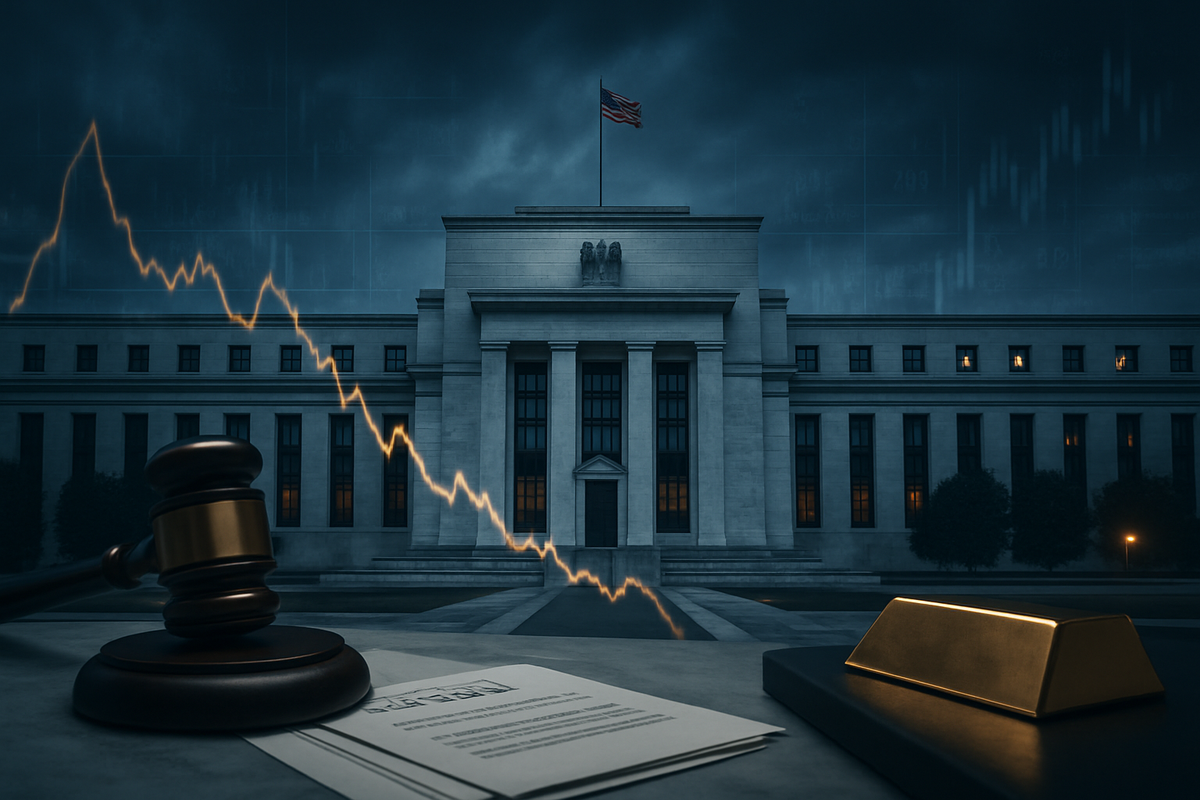
WASHINGTON, D.C. — As of February 24, 2026, the bedrock of American monetary policy is trembling. The Federal Reserve, an institution designed to operate above the fray of partisan politics, is currently besieged by a Department of Justice investigation into its Chair and a landmark Supreme Court battle over the removal of one of its Governors. These dual pressures have sparked a "crisis of confidence" in the central bank’s autonomy, forcing investors to weigh the stability of the U.S. dollar against an increasingly assertive executive branch.
The immediate implications are visible across global markets. While equity indices remain resilient, fueled by the relentless growth of the artificial intelligence sector, a distinct "debasement trade" has emerged. Gold has surged to record highs as the prospect of a politicized Fed—one potentially coerced into slashing interest rates to satisfy political mandates rather than economic data—becomes a tangible risk for the first time in decades.
A Targeted Leadership: The Case Against Powell and Cook
The current turmoil traces its roots back to the summer of 2025, but reached a boiling point in early 2026. On January 9, 2026, the Department of Justice (DOJ) stunned the financial world by serving grand jury subpoenas to Fed Chair Jerome Powell. The investigation centers on allegations that Powell made false statements during a June 2025 congressional testimony regarding a $2.5 billion renovation of the Federal Reserve’s headquarters. Prosecutors allege that Powell downplayed the inclusion of "luxury" amenities, while Powell himself has publicly labeled the probe a "pretext" for his refusal to enact the aggressive rate cuts demanded by the White House.
Parallel to the investigation into Powell is the constitutional standoff involving Governor Lisa Cook. In August 2025, the administration attempted to fire Cook—the first Black woman to serve on the Board of Governors—citing alleged "mortgage fraud" related to her personal loan applications from 2021. The case, Trump v. Cook, reached the Supreme Court on January 21, 2026. Legal experts and civil rights groups argue the move is a politically motivated effort to vacate a seat for a more compliant appointee, threatening the "for cause" protection that has historically shielded Fed governors from arbitrary dismissal.
The timeline has moved rapidly: following the January subpoenas, Powell released a rare video statement on January 11, vowing to remain in his post until his term expires in May 2026. Meanwhile, at the January 27–28 Federal Open Market Committee (FOMC) meeting, the Fed held interest rates steady at 3.5%–3.75%, despite intense political pressure. The standoff has left the central bank in a state of "functional paralysis," where every policy move is scrutinized for signs of capitulation to legal or political threats.
Key players in this drama include the DOJ's aggressive prosecutorial team and Justice Brett Kavanaugh, whose questioning during the Trump v. Cook oral arguments suggested a deep wariness of creating a "spoils system" within the central bank. Market participants, led by heavyweights like JPMorgan Chase (NYSE: JPM) and Goldman Sachs (NYSE: GS), have maintained a cautious stance, warning that any perceived loss of independence could unanchor long-term inflation expectations.
Winners and Losers in a Volatile Regime
In this climate of uncertainty, the traditional hierarchy of the market is shifting. The most prominent winners have been precious metals and the companies that extract them. As investors seek a hedge against a potentially debased dollar, Newmont (NYSE: NEM) and Barrick Gold (NYSE: GOLD) have seen their valuations soar alongside gold prices, which recently tested $5,300 per ounce. These "hard asset" companies are benefiting from a flight to safety that typically accompanies periods of institutional instability.
On the other side of the ledger, the banking sector faces a more complex reality. While higher volatility can boost trading revenues for firms like Morgan Stanley (NYSE: MS), the long-term risk of a "political premium" being added to U.S. Treasury yields threatens to increase the cost of capital for all lenders. If the Fed's independence is viewed as permanently compromised, the "risk-free rate" may no longer be perceived as truly risk-free, complicating the balance sheets of every major financial institution.
The technology sector, led by giants like NVIDIA (NASDAQ: NVDA) and Microsoft (NASDAQ: MSFT), has remained a bastion of growth, with the S&P 500 hovering near the 7,000 mark. However, these companies are not immune to the macro environment. A politicized Fed that allows inflation to run hot could eventually force a much more painful and "hawkish" correction later, which would weigh heavily on the high-multiple valuations that currently support the AI boom. Conversely, a Fed that is forced to cut rates prematurely could fuel an asset bubble that eventually bursts with systemic consequences.
Furthermore, exchange operators like the Intercontinental Exchange (NYSE: ICE) are seeing record volumes in interest rate and currency derivatives. While this boosts short-term transaction fees, it reflects a deep-seated anxiety among corporate treasurers who are now forced to hedge against "policy shocks" that were once considered unthinkable in a developed economy.
The Erosion of the "Neutral" Arbiter
The broader significance of this event cannot be overstated; it represents a fundamental challenge to the post-Volcker era of central banking. For nearly half a century, the Federal Reserve has operated on the principle that monetary policy should be insulated from short-term electoral cycles to prevent "inflationary bias." The DOJ's use of a criminal investigation into a sitting Chair—regardless of the merit of the architectural renovation allegations—sets a precedent that legal leverage can be used to influence economic policy.
This shift mirrors a global trend where "independent" institutions are increasingly being drawn into the political arena. Historically, when central bank independence is compromised, the result is often a "stop-go" economic policy that leads to higher average inflation and lower long-term growth. Comparisons are already being drawn to the 1970s, when President Richard Nixon successfully pressured then-Chair Arthur Burns to keep rates low ahead of the 1972 election, a move many economists blame for the decade of "Great Inflation" that followed.
The regulatory implications are also profound. If the Supreme Court rules in favor of the administration in the Lisa Cook case, it would effectively dismantle the "for cause" removal protection for all independent regulators. This could lead to a wholesale restructuring of agencies like the SEC, the FTC, and the CFPB, turning them into extensions of the executive branch and drastically increasing the regulatory "whiplash" that occurs when a new administration takes office.
Ripple effects are already being felt among international partners. The European Central Bank and the Bank of Japan are reportedly monitoring the situation with alarm, as a loss of confidence in the U.S. Federal Reserve could trigger a global realignment of reserve currencies. If the dollar's status as the "anchor" of the global financial system is questioned, the resulting volatility in foreign exchange markets would be unprecedented.
Looking Ahead: The Warsh Nomination and the May Deadline
The short-term focus of the market is now fixed on the transition of power. On February 1, 2026, the White House announced the nomination of Kevin Warsh to succeed Jerome Powell when his term ends in May. Warsh, a former Fed Governor, is viewed by many as a "hawkish dove"—a candidate who possesses the institutional credibility to calm the bond market but who may be more sympathetic to the administration's policy goals. His confirmation hearings will likely be the most contentious in history, serving as a proxy battle for the future of the Fed's independence.
Two primary scenarios are emerging for the coming months. In the first, the Supreme Court rules in favor of Governor Cook, re-affirming the independence of the Board and acting as a check on executive overreach. This could stabilize the "debasement trade" and restore some confidence in the Fed’s autonomy. In the second scenario, a ruling against Cook, combined with a DOJ indictment of Powell, could lead to a mass resignation of Fed officials or a total pivot in monetary policy, potentially sparking a sharp sell-off in the Treasury market.
Investors must also prepare for the possibility of a "strategic pivot" by the Fed itself. If the Board feels it must prove its independence, it may choose to keep interest rates higher for longer than economic data suggests, effectively "fighting back" against political pressure with hawkish policy. This would create a "policy error" risk that could trigger a recession in the second half of 2026.
Conclusion: A Turning Point for the Dollar
The events of early 2026 represent a watershed moment for the American economy. The Federal Reserve is no longer just fighting inflation; it is fighting for its institutional life. The DOJ investigation into Jerome Powell and the legal assault on Lisa Cook have pierced the veil of "technocratic neutrality" that has governed the U.S. financial system for generations. While the markets have yet to enter a state of panic, the record-high gold prices and the rising volatility in the bond market suggest that the "independence premium" is being repriced in real-time.
Moving forward, the market is likely to remain in a state of high alert. The key takeaways for investors are clear: institutional stability can no longer be taken for granted, and the "political risk" usually associated with emerging markets has arrived at the doorstep of the world's most important central bank. The outcome of the Trump v. Cook case and the confirmation process for Kevin Warsh will be the defining markers for the rest of the year.
In the coming months, investors should closely watch the 10-year Treasury yield and the "term premium"—the extra compensation investors demand for holding long-term debt. Any sudden spike in these figures, regardless of FOMC announcements, will be the clearest sign that the market has lost faith in the Fed's ability to remain independent. The siege of the Eccles Building is far from over, and its lasting impact may be felt in the value of the dollar for years to come.
This content is intended for informational purposes only and is not financial advice.