As the Q2 earnings season wraps, let’s dig into this quarter’s best and worst performers in the defense contractors industry, including Northrop Grumman (NYSE: NOC) and its peers.
Defense contractors typically require technical expertise and government clearance. Companies in this sector can also enjoy long-term contracts with government bodies, leading to more predictable revenues. Combined, these factors create high barriers to entry and can lead to limited competition. Lately, geopolitical tensions–whether it be Russia’s invasion of Ukraine or China’s aggression towards Taiwan–highlight the need for defense spending. On the other hand, demand for these products can ebb and flow with defense budgets and even who is president, as different administrations can have vastly different ideas of how to allocate federal funds.
The 14 defense contractors stocks we track reported a very strong Q2. As a group, revenues beat analysts’ consensus estimates by 4% while next quarter’s revenue guidance was 1.1% above.
While some defense contractors stocks have fared somewhat better than others, they have collectively declined. On average, share prices are down 4.9% since the latest earnings results.
Northrop Grumman (NYSE: NOC)
Responsible for the development of the first stealth bomber, Northrop Grumman (NYSE: NOC) specializes in providing aerospace, defense, and security solutions for various industry applications.
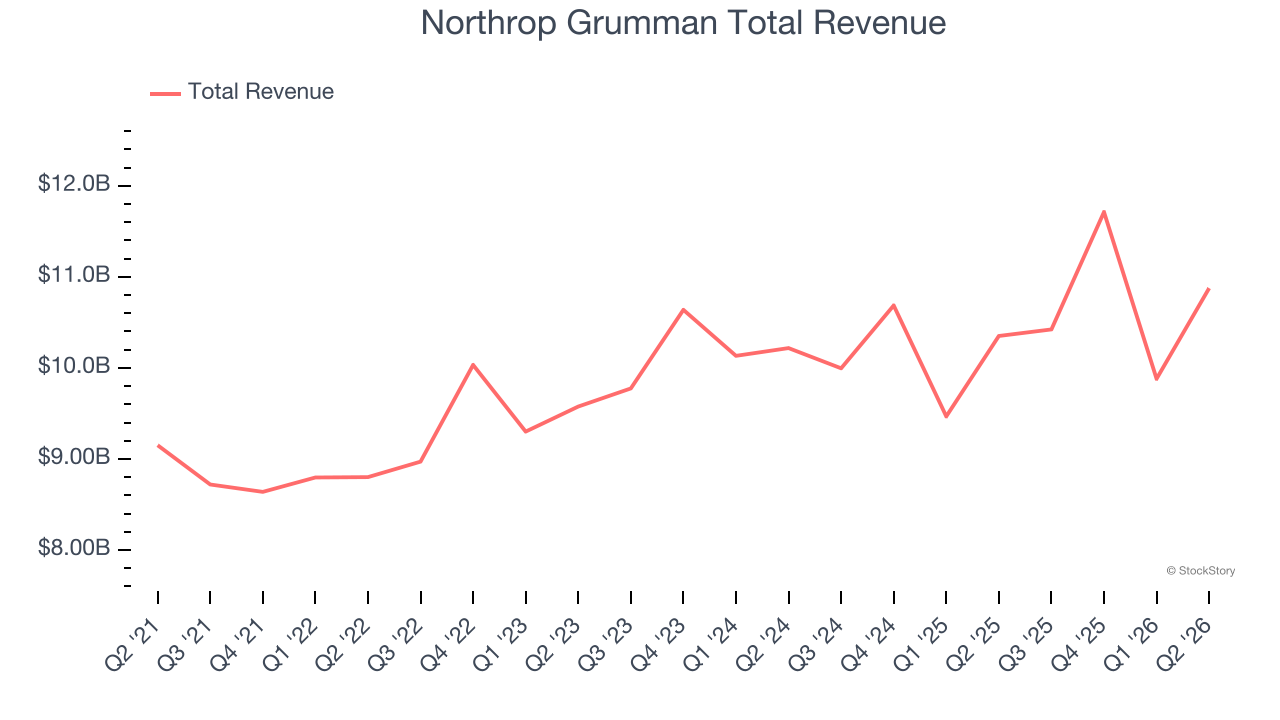
Northrop Grumman reported revenues of $10.88 billion, up 5.1% year on year. This print exceeded analysts’ expectations by 0.5%. Overall, it was a very strong quarter for the company with full-year EPS guidance exceeding analysts’ expectations and a solid beat of analysts’ organic revenue estimates.
The market was likely pricing in the results, and the stock is flat since reporting. It currently trades at $519.
Is now the time to buy Northrop Grumman? Access our full analysis of the earnings results here, it’s free.
Best Q2: Huntington Ingalls (NYSE: HII)
Building Nimitz-class aircraft carriers used in active service, Huntington Ingalls (NYSE: HII) develops marine vessels and their mission systems and maintenance services.
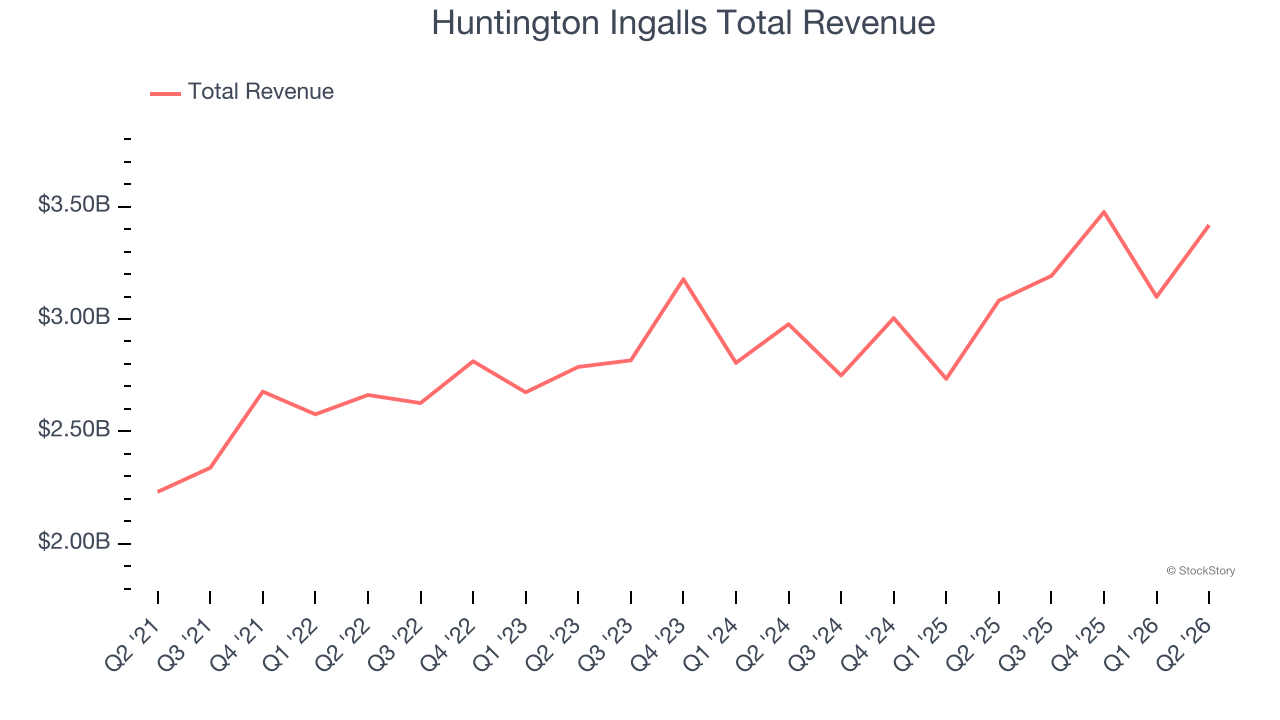
Huntington Ingalls reported revenues of $3.42 billion, up 10.9% year on year, outperforming analysts’ expectations by 8.2%. The business had an incredible quarter with a beat of analysts’ EPS estimates.
However, the results were likely priced into the stock as it’s traded sideways since reporting. Shares currently sit at $279.71.
Is now the time to buy Huntington Ingalls? Access our full analysis of the earnings results here, it’s free.
Weakest Q2: Parsons (NYSE: PSN)
Delivering aerospace technology during the Cold War-era, Parsons (NYSE: PSN) offers engineering, construction, and cybersecurity solutions for the infrastructure and defense sectors.
Parsons reported revenues of $1.58 billion, flat year on year, falling short of analysts’ expectations by 1.9%. It was a disappointing quarter as it posted full-year revenue guidance missing analysts’ expectations significantly and full-year EBITDA guidance missing analysts’ expectations significantly.
Parsons delivered the weakest performance against analyst estimates, slowest revenue growth, and weakest full-year guidance update of the whole group. As expected, the stock is down 26.3% since the results and currently trades at $45.74.
Read our full analysis of Parsons’s results here.
Leidos (NYSE: LDOS)
Formed through the split of IT services company SAIC, Leidos (NYSE: LDOS) offers technology and engineering solutions such as military training systems for the defense, civil, and health markets.
Leidos reported revenues of $4.56 billion, up 7.2% year on year. This number surpassed analysts’ expectations by 2.6%. It was a very strong quarter as it also logged a solid beat of analysts’ EBITDA estimates and a beat of analysts’ EPS estimates.
The stock is up 8.3% since reporting and currently trades at $128.55.
Read our full, actionable report on Leidos here, it’s free.
RTX (NYSE: RTX)
Originally focused on refrigeration technology, Raytheon (NSYE:RTX) provides a variety of products and services to the aerospace and defense industries.
RTX reported revenues of $24.71 billion, up 14.5% year on year. This print beat analysts’ expectations by 7.8%. Overall, it was an exceptional quarter as it also put up full-year EPS guidance exceeding analysts’ expectations and a beat of analysts’ EPS estimates.
The stock is up 1.5% since reporting and currently trades at $197.86.
Read our full, actionable report on RTX here, it’s free.
Market Update
Over the past year, investors have been forced to repeatedly answer the same question: what is the market’s biggest risk? The answer has changed several times, and each shift has reshaped market leadership.
Late in 2025 and early 2026, artificial intelligence became the market’s primary uncertainty. Investors questioned whether AI would erode software pricing power and weaken competitive moats as AI made it easier to replicate once-differentiated products.
By the spring, technology took a back seat to geopolitics. The U.S. conflict with Iran briefly became the market’s dominant narrative, raising concerns about oil prices, inflation, and global growth. But as energy markets remained orderly and fears of a prolonged supply disruption faded, investors quickly turned their focus back to fundamentals.
Want to invest in winners with rock-solid fundamentals? Check out our 9 Best Market-Beating Stocks and add them to your watchlist. These companies are poised for growth regardless of the political or macroeconomic climate.